Monday, November 12, 2012

Leadership Lesson: Compassion and Courage

Compassion is a huge thing as a leader. It is lacking in so many cases today it is stunning. We hear a lot about freedom to make mistakes but what is the response if someone makes one, admits it and learns from it? As a leader, what is your response? Think about it.

Compassion International

So, what is courage? Can you lead from the heart? Do you have courage to forgive?

Courage is about connecting to reality and suspending judgement. As a leader, courage is about love. That is our mission. That is how we serve others.
"Without courage, compassion falters. Without compassion, courage has no direction." ~ Eric Greitens
Enhanced by Zemanta

Sunday, November 11, 2012

Is your strategy as a non-profit one about tote bags?

Author Seth Godin at PDF 2007

As a non-profit CIO, former fund raiser and customer strategy professional, Seth Godin nails this one. Hhe personally did the opposite of this in his successful effort to help end malaria in Africa. Check out the blog to see the end of the story. Well worth the read.
1,500 pair of shoes were made based on the futuristic sneakers he wore in the original Back to the Future movie. So far, typical bids are around $4,000 a pair, and it’s certainly going to go up as the auction goes on. Figure they’ll raise $10,000,000, easily. Good for them.

The interesting lesson for me is that this fundraiser is 100% about the shoes. The charity is an asterisk. This is a branding and nostalgia exercise, with the opportunity for resale at a profit thrown in as a bonus. Tote bag marketing, without a doubt. The lesson for fundraisers everywhere is: if you have something like a celebrity shoe or a signed Chuck Close painting to sell, you should definitely go do that. The ends are fabulous, and there’s nothing wrong with the means to get there.

Tote bag marketing, books and sneakers


Saturday, November 10, 2012

Do you need a multi-channel messaging strategy?

This is a very good blog on how disruptive social media has become for a business focus on the Customer. If you haven’t been convinced yet, this blog is for you.  The world has changed. Consumers have changed. We have to change to meet the needs and expectations of our customers. Are you ready?

Illustration of Facebook mobile interface
Social media and smartphones are disrupting the established patterns and practices for B2C interactions. To be successful, businesses have to engage with customers through their preferred channels, whether that be mobile, IM or social networks.

The link between technology and consumers is, however, a two-way street. Take, for example, Facebook notifications (the auto-generated email or text alerts you get when someone posts you on your wall or comments on a photo). These alerts constitute B2C dialogue, though they operate under the guise of a C2C interaction.

The initial attraction of social networks like Facebook and other pioneers in the space was bringing groups of people of shared interest together on the web. Adding a messaging capability to the basic web presence extends the social experience beyond the website. Without notifications, you’d have to go online to Facebook to hangout with your friends. With notifications, your friends — and the Facebook brand — come and check in with you throughout the day via your inbox.

This kind of messaging lets businesses participate in, inform, and add value to the social interaction (wall post/sharing) without ever forcing users back to the site.

Why Businesses Must Adopt a Multi-Channel Messaging Strategy


Thursday, November 8, 2012

No mobile -- no future | Inspiring Generosity

Everything we do must begin with the mobile experience. It is that clear? Without that, from a business perspective, we have no future.

While Apple has not listened to my complaints ...

Now that is something to think about. Are we ready?
Much has been made about the necessity of developing a mobile web strategy. Mobile now comprises 10% of global web traffic. This year’s Millennial Impact Report shows how important mobile has become for U.S. nonprofits. Without a mobile strategy, nonprofits have no online future. Why? Because millennials use their smartphone like a computer, reading e-newsletters, emailing people, and engaging in social media.

via No Mobile, No Future | Inspiring Generosity.


Wednesday, November 7, 2012

Social media and Presidential elections

Obama’s initial reaction to the news of his re-election was a three word tweet: "Four more years." alongside a picture of him and his wife Michelle in warm embrace. The message was retweeted more than 600,000 times, making it the most popular tweet in the history of the microblogging service.

The 31 million election-related tweets posted throughout yesterday, make Election Day 2012 the most tweeted political event ever.

With 327,452 tweets per minute, the activity peaked shortly after the first networks had called Obama’s re-election.


http://www.statista.com/topics/893/2012-election/

Tablets are the fastest adopted device in history

English: The iPad on a table in the Apple case

The use and adoption of tablets is exploding. Some just use it to access email on the run, others are using to easily show presentations to clients and customers and some are just having fun.

Tablets are the fastest-adopted devices in history. If we mark the modern tablet era by Apple's 2010 iPad launch, then an astounding 84 million iPads and as many as 120 million tablets in total have flown off the shelves in just two years. Forrester's global workforce and decision-maker surveys and client conversations show just how fast tablets are being adopted. What is your take on all this? As an iWorker, how are you using tablets?


  • Three-quarters of a billion tablets will be in use by 2016. It took more than 20 years for the PC to reach an installed base of 750 million people. But tablets will surpass that mark in less than half the time. Global tablet sales will top 375 million in 2016 with about one-third of tablets acquired by businesses for employees. Back in 2007, we wrote that to reach the second billion users, the computer market would be driven by lower-cost hardware, useful applications, and easy access to the Internet from anywhere.Tablets fit that bill perfectly.

  • Some 81% of firms expect to support tablets for employees. IT decision-makers are getting tablet fever as 81% of firms report interest in using tablets. According to these IT decision-makers, tablets will come into the enterprise via several doors, including employees bringing their own: Our latest survey of global information workers shows that 12% use tablets, and 8% paid for it themselves. And more than half of the 1,004 firms we surveyed plan to increase their spending on mobile devices and apps by at least 10% next year.

  • Tablets will accelerate the rise of the anytime, anywhere information worker. Today, 15% of information workers use at least three connected devices for work, work from at least three different locations, and use at least seven apps for work. And 30% of information workers satisfy at least two of those three criteria. The rise of tablets will drive the number of anytime, anywhere information workers up. Tablets enable access from more locations and bring relevant and useful apps to make employees more productive.


via Forrester Research : Research : Mastering The Business Tablet Landscape.


Tuesday, November 6, 2012

As a leader, what should you stop doing today? Here is a good list

I am a big fan of list of things "to stop" doing. We all have "to do" lists but we all need more "to stop" lists. Here is a good one for leaders.

Which is your favorite?
1. Out: Micro-management, or the need to control every aspect of your company. In: Empowerment, the ability to give your people some rope--even rope to make mistakes without blame.

2. Out: Management by walking around the office; it is no longer enough to be visible. In: Leadership by watching and listening, engaging in conversation, implementing the ideas presented to you, and distributing the results.

3. Out: Pretending you know everything. You don't have all the answers, so why try to make people think you do? In: Knowing your leadership team members and trusting them. Choose great people who have the right skills and fit the culture. And get out of the way.

4. Out: No mistakes, or a "no tolerance policy" some still think works. In: Learning from mistakes, or being the first to admit an error.

5. Out: The balance sheet drives the business, and informs all other decisions. In: People drive the business, boosting customer loyalty, and profit.

6. Out: Job competency is sufficient. Do the job asked, and you'll survive. In: Recruit "A" players who will go the extra mile. They're out there.

7. Out: Invest in technology to increase productivity. In: Invest in people.

8. Out: Demand change; be very specific about what you want and when. In: Nurture change; your people can come up with the best ideas and you can give them credit for it.

9. Out: Fried food in the cafeteria. In: Wellness in the workplace.

10. Out: Incentives; pay employees more money and they'll do more. In: Rewards; being valued matters more than money.

via Leadership Practices to Stop Today | Inc.com.


Monday, November 5, 2012

Apple iPad market share is dropping as rivals are catching up

The global tablet market continues to grow. According to market research group IDC, Apple, Samsung and co. shipped 27.8 million tablets in the past quarter, almost reaching the record of 28.2 million from last year’s holiday quarter.

With the iPad Mini, the first Windows 8 tablets and the popular $199 tablets from Google and Amazon all lined up for holiday season, the fourth quarter is likely going to be a blowout quarter for tablet vendors.

This chart shows global tablet shipments since the second quarter of 2012, the quarter in which Apple released the first iPad.


http://www.statista.com/topics/841/tablets/chart/695/global-tablet-shipments-since-q2-2010/

Meanwhile Apple’s market share in the global tablet market begins to erode. In the third quarter, Apple accounted for 50 percent of global tablet shipments, down from 66 percent in the June quarter and a new low since the introduction of the first iPad in April 2010. The launch of Google’s $199 Nexus 7 tablet and Amazon’s refresh of its popular Kindle Fire have clearly hurt Apple and the upcoming holiday quarter will show whether the iPad Mini can help Apple to re-strengthen its position. Starting at $329, Apple’s lower-end tablet is priced significantly higher than the entry models of Google and Amazon, a strategy that hasn’t fared well with many consumers.

This second chart shows global tablet market share in the third quarter of 2012, based on unit shipments.


http://www.statista.com/topics/841/tablets/chart/696/global-tablet-market-share-in-q3-2012/

Sunday, November 4, 2012

Microsoft may be down but are they out?

The new mobile wars are about an ecosystem across devices.  Microsoft is obviously not in a great position. I have casually looked at Windows 8 devices the last few days. I am encouraged by what I see. That said, in my house we have 2 iPads, 3 iPhones and 2 Android phones. I will buy a Windows 8 device soon. Probably a laptop/tablet combo. Here are the contenders from a recent Forrester report.

Image representing iPad as depicted in CrunchBase


  • Amazon puts content — and commerce — first. Amazon's strongest asset is its ability to deliver a rich assortment of content seamlessly to its customers, who are very comfortable with buying from the big retailer on any device, not just those from Amazon. In addition, the company is a powerhouse in cloud computing and provides seamless access to purchased and personal content across any device. Yet Amazon's device offerings are limited, and its use of a modified variant of the Android platform requires a devoted effort to entice developers to create application versions tuned to that variant. While Amazon has global ambitions, its reach today is much more limited than its competitors; additionally, its method of working with mobile operators challenges its expansion rate.

  • Apple exerts by far the strongest loyalty gravitational pull. Apple's collective offerings are demonstrably attractive to its customers, anchored most firmly by its most popular product, the iPhone. Consider that, compared with the total US online population, iPhone owners are 156% more likely to own an iPad, 188% more likely to own a Mac, and 235% more likely to own both. Apple has succeeded in providing digital distribution for nearly every major owner of music, video, books, newspapers, and magazines; additionally, while some media companies have publicly complained about Apple's perceived stranglehold on the market, by and large Apple has helped those companies benefit from digital disruption. Apple customers have warmly embraced the company's personal cloud services — but these services still have gaps to fill versus, for example, Google Docs.

  • Google touches the greatest number of mobile customers, but its loyalty force is less strong. The company's Android software has skyrocketed to become the leading smartphone platform, but Android phone owners are not as strongly drawn to other Android devices as is the case for Apple. Online adults in the US who own an Android phone are twice as likely to own an Android tablet than the total US online population — but also 13% more likely to own an iPad.  Google's range of content partnerships has grown rapidly in the past year. However, its library still falls short of both Apple's and Amazon's, and some media companies have shown reluctance to embrace Google as a partner given past collisions such as that between YouTube and Viacom. The company's greatest strength is in its broad reach via cloud services and its Chrome browser, which is now available on the vast majority of connected devices.

  • Microsoft has the steepest mountain to climb. Microsoft has been singularly unsuccessful in translating its dominance in PCs to the mobile market, in fact suffering from a loss of smartphone market share since the introduction of its revamped Windows Phone 7 OS. The company has no presence so far in the vital tablet market and, as a result, has struggled to attract developers to its mobile platforms. While Microsoft has released a wide range of personal cloud services such as SkyDrive, it has not effectively communicated the value of those services to its customers. Microsoft's greatest strength in content and media resides on the Xbox, whose connections to other devices powered by the company's software is nearly invisible. With the release of Windows 8 and Windows Phone 8, Microsoft hopes to translate a common user experience into loyalty across multiple devices — a tall order given its competitors' positions.

  • Others face a daunting task in building from (almost) scratch. It's clear that many companies seek to establish a competitive ecosystem. RIM promises that its upcoming OS revamp, BlackBerry 10, and associated devices will revitalize the once-dominant smartphone maker. Samsung, the world leader in phone shipments, has invested in its own bada OS, has a range of content partnerships and its own media store, and has also hedged its bets by joining Intel's Tizen development effort. Companies like HP, with strong ties to the enterprise, recognize the importance of having a diverse mobile offering, including smartphones. But we consider it highly unlikely that any of these companies can craft and unite all of the requisite components and then lure customers who have already placed their significant investments. Therefore their hope lies in those customers whose assets remain on the table — and there are billions of them.


Social Media Update: 11/4/2012

6 Habits of Highly Successful People Using Social Media for Sales - Social media has revolutionized how companies handle sales responsibilities. The traditional approaches to reaching out to new customers have been upended in many ways as business communication becomes increasingly social, with sales teams and social media managers working together in a unit to drive customer adoption.

This Week in Social Media Law: Do Cyberbullies Have First Amendment Rights? - A regular roundup of interesting issues at the intersection of social media and the law, as written by some of the nation’s leading lawyers. Cyberbullies claim First Amendment rights to freedom of speech (and lose). Company learns that the best defense against CAN-SPAM Act violations is a good contract. California Attorney General raises the bar for company privacy policies (for all of us).

Top 10 Reasons You’re Not Blogging - Addressed to all the naysayers who have not yet put fingers to keyboard and started blogging, here are the author's top 10 reasons why he thinks you "have not yet embraced the manifold benefits of blogging..."

Is Your Content Marketing Keeping Pace with Your Buyers? - If buyer’s abilities to master content are doubling every year, is your ability to inform growing at the same rate? This is profound. Buyers exposed to static content for two years straight are bound to lose interest. Fast.

How to Effectively Listen on the Social Web [Infographic] - An easy two-step guide on monitoring and acting on social media conversations to uncover deeper meaning of social conversations.

3 Ways to Boost Your Brand Without Facebook - Now that we know Facebook is charging brands to reach their own cultivated fans bases, what's a brand to do? If you don't have a budget for Facebook, here are three ways you can boost your brand without it.

Why Most Corporate Culture Programs Fail - Tribes have cultures, organizations don’t — unless they are one tribe. Most organizations have many tribes — you may have a developer tribe, a sales tribe, multiple customer service tribes, a cost conscious tribe, an innovator tribe, a middle management tribe, or a tribe of Belgian-American wine drinkers. Having multiple tribes means that you have multiple cultures.

Link Building Strategies of Yosemite Sam Meet Google’s Disavow Tool - Much like the cartoon counterpart, Yosemite Sam the link builder lacks strategy and instead gallops into the far reaches of the internet in search of links. I picture the Yosemite Sam link building strategy is one with guns drawn, wildly shooting into the air while jumping up and down left to right yelling “Wahoo! LINKS! Gimmie‘dem links!” To Sam, a link is a link and he wants all of them. This was working for him until a penguin walked onto the set...

Saturday, November 3, 2012

Customer Experience Update: 11/3/2012

Fidelity Communications Brings Customer Experience Into the Contact Center For smaller companies, superior service often becomes their ticket to success. For Fidelity Communications, a high-speed Internet, phone, and cable TV provider based in Missouri, transforming their contact center became the way to satisfy customers and engage call center agents across multiple states, thereby cutting costs, decreasing hold time, and building loyal relationships in an industry overshadowed by big business.

Hoffman's Hot Seat: Building the Contact Center of the Future 1to1 Media's Tom Hoffman catches up with Paul Jarman, CEO at inContact, about the trends that are shaping customer service, including rising customer expectations and the need for companies to become more agile and responsive in meeting the needs and preferences of their customers, and how these factors are influencing the requirements for running the contact center of the future.

6 Tips for Social Media Customer Service - Social media has revolutionized the way we communicate and is providing organizations a new way to interact with their customers and foster relationships. And customers themselves are leveraging social media to get the answers they need from the brands they do business with quicker and also magnify their voice. According to Jasdev Dhaliwal, head of communities for global social media and online engagement at AVG, 17 percent of Americans have used social media for their customer service needs at least once in the past year. "Customers have a voice and they're using it," Dhaliwal said during the Social Media for Customer Service Summit organized this week by Useful Social Media.

Your Customers Are Complaining. Do Something About It - I'm about to start a gut renovation of my kitchen, which, of course, is an incredibly stressful -- not to mention expensive - project. For cabinets, we got a recommendation for a designer at a local cabinet store. We met with her, got some great ideas, and went home to wait for the quote.

R & D spending to perceived innovation. Is Apple the best?

For the third year in a row, Apple has been voted most innovative company in the world by R&D professionals. In the survey, conducted by Booz & Company, almost 80 percent of the respondents named Apple as one of the three most innovative companies in the world. Google is a distant second with 43 percent of the respondents naming the search engine provider in their top three. This result comes at a time when many are starting to wonder whether Apple has lost its magical innovative touch. Although the company recently updated its entire product range, people are missing revolutionary new features from the company that re-imagined the mobile phone with the iPhone.

What’s interesting is the fact that Apple has the lowest R&D intensity (the ratio of R&D investments to a company’s sales) of all companies in the top ten. In fiscal 2011, Apple spent 2.2 percent of sales ($2.4 billion) on research and development. Google and Microsoft, two of Apples main competitors, each invested more than 10 percent of sales in R&D. Overall there is surprisingly little correlation between R&D expenditure and perceived innovativeness. Only three of the top ten R&D spenders in 2011 made the list of most innovative companies as perceived by the industry experts.

This chart shows a ranking of the most innovative companies in the world, based on a survey among 700 high-level R&D professionals.


http://www.statista.com/markets/15/technology-telecommunication/chart/686/the-most-innovative-companies-in-the-world/

Thursday, November 1, 2012

Do you suffer from Social Media FOMO?

Fear is real and we don't know sometimes the grip it can have on us. I hadn't thought of this, fear of missing out, but it is real.
Do you know FOMO? That’s not some fancy latte — it’s Fear Of Missing Out, and something that’s become a recognized thing by many social media users these days.

You’re probably familiar with the concept, if not the name. Here’s an example: It’s been a long workweek and you really just want to spend Friday night at home watching a movie. But then that old familiar urge hits, and you can’t resist grabbing your smartphone for a jolty fix of quick-burst information. One friend’s Twitter post mentions an awesome concert. On Facebook, someone else put up photos of a raging house party.

Suddenly, your mellow evening feels entirely inadequate and you wonder what else you’re missing out on. You put the phone down, only to pick it up again and again because you can’t shake the feeling that you’re missing out on finding out just how much you’re missing out on. The vicious cycle continues.

via Do You Suffer From Social Media FOMO? [INFOGRAPHIC].


Wednesday, October 31, 2012

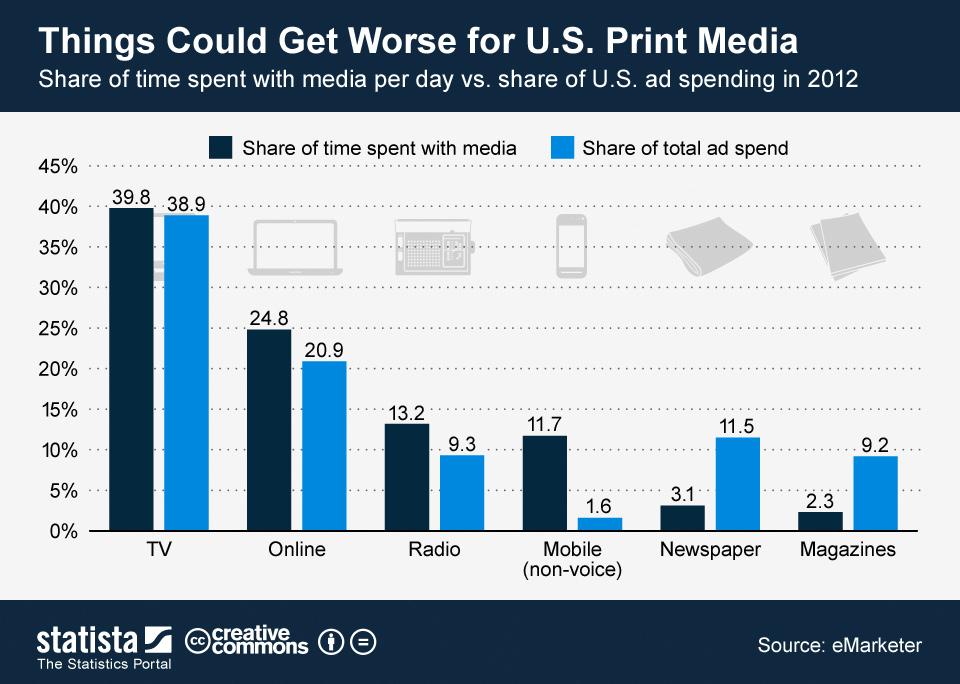
Can things get worse for the U.S. print media?

Can things get worse for the U.S. print media? Unfortunately, yes. Newspaper ad spending in the United States peaked in 2000 and has since then dropped to a level as low as it hasn’t been in 50 years. Magazines have suffered a similar fate and according to data released by eMarketer last week, the situation could get even worse for print media in the United States.

eMarketer compared selected media’s share of the time Americans spent with media with their share of total ad spend in 2012.

While in the cases of TV, online and radio, the time spent with the medium is roughly proportionate to the share of ad expenditure, newspapers and magazines hold a significantly larger share of total ad spend than they should if ad spend were proportional to the time spent with the medium.

American adults on average only spend 3.1 percent of their media time reading offline newspapers, yet newspapers rake in 11.5 percent of total media ad revenues.  The opposite holds true for mobile: Americans spend 11.7 percent of their media time on mobile devices, yet mobile advertising only accounts for 1.6 percent of total ad spend.

If the numbers at hand are any indication for the future growth of advertising mediums, mobile ad expenditure is about to take off. For newspapers and magazines however, the worst may be yet to come.


http://www.statista.com/topics/979/advertising-in-the-us/chart/682/share-of-media-time-vs-share-of-total-ad-spend/

Tuesday, October 30, 2012

The anywhere office

Home Office

Over the last year, we have been experimenting with an office anywhere approach. We have combined this with a new collaborative environment in our physical office. So … after a year in, how is it working? Here are a couple of recent quotes from 2 of our staff.
I feel like I have the best of all worlds… I can come into our open area at work when I need to meet with staff or someone in particular. I can hole away in my home office to do solitary work, and I am in fact, in my home office most of the time. My home office is a quiet environment (most of the time) and I can actually think and work. While there, I feel totally connected just by having my Lync window up showing all my team's status colors. I think the work-life balance benefits of this arrangement are incredible and I feel empowered knowing that I don't have to "show up" in the collaborative area just to be seen.

And another.
I enjoy telecommuting because I have the option of staying away from the masses, the drive byes, and the side conversations if I wish.  My favorite days are those where I have few meetings and I can actually do work.  Unfortunately that doesn't happen very often so I have to find other ways to get real work done or to just think/strategize.

So, what do you think? Are you an anywhere office kind of person?

Monday, October 29, 2012

Where's the walls now to your office? Not so clear anymore ... is it?

Industrialization

Walls to offices during the Industrial Age intended to guard leaders from the daily onslaught of activity and requests. Today, leaders are bombarded with Facebook requests, Twitter feeds, texts, IM pings, SPAM, an eMail from their boss demanding the most recent numbers in a report, and another eM just below the eMail from the boss ... from a friend sending a stupid "forward" eMail with cats in it.

Where's the walls now to your office? Not so clear anymore ... is it?

via Saying Goodbye to the Industrial Age | MAGsays.

We have moved to an "open world". Whether we want to believe it or not, the command and control world is now gone. It seems to me we have a choice. We can continue to ignore it. Where will that lead me? Or, we can embrace it. What would that look like?

Sunday, October 28, 2012

Good bye my good friend iGoogle

Recently I noticed something on my home page which is iGoogle. I've used what seems like forever.

I see a note that they are going to take it down completely. Click on the link and here is what I see. I am in shock. Not sure why but it is an emotional reaction I guess. I've been loyal. I've introduced lots of people to the power of iGoogle over the years. So what is the payback for my loyalty to Google and their products?

Apparently it isn't worth much.
Related articles

Friday, October 26, 2012

From the oracles at IBM - 5 very interesting possibilities

Image representing IBM as depicted in CrunchBase

Big Blue always has some great ideas in their “IBM 5 in 5” — five innovations that “have the potential to change the way people work, live and interact during the next five years.”

Here’s the Cliff Notes version:

  1. Generating electric power through everything from your running shoes to water flowing into your home;

  2. Eradicating passwords through facial and voice recognition technology;

  3. Linking your thoughts to your devices (i.e. technological mindreading);

  4. Wiping out the digital divide, thanks to mobile broadband advances;

  5. Targeted ads so precise that spam ceases to exist.


More here: http://bit.ly/uINd4p

Wednesday, October 24, 2012

Are we denying the facts?

This happens way too much. It clearly isn't helpful to deny the facts. It is also important to actually know the facts.

Transformation starts with reality. It doesn't stop there. It moves to, despite our reality, what kind of world do we want to create. True transformation requires both.

Let's advocate for "the facts" and "a vision".
Transformational leaders don't start by denying the world around them. Instead, they describe a future they'd like to create instead.

Denying the truth about relative market share, imperial power or the scientific method helps no one.

Gandhi didn't pretend the British weren't dominating his country, and Feynman didn't challenge Einstein's theory of relativity or the laws of thermodynamics.

It's okay to say, "this is going to be difficult." And it's productive to point out, "our product isn't as good as it should be yet."

The problem with Orwellian talking heads, agitprop, faux news and Ballmer-like posturing is that they take away a foundation for a genuine movement to occur, because once we start denying facts, it's difficult to know when to stop. Tell us where we are, tell us where we're going. But if you can't be clear about one, it's hard to buy into the other.

via Seth's Blog: Denying facts you don't like.


Tuesday, October 23, 2012

Will Yahoo turn it around? Third quarter results are in

Image representing Marissa Mayer as depicted i...

Yesterday afternoon, Yahoo! held an earnings call announcing third quarter results. The results modestly beat analyst expectations, but gave little insight about where the company is heading.

Revenue appears to have stabilized but shows no signs of growth either. Net income was extra-ordinarily high last quarter due to Yahoo’s sale of half its stake in Chinese Internet company Alibaba. Operating income declined 14 percent year-over-year though, giving a better idea of the state of Yahoo’s business.

CEO Marissa Mayer announced that her company will increasingly focus on search and mobile in the future and sees Yahoo! in a good starting position for the shift to mobile platforms.


http://www.statista.com/markets/21/internet/chart/669/yahoo-s-business-in-numbers/

How did being on-line change things for you so far this year?

oh, da's leuk :)

We are all online now more than ever. So how did being online change things for you this year?

Here are some questions to help get the answers:

  1. What business opportunities have you discovered through social media or other online channels this year?

  2. What online tool did you start using this year that changed the way you work?

  3. What online project helped you develop new knowledge or skills this year?

  4. What is the most important business or personal relationship that began or grew online this year?

  5. Which of 2012's entertaining online discoveries have helped you bond with friends, family or colleagues?


I would love it if you would share your thoughts on any of these questions. What do you think?

Monday, October 22, 2012

Will the iPad Mini release continue Apple's domination of the tablet market?

English: Apple iPad Event

Tomorrow Apple will hold an event in San Jose, CA to unveil a highly anticipated addition to its iPad line-up. The long-rumoured smaller iPad (reportedly called ‘iPad Mini’ or ‘iPad Air’) is expected to be priced to compete directly with Amazon’s Kindle Fire and Google’s Nexus 7 tablet, both priced at $199. Although it is considered unlikely that Apple will match that price point, analysts expect a starting price way below the $499 of the cheapest full-size iPad.

Apple’s competitors will likely be on the edge of their seats when Tim Cook and Co. announce details about the all but confirmed tablet. If Apple manages to offer a competitive product at a price close enough to $199, Google and Amazon will see the biggest selling point of their tablets disappear. This could reinforce Apple’s stranglehold on the tablet market just as its competitors were starting to see some light.


In the second quarter of 2012, Apple’s market share was 68 percent, i.e. Apple shipped more than twice as many tablets as all of its competitors combined. In the September quarter (the numbers are not out yet), Apple’s market share will likely come in a little lower, as Google’s Nexus 7 has reportedly had a successful start. It will be interesting to see how the tablet market develops over the next few quarters with another iPad, more Android tablets and the first Windows 8 tablets in the mix.


http://www.statista.com/topics/841/tablets/chart/530/global-tablet-shipments-from-q2-2010-to-q2-2012/


Sunday, October 21, 2012

Screw business as usual....this is the real world

Brian Solis is principal at Altimeter Group, a research-based advisory firm. Solis is globally recognized as one of the most prominent thought leaders and published authors in new media. A digital analyst, sociologist, and futurist, Solis has studied and influenced the effects of emerging media on business, marketing, publishing, and culture. His new book, The End Of Business As Usual, looks at the changing consumer landscape, it's impact on business & what companies can do to adapt & lead.

In this video overview, Brian nails it.

http://www.youtube.com/watch?v=b3hi0V13oag&feature=youtu.be

How do you turn bad customer service into a win-win?

Customer service isn't always easy. No product or service is perfect. Customers get frustrated. There are some basic principles that executed consistently can turn bad customer service into a win-win.

Here are some very good ideas from Amber Schaub, founder and CEO of RuffleButts, an online retailer specializing in clothing for toddlers, offers a few tips on providing excellent customer service based on her five years’ experience as a small-business owner:


  • Always respond promptly. Even if you don’t have an immediate solution, customers like to know their complaint has been heard. Offer a tentative time frame if possible, or let them know you’re working on a solution.

  • Carefully choose employees. Employees who will be working in the customer service department or handling any customer interactions. “They are ultimately your voice,” says Schaub.

  • Make it personal. Include a handwritten note or a personal follow-up call.

  • Follow the golden rule. Treat your customers as you would like to be treated in a similar situation.

  • Use the Wow factor. Wow them. They will never forget it.


via How to Turn Bad Customer Service Into a Win-Win : topic :: American Express OPEN Forum.


Saturday, October 20, 2012

How can you turn a problem into an opportunity? Great service is the key!

customer-service

We all experience problems with products we buy or service we receive from companies. We know it happens and can to some extent deal with it. What we can't deal with is a lame effort at resolving the problem. This is a great story on how to set up service to handle the inevitable.
Customers expect great service all the time but great customer service shines through mainly when something goes wrong. And despite their best attempts, organizations will face circumstances when their customers are unhappy with their experience.

The trick, and what differentiates great brands from the rest, is how they recover from these roadblocks. I recently purchased a highly discounted cardigan from one of my favorite companies, the flash sales site Ideeli. When the item arrived, I noticed that the belt that was supposed to be included was missing. I quickly emailed the organization to explain what happened and ask whether they could send me the missing belt.

Read the rest here: Great Service Turns Problems into Opportunities - Think customers: The 1to1 Blog.


Friday, October 19, 2012

Are Smartphones the new wallets?

eMarketer expects the transaction volume of mobile payments in the United States to reach $640 million this year and predicts a 100-fold increase until 2016. But are we really ready to ditch our wallets in favor of our smartphones?

When Apple released the iPhone 5 last month, some people were disappointed that Apple chose not to include a Near Field Communication chip for mobile payments. Others interpreted Apple’s omission of an NFC chip as proof that the time has yet to come for the technology to become relevant to the mass market. After all, Apple has a history of dismissing technologies until they have proven their viability. eMarketer expects 8 million Americans to make a point-of-sale purchase with their smartphone this year. That’s roughly seven percent of U.S. smartphone users and clearly shows that mobile payments are still in the early stages of adoption. If eMarketer is right, almost 50 million Americans will be using their phones to make in-store purchases by 2016. So the iPhone 7 will probably have NFC.


http://www.statista.com/topics/840/smartphones/chart/665/mobile-payment-forecast/

What is the urgency of now?

[caption id="" align="alignright" width="207"]Cover of "Digital Darwinism" Cover of Digital Darwinism[/caption]

Jon Swartz is a veteran technology reporter based in Silicon Valley currently covering emerging and disruptive tech at USA Today. This is the second time he's been invited to Revolution. His take on news trends is less about hype and more about how technology impacts everyday business and society. Sometimes technology is the solution as much as it is part of the problem. For consumers, the ability to use mobile, social and the web is not only enlivening real-time experiences, it’s also delivering immediacy to e-commerce and social commerce.

On this episode, Jon explores the importance of “the urgency of now” and how its changing the landscape for commerce. From shopping to how we pay for what we want, and the technology that changes customer expectations along the way, businesses must now evaluate how to adapt to not only react but lead customer experiences before they fall to digital darwinism.

http://www.youtube.com/watch?feature=player_embedded&v=G17SO-HV9hY#!

Brian Solis is principal at Altimeter Group, a research-based advisory firm. Solis is globally recognized as one of the most prominent thought leaders and published authors in new media. A digital analyst, sociologist, and futurist, Solis has studied and influenced the effects of emerging media on business, marketing, and culture. His new book, The End of Business as Usual explores the emergence of GenerationC, a new generation of customers and how businesses must adapt to reach them. Engage, Solis' previous book, is regarded as the industry reference guide for businesses to build and measure success in the social web.

Thursday, October 18, 2012

The mobile war, transforming customer expectations and business capabilities ...

English: Stephen Monaco speaking about Social ...

The Mobile War CEOs should be aware of an approaching tech war -- because its outcome is going to change their customers.  As the Web becomes the AM radio of digital, the mobile App Internet will rise. This market will be dominated by two or three ecosystems -- semi-closed worlds built on a closely fitting set of apps, phones, tablets, computers, operating systems, and partners. An ecosystem owner will possess extraordinary market power -- able to dictate terms to content providers, customers, and application developers. It doesn't matter what you sell -- insurance, pills, cars, energy, bonds -- you'll be reaching many of your customers through these ecosystems in the future.

Social Media Has Transformed Customer Expectations At Every Step Of The Customer Journey After moving to a new apartment, do you need to get a new TV. The first instinct may be to gather information from a few sources. Do you browse online retailers to get an idea of prices, and look atoked at manufacturers' marketing content to understand the latest technologies like 3D TV. After all of that, you may turn to consumer reviews and discussions to get a feeling for whether you would actually find those features valuable. (For example, some customer reviews may help you confirm that you don’t want 3D TV.)

Where did you find those reviews? Everywhere -- there are star ratings and comments on product pages at retail sites (like John Lewis and Amazon.com), technology media sites (like CNET) and manufacturer websites. Interestingly – you get the feeling that the manufacturers still aren't entirely comfortable with the transparency that social media brings. They'd like to put a spin on the message, even if they can't entirely control it -- For example, Panasonic's UK site has a page that promotes "5 Star Reviews Of The Month". Can you think of a situation when you’d want a firm to guide you only to the most positive reviews of its products. Can you?

Business Capabilities Are The Strongest Foundation For Tech Strategy In developing a technology strategy for your organization, what will be your basis for deciding which technologies to pursue, when to pursue them, and how to implement them? In other words, what will be the foundation for your technology architecture and strategy? In considering this question, I assume we agree that technology strategy should directly support improvement of business outcomes, both now and over the long haul. To provide for the long haul, your technology architecture and strategy must be crafted to support a continuous stream of business change, both small incremental steps and large radical shifts.

Wednesday, October 17, 2012

Motivate millennials, bill customers later, Klout perks, LinkedIn recruting and more

Motivate Millennials: Take a Cue From Video Games Millennials don't readily accept doing tasks just because "I said so." They want to understand why they should do something--the overall objective, goal, or purpose. And they want to wrap their heads around how the work that we do as a company impacts our customers. To keep millenials engaged, take time to explain the purpose, and cause and effect of how their role is important. Just like popular video games, they need a princess or a kingdom to save.

Bill Customers Later, Get Paid Now Just in time for the holiday shopping season, PayPal will let you offer customers a buy now, pay later option. Bonus: You get paid right away.

Klout Makes Perks Easier to Claim Klout announced several enhancements to its Perks program Wednesday, including an update to its iPhone app as well as a new Passbook card.

How Small Businesses Can Use LinkedIn to Recruit In one sense, LinkedIn has revolutionized job recruiting, but in another sense it hasn't. After all, the social network is just a giant database of potential employees. To actually recruit, you still have to email or even -- gulp -- pick up the phone. If you're a small business, you have to do some number-crunching to determine how much to invest in LinkedIn. If you're looking to fill just one or two positions, then spending $7,000 or so for LinkedIn Recruiter might be a bit extravagant. However, if you considered hiring a specialist or firm to fill those positions, that 15% to 30% of a hire's first-year salary might go to the recruiter.

Applying Customer Centricity Beyond the Private Sector Customer centricity is often associated with steps that companies in the private sector can take to build closer relationships with their customers and to deliver products, services, and experiences that are designed with the customer in mind. But customer centricity doesn't just apply to the business world. As a Peppers & Rogers Group white paper points out, a growing number of governments, associations, and non-profits around the world are adopting best practices from the business community and designing citizen-centric offerings and experiences for its constituents.