There is a gap that is growing in your nonprofit. It is the gap between the connected constituent, their expectations and the programs, products and services you are offering. 80% of the U. S. adult population uses the internet. Most of them have smart phones or will soon. Most of your constituents are constantly connected from the time they wake up to the time they go to sleep. As nonprofits, our reality is a digital world. And so do you have a sense of urgency to bridge the gap?
What does it take to compete for the hearts of your connected constituents? Do you have a plan? Is that plan funded?
One thing to think through very carefully is the urgency to create a culture of innovation to be able to compete for the connected constituent. Someone is going to do it. Will it be your nonprofit?
You will be a hero if you take up that mantle. You will lead a journey to a new level of engagement for the connected constituent and their engagement with your mission. Do you have a heart for innovation? If so, then you will be a hero. You will be the champion for the new world. You will create amazing experiences to generate new loyalty to your cause.
So here is a challenge. Primarily for the C-Suite. Think through it carefully. One of the greatest opportunities before you is the evolution of the connected constituent. How your nonprofit is designed and structured today will work against you if nonprofit digital transformation is not on your agenda. As a leader, you know that management structure, goals, strategies, people, processes, systems, and rewards are all constructed to improve “what is” today. Typically we ignore “how it should be” for the new connected constituent. To innovate requires an innovators heart. Do you have one? Who else at your nonprofit does?
Showing posts with label Smartphone. Show all posts
Showing posts with label Smartphone. Show all posts
Friday, May 31, 2013


Monday, May 6, 2013
Use your personal smartphone for work email? Your company might take it
If you use your personal smartphone or tablet to read work email, your company may have to seize the device some day, and you may not get it back for months. Employees armed with a battery of smartphones and other gadgets they own are casually connecting to work email and other employer servers. It's a less-than-ideal security arrangement that technology pros call BYOD — bring your own device.
Now, lawyers are warning there's an unforeseen consequence of BYOD. If a company is involved in litigation — civil or criminal — personal cellphones that were used for work email or other company activity are liable to be confiscated and examined for evidence during discovery or investigation.
More here: Use your personal smartphone for work email? Your company might take it - Red Tape.
Now, lawyers are warning there's an unforeseen consequence of BYOD. If a company is involved in litigation — civil or criminal — personal cellphones that were used for work email or other company activity are liable to be confiscated and examined for evidence during discovery or investigation.
More here: Use your personal smartphone for work email? Your company might take it - Red Tape.
Thursday, January 31, 2013
Samsung outsells Apple in 2012
Samsung capped an impressive year 2012 with record smartphone sales in the fourth quarter. The Korean company shipped 63.7 million smartphones during the holiday quarter, outselling its biggest rival Apple by more than 15 million units.
Samsung’s strong line-up of high-end and low-cost smartphones has helped the company to increase shipments by 76 percent over last year’s fourth quarter.
Apple sold 47.8 million smartphones, cementing its status as the second largest vendor. With an increase of 29 percent, the Cupertino-based company saw the lowest relative growth among the top 5 vendors though, a testament to the stronger competition from company’s such as Sony, Huawei and ZTE. The latter two, both Chinese manufacturers, entered the top 5 as the Chinese smartphone market continued to grow rapidly.
Overall, smartphone demand remains strong as overall shipments in the fourth quarter rose 36 percent to a total of 219 million units.

http://www.statista.com/topics/840/smartphones/chart/852/global-smartphone-shipments-in-q4-2012/
Wednesday, January 16, 2013
What is on consumers wish list for 2013?
The iPhone ranks first on Americans’ 2013 consumer technology wish list. 23.5 percent of 2,285 U.S. consumers surveyed in October 2012 by Strategy Analytics said they are somewhat or very likely to buy Apple's smartphone during the next twelve months. A smartphone with Android comes second, with 21.6 percent. This is followed by a portable PC (17.4 percent) and again an Apple product, the iPad (15.3 percent).
The top 10 consumer electronics buying intentions list is rounded off with Android Tablets (10,7 percent) and E-Readers (10,6 percent). You can find the full list including 22 key consumer electronics products on strategyanalytics.com.

http://www.statista.com/markets/15/topic/126/electronics/chart/815/top-10-consumer-electronic-products-in-the-u.s.-2013/
The top 10 consumer electronics buying intentions list is rounded off with Android Tablets (10,7 percent) and E-Readers (10,6 percent). You can find the full list including 22 key consumer electronics products on strategyanalytics.com.

http://www.statista.com/markets/15/topic/126/electronics/chart/815/top-10-consumer-electronic-products-in-the-u.s.-2013/
Related articles
- Consumer Reports Ranks iPhone 5 Worst Top Smartphone (usnews.com)
- iPad eclipses iPhone launch (businesstechnologypartner.wordpress.com)
- Report: Apple may build less expensive iPhone (kfwbam.com)
- In 2013, Americans want to buy an iPhone, followed by an Android phone, portable PC, and then iPad (thenextweb.com)
Tuesday, December 11, 2012
Are newspapers losing relevance as a news source?
Last week, mobile ad network Mojiva published the results of a survey regarding news consumption of smartphone and tablet owners in the United States. The results of the survey among 2,000 mobile device owners show that computers and television are the primary news source for most respondents. Meanwhile only one percent of smartphone and tablet owners consider newspapers their primary news source. Now that online sources deliver news 24/7, newspapers appear to have lost relevance as a news medium. To avoid obsolescence, newspaper publishers should embrace their new role and focus on in-depth analysis rather than news delivery.

http://www.statista.com/markets/14/topic/113/books-publishing/chart/765/primary-news-sources-of-american-tablet-and-smartphone-owners/
http://www.statista.com/markets/14/topic/113/books-publishing/chart/765/primary-news-sources-of-american-tablet-and-smartphone-owners/
Related articles
- 20 per cent of Brits get primary news updates via mobile devices (mobile-ent.biz)
- New Study Looks at How Mobile Fits Into Daily News Consumption (marketingpilgrim.com)
- Mojiva Tab debuts as tablet-only mobile advertising network (zdnet.com)
- Is your eCommerce mobile? (businesstechnologypartner.wordpress.com)
Tuesday, November 20, 2012
Is your eCommerce mobile?
As we are approaching the most important days of this year’s holiday shopping season, many experts are predicting that mobile devices will play a bigger role than ever in the hunt for Christmas gifts.
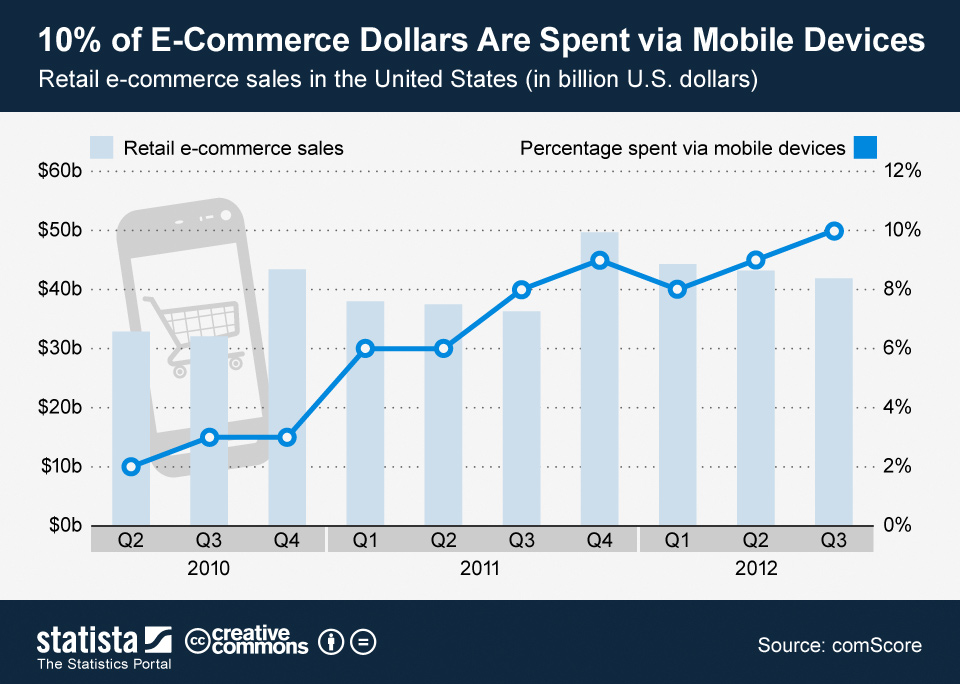
Consumers are using their smart devices to research products, check prices and more and more often to actually make a purchase. According to comScore data, 1 in 10 e-commerce dollars spent in the third quarter was spent via smartphone, tablet or another mobile device.
With ever-growing adoption of smartphones and the huge popularity of tablets, it can be safely assumed that the percentage of mobile purchases will grow further in the future and retailers are well-advised to embrace their mobile audience.
This chart shows quarterly retail e-commerce sales in the United States and the percentage of sales made through mobile devices.

http://www.statista.com/topics/871/online-shopping/chart/726/e-commerce-sales-in-the-united-states/
Consumers are using their smart devices to research products, check prices and more and more often to actually make a purchase. According to comScore data, 1 in 10 e-commerce dollars spent in the third quarter was spent via smartphone, tablet or another mobile device.
With ever-growing adoption of smartphones and the huge popularity of tablets, it can be safely assumed that the percentage of mobile purchases will grow further in the future and retailers are well-advised to embrace their mobile audience.
This chart shows quarterly retail e-commerce sales in the United States and the percentage of sales made through mobile devices.
http://www.statista.com/topics/871/online-shopping/chart/726/e-commerce-sales-in-the-united-states/
Related articles
- 'Mobile Thursday' Shopping via Smartphones and Tablets Will Nearly Double from Last Year (hispanicbusiness.com)
- Mobile Thursday? (adweek.com)
- Holiday Shopping Tidbits and Forecasts (fatwallet.com)
- Shopping Online Means Shopping Anywhere (hispanicbusiness.com)
Friday, October 19, 2012
Are Smartphones the new wallets?
eMarketer expects the transaction volume of mobile payments in the United States to reach $640 million this year and predicts a 100-fold increase until 2016. But are we really ready to ditch our wallets in favor of our smartphones?
When Apple released the iPhone 5 last month, some people were disappointed that Apple chose not to include a Near Field Communication chip for mobile payments. Others interpreted Apple’s omission of an NFC chip as proof that the time has yet to come for the technology to become relevant to the mass market. After all, Apple has a history of dismissing technologies until they have proven their viability. eMarketer expects 8 million Americans to make a point-of-sale purchase with their smartphone this year. That’s roughly seven percent of U.S. smartphone users and clearly shows that mobile payments are still in the early stages of adoption. If eMarketer is right, almost 50 million Americans will be using their phones to make in-store purchases by 2016. So the iPhone 7 will probably have NFC.

http://www.statista.com/topics/840/smartphones/chart/665/mobile-payment-forecast/
When Apple released the iPhone 5 last month, some people were disappointed that Apple chose not to include a Near Field Communication chip for mobile payments. Others interpreted Apple’s omission of an NFC chip as proof that the time has yet to come for the technology to become relevant to the mass market. After all, Apple has a history of dismissing technologies until they have proven their viability. eMarketer expects 8 million Americans to make a point-of-sale purchase with their smartphone this year. That’s roughly seven percent of U.S. smartphone users and clearly shows that mobile payments are still in the early stages of adoption. If eMarketer is right, almost 50 million Americans will be using their phones to make in-store purchases by 2016. So the iPhone 7 will probably have NFC.

http://www.statista.com/topics/840/smartphones/chart/665/mobile-payment-forecast/
Related articles
- Banks still upbeat on NFC despite iPhone 5 disappointment (computerworld.co.nz)
- NatWest tests NFC iPhone case and app in mobile payments trial (zdnet.com)
- Visa and RBS launch program to bring NFC mobile payments to the iPhone (mobileburn.com)
- App turns Google Nexus phone into payment tool (reviews.cnet.com)
- NFC mobile payment spend to hit $100 billion in 2016 (pcadvisor.co.uk)
Friday, October 12, 2012
The global mobile phone market continues to sky rocket
By the end of 2012, more than 5 billion mobile phones will be in use around the globe. Among these will be 4.4 billion camera phones and 1.2 billion smartphones. To put things in perspective: the installed base of television sets and personal computers is 1.9 and 1.4 billion, respectively. These astonishing numbers come by way of Tomi Ahonen, a former Nokia exec rated the most influential expert in mobile by Forbes in 2011. Ahonen released his annual analysis on the mobile phone industry this week and pre-published these numbers along with some other statistical tidbits on his blog.
The data provides some neat insights about the scope and composition of the mobile phone market. For example we tend to forget that less than one quarter of mobile handsets are actually smartphones. Moreover, even in 2012, only 11 percent of global handset sales will be premium smartphones, Ahonen notes. I.e. those phones everybody keeps talking about currently account for little more than one tenth of the market (in unit terms). Almost 60 percent of all mobile phones sold in 2012 will cost less than $79 dollars and that is without the carrier subsidies we all grew accustomed to.
This chart shows the prevalence of selected features in the global installed base of mobile phones.

http://www.statista.com/topics/840/smartphones/chart/653/prevalence-of-selected-features-in-the-global-installed-base-of-mobile-phones/
The data provides some neat insights about the scope and composition of the mobile phone market. For example we tend to forget that less than one quarter of mobile handsets are actually smartphones. Moreover, even in 2012, only 11 percent of global handset sales will be premium smartphones, Ahonen notes. I.e. those phones everybody keeps talking about currently account for little more than one tenth of the market (in unit terms). Almost 60 percent of all mobile phones sold in 2012 will cost less than $79 dollars and that is without the carrier subsidies we all grew accustomed to.
This chart shows the prevalence of selected features in the global installed base of mobile phones.

http://www.statista.com/topics/840/smartphones/chart/653/prevalence-of-selected-features-in-the-global-installed-base-of-mobile-phones/
Related articles
- A Look At the Handset Industry, Market and Installed Base in 2012 (communities-dominate.blogs.com)
- Introducing the TomiAhonen Phone Book 2012, my statistical volume on the handset industry, totally updated for 2012 data (communities-dominate.blogs.com)
- Bad news for Windows Phone Development (businesstechnologypartner.wordpress.com)
- CHART OF THE DAY: Why Smartphones Remain Out Of Reach For Many Global Consumers (businessinsider.com)
Saturday, October 6, 2012
Remember when the family gathered in the living room to watch TV?
The old idea of families gathering in the living room to watch TV together undistracted is on its way out, if not gone already. Today, people actively use tablets and smartphones while they watch, and sometimes even watch TV entirely on these mobile devices. This is more than a fad.
Last night I wanted to watch the Atlanta Braves and the Texas Rangers. I also had a local homecoming game to go to. Not a problem. I subscribe to MLB.tv. I stated on cable. Moved (still at home) to my iPad as I got ready to go. Switched again to my iPhone at the game.
I have one child who gave up their set top box in their room. All they do is stream. Two others stream Netflix a lot on their phones. My wife and I use Apple TV a lot.
[caption id="" align="alignright" width="240"] Intel Mobile Device (Photo credit: Frank Gruber)[/caption]
Is traditional TV and cable going the way of newspapers? What are the implication for advertising?
Last night I wanted to watch the Atlanta Braves and the Texas Rangers. I also had a local homecoming game to go to. Not a problem. I subscribe to MLB.tv. I stated on cable. Moved (still at home) to my iPad as I got ready to go. Switched again to my iPhone at the game.
I have one child who gave up their set top box in their room. All they do is stream. Two others stream Netflix a lot on their phones. My wife and I use Apple TV a lot.
[caption id="" align="alignright" width="240"]
Intel Mobile Device (Photo credit: Frank Gruber)[/caption]Is traditional TV and cable going the way of newspapers? What are the implication for advertising?
Related articles
- Half of Canada's Internet users also using mobile device, TV to get online (ctvnews.ca)
- Report: Mobile device users consume more news (utsandiego.com)
- Televisions in the Digital Age | Ebuyer HQ (ebuyer.com)
- TV viewing on tablets is rising among older viewers, finds survey (lostremote.com)
Wednesday, October 3, 2012
Do you read your mobile news in a browser or app?
Imagine you have invested heavy in a technology betting it is the next new shiny toy. Imagine it isn't. Interesting that the web browser is still the app of choice for consumers who read news on mobile devices. Early on I noticed that I preferred to read the WSJ on my iPad browser as opposed to their app. 
Interesting study from Pew Research Center.

Interesting study from Pew Research Center.
News organizations have invested significantly in native apps for iOS, Android, WP7 and even, for a time, webOS — yet nearly three times as many tablet owners and twice as many smartphone users access news primarily through browsers rather than apps, according to a Pew Research Center study released Monday.
Sixty percent of tablet news readers and 61% of smartphone news readers in the survey said they get most of their news through web browsers on those devices. Twenty-three percent of tablet news readers and 28% of smartphone news readers claimed they use apps, while 16% and 11%, respectively, said they use apps and web browsers equally.
via Twice As Many Mobile News Readers Prefer Browsers to Apps [Study].
Related articles
- Tom's Guide: 10 Mobile Browsers for Surfing On the Go (tomshardware.com)
- It's official: News consumption is all about social and mobile (gigaom.com)
- Google Chrome goes mobile (lenovo.com)
- The 5 Best Alternative Browsers for iOS (vikitech.com)
Wednesday, September 19, 2012
Bad news for Windows Phone Development
Market research firms, such as Gartner and IDC, publish estimates of global smartphone shipments on a quarterly basis. While these numbers are very helpful to determine who's currently on top of the smartphone market, there is one other metric that is just as important, if not more. Let's say you're an app developer. Of course you're interested in short term trends, because they give you an idea which platform has a future. But if you want to know if a platform is worth developing for NOW, what's at least as important is the installed base of that platform, i.e. the number of phones that are actually in use at a given point of time.
Former Nokia executive turned consultant Tomi Ahonen has recently published his estimates for the global smartphone market and the message is clear: if you're planning to develop apps for Windows Phone, you might want to think again. Why, Windows Phone has a global installed base of 14 million units. A number ridiculously small compared to Android's 427 million and Apple's 198 million. Even Bada, a low-end operating system pretty much left for dead by Samsung, has a larger installed base than Windows Phone does. So if Microsoft really wants to establish Windows Phone as the "third ecosystem" in the mobile game, the Redmond-based company has a rocky road ahead of it.
This chart shows the global installed base of smartphones at the end of Q2 2012, broken down by operating system.

Former Nokia executive turned consultant Tomi Ahonen has recently published his estimates for the global smartphone market and the message is clear: if you're planning to develop apps for Windows Phone, you might want to think again. Why, Windows Phone has a global installed base of 14 million units. A number ridiculously small compared to Android's 427 million and Apple's 198 million. Even Bada, a low-end operating system pretty much left for dead by Samsung, has a larger installed base than Windows Phone does. So if Microsoft really wants to establish Windows Phone as the "third ecosystem" in the mobile game, the Redmond-based company has a rocky road ahead of it.
This chart shows the global installed base of smartphones at the end of Q2 2012, broken down by operating system.
Related articles
- Smartphone Market Shares Q2 Full Numbers - Samsung and Android solidifying their leads (communities-dominate.blogs.com)
- Global Mobile Smartphone Sales: Samsung Lead the Stats (txt4ever.wordpress.com)
- Windows Phone to surpass BlackBerry in install base (arstechnica.com)
Wednesday, September 5, 2012
How not to miss a beat all day long.
You know technology is moving fast. So are customer expectations. Adoption of multiple devices is now the norm. I connect from my work laptop, iPad, iPhone, and home iMac on any given day. Most of what I connect to is pervasive from device to device. Just today I have used a "to do" manager on the web via a laptop, my iPhone and my iPad. Everything I need to do is always synched and up to date. I love it. But that is also my expectation now for how things work.
Consider this from Forrester Research:
We can all connect and interact from multiple devices all day long without missing a beat. What opportunities does this present for us to improve the customer experience?
Consider this from Forrester Research:
- Thirty-two percent of US online adults accessed the Internet from multiple physical locations using a PC only; for example, from home, work, and the sidelines of a son's soccer game.
- Forty-five percent of all US mobile subscribers owned a smartphone in 2011, slightly less than doubling from just two years before, when only 24% owned one. Forrester forecasts that more than half of US mobile subscribers will own smartphones by the end of 2012. And, in Western Europe, they expect smartphone penetration to jump from 34% in 2011 to 67% by 2016.
- Thirty-six percent of US adults with a mobile phone access the mobile Internet at least monthly or more often. In 2010, only 23% engaged in this behavior. Western European adults with a mobile phone accessing the mobile Internet at least monthly or more often grew from 9% to 18% from 2009 to 2011.
We can all connect and interact from multiple devices all day long without missing a beat. What opportunities does this present for us to improve the customer experience?
Related articles
- Intel partners with LG on mobile Internet devices (reviews.cnet.com)
- Keep Your Mobile Internet On When Visiting France (prweb.com)
- Cord Cutting: Has Your Home Gone Mobile? (mycricket.com)
Monday, September 3, 2012
Who will be the largetst SmartPhone market?
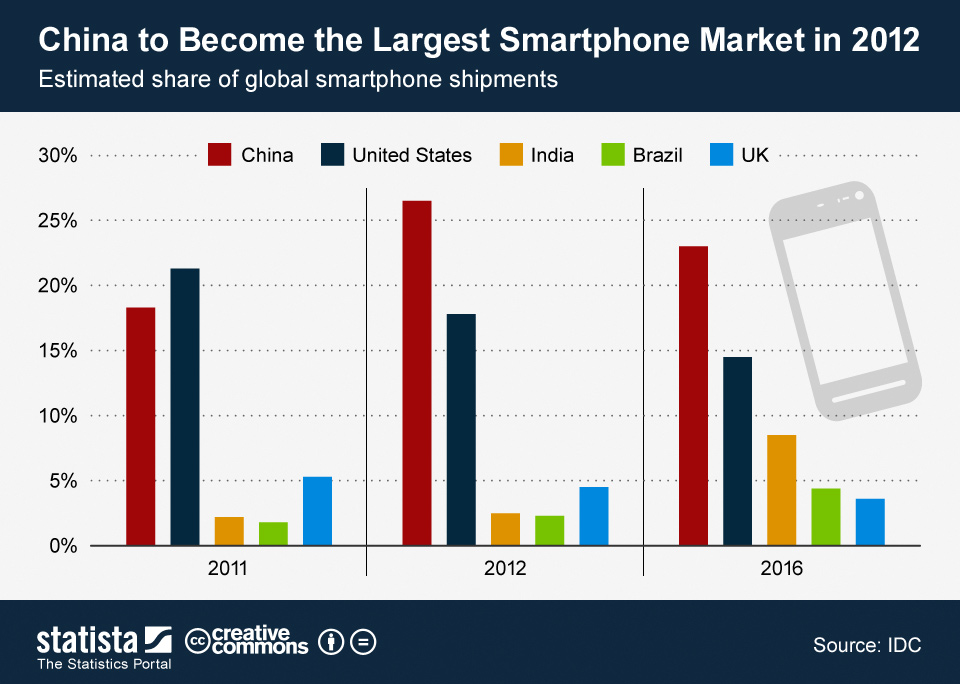
Now this makes sense. According to market research firm IDC, China will overtake the United States this year to become the world’s largest smartphone market. China’s share of global smartphone shipments is expected to grow from 18.3 percent in 2011 to 26.5 percent in 2012. China’s market share is forecast to decline slightly until 2016, as smartphone adoption will accelerate in other emerging markets, such as India.
 Smartphone adoption in the United States is starting to slow down and as emerging markets are quickly growing, the U.S. share of global shipments is expected to decline from 21.3 percent in 2011 to 14.5 percent in 2016.
Meanwhile, India could become the third largest market by 2016. IDC projects an average annual growth rate of more than 50 percent for the Indian smartphone market in the next five years.
The chart shows the five largest smartphone markets, based on their share of global smartphone shipments.
Source: http://www.statista.com/topics/840/smartphones/chart/585/china-to-become-the-largest-smartphone-market-in-2012/
 Smartphone adoption in the United States is starting to slow down and as emerging markets are quickly growing, the U.S. share of global shipments is expected to decline from 21.3 percent in 2011 to 14.5 percent in 2016.
Meanwhile, India could become the third largest market by 2016. IDC projects an average annual growth rate of more than 50 percent for the Indian smartphone market in the next five years.
The chart shows the five largest smartphone markets, based on their share of global smartphone shipments.
Source: http://www.statista.com/topics/840/smartphones/chart/585/china-to-become-the-largest-smartphone-market-in-2012/
Subscribe to:
Posts (Atom)