Heartfelt criticism of your idea or your art is usually right (except when it isn't...)
Check out this letter from the publisher of a magazine you've never heard of to the founder of a little magazine called Readers Digest:
But, personally, I don't see how you will be able to get enough subscribers to support it. It is expensive for its size. It isn't illustrated... I have my doubts about the undertaking as a publishing venture.
Of course, he was right--given his assumptions. And that's the except part.
Criticism of your idea is usually based on assumptions about the world as it is. Jackson Pollock could never have made it as an painter in the world as it was. And Harry Potter was rejected by just about everyone because for it to succeed the way kids read would have to change.
The useful element of this sort of criticism isn't that the fact that people in the status quo don't like your idea. Of course they don't. The interesting question is: what about the world as it is would have to change for your idea to be important?
In the case of Readers Digest, the key thing that changed was the makeup of who was reading magazines. Most of the people (and it was a lot of people) who subscribed to the Digest didn't read other magazines. And so comparing to other magazines made no sense, except to say, "this is so different from other magazines, the only way you're going to succeed is by selling it to millions of people who don't read those magazines." And Starbucks had no chance if they were going to focus on the sort of person who bought coffee at Dunkin Donuts or a diner, and the iPad couldn't possibly succeed if people were content to use computers the way they were already using them.
Keep that in mind the next time a gatekeeper or successful tastemaker explains why you're going to fail.
Seth's Blog: Interpreting criticism
Showing posts with label iPad. Show all posts
Showing posts with label iPad. Show all posts
Saturday, March 30, 2013
Why was Readers Digest bound to fail?
This blog by Seth Godin is worth reading in it's entirety. What is your Readers digest idea?


Wednesday, January 16, 2013
What is on consumers wish list for 2013?
The iPhone ranks first on Americans’ 2013 consumer technology wish list. 23.5 percent of 2,285 U.S. consumers surveyed in October 2012 by Strategy Analytics said they are somewhat or very likely to buy Apple's smartphone during the next twelve months. A smartphone with Android comes second, with 21.6 percent. This is followed by a portable PC (17.4 percent) and again an Apple product, the iPad (15.3 percent).
The top 10 consumer electronics buying intentions list is rounded off with Android Tablets (10,7 percent) and E-Readers (10,6 percent). You can find the full list including 22 key consumer electronics products on strategyanalytics.com.

http://www.statista.com/markets/15/topic/126/electronics/chart/815/top-10-consumer-electronic-products-in-the-u.s.-2013/
The top 10 consumer electronics buying intentions list is rounded off with Android Tablets (10,7 percent) and E-Readers (10,6 percent). You can find the full list including 22 key consumer electronics products on strategyanalytics.com.

http://www.statista.com/markets/15/topic/126/electronics/chart/815/top-10-consumer-electronic-products-in-the-u.s.-2013/
Related articles
- Consumer Reports Ranks iPhone 5 Worst Top Smartphone (usnews.com)
- iPad eclipses iPhone launch (businesstechnologypartner.wordpress.com)
- Report: Apple may build less expensive iPhone (kfwbam.com)
- In 2013, Americans want to buy an iPhone, followed by an Android phone, portable PC, and then iPad (thenextweb.com)
Thursday, December 6, 2012
iPad eclipses iPhone launch
When Apple introduced the original iPad in January 2010, many analysts were sceptical whether the new device could replicate the iPhone’s success in establishing a new product category. Two and a half years and 100 million shipped iPads later, the answer has to be: yes!
Not only has the iPad redefined (or reignited) the tablet market, it even eclipsed the iPhone in terms of launch sales. In the first ten quarters after the iPad’s launch in April 2010, Apple shipped 98.16 million units of its popular tablet. During the same period after the iPhone’s launch in 2007, Apple shipped 33.75 million units of its popular smartphone. I.e. the iPad outsold the iPhone 3 to 1 in its first two and a half years on the market, making it one of the fastest consumer electronics launches ever.
The recently launched iPad Mini could give iPad sales another boost, as the entry price to Apple’s tablet products dropped from $399 to $329. This chart shows cumulative global unit shipments in the first 10 quarters after the launches of Apple's mobile gadgets: the iPod, the iPhone and the iPad.

http://www.statista.com/topics/847/apple/chart/753/apple-s-mobile-product-launches/
Not only has the iPad redefined (or reignited) the tablet market, it even eclipsed the iPhone in terms of launch sales. In the first ten quarters after the iPad’s launch in April 2010, Apple shipped 98.16 million units of its popular tablet. During the same period after the iPhone’s launch in 2007, Apple shipped 33.75 million units of its popular smartphone. I.e. the iPad outsold the iPhone 3 to 1 in its first two and a half years on the market, making it one of the fastest consumer electronics launches ever.
The recently launched iPad Mini could give iPad sales another boost, as the entry price to Apple’s tablet products dropped from $399 to $329. This chart shows cumulative global unit shipments in the first 10 quarters after the launches of Apple's mobile gadgets: the iPod, the iPhone and the iPad.
http://www.statista.com/topics/847/apple/chart/753/apple-s-mobile-product-launches/
Related articles
- YouTube updates iOS app with iPad and iPhone 5 support, adds AirPlay, faster video loading, improved playlist management (9to5mac.com)
- Apple's iPad Grabs 98% Of Tablet Web Traffic (misco.co.uk)
- The New iPad vs. iPad 2 - What's Different & Should You Switch? (epicagear.com)
- iPad mini before Christmas has limitations (product-reviews.net)
Friday, November 30, 2012
Which mobile platform should you pick? Android, iOS, Windows 8 or HTML5?
The last month has introduced much new food for thought if you are trying to decide which mobile platform to build on first:
Thirty days ago, you were probably thinking to start with iOS, not just because of the launch of the iPad Mini but also the preponderance of Apps in iTunes
Then Microsoft launched Windows 8 (and the Surface), driving a full-court press to get developers to build apps for the Windows Store
A few days later, IDC came out with the latest numbers, showing Android was crushing everyone, with a 75% market share of new phones sold in Q3.
As a result, some declared that iOS was going the way of the Dodo–until last week, when iOS (especially the iPad) crushed the competition in online purposes purchases on Black Friday.
It has definitely been an eventful pre-Holiday Season in mobile.
With all these different metrics and shifts in leadership, which platform do you pick? The market share leader (Android)? The eCommerce leader (iOS)? The one most familiar to enterprise (Windows)? The one most open of all (HTML5)?
If you are Fortune-500 company with a big mobile budget the decision is easy: build on several. If you are smaller, you probably can only build one or two at most (or at least one to start on first). Which one do pick?
Thirty days ago, you were probably thinking to start with iOS, not just because of the launch of the iPad Mini but also the preponderance of Apps in iTunes
Then Microsoft launched Windows 8 (and the Surface), driving a full-court press to get developers to build apps for the Windows Store
A few days later, IDC came out with the latest numbers, showing Android was crushing everyone, with a 75% market share of new phones sold in Q3.
As a result, some declared that iOS was going the way of the Dodo–until last week, when iOS (especially the iPad) crushed the competition in online purposes purchases on Black Friday.
It has definitely been an eventful pre-Holiday Season in mobile.
With all these different metrics and shifts in leadership, which platform do you pick? The market share leader (Android)? The eCommerce leader (iOS)? The one most familiar to enterprise (Windows)? The one most open of all (HTML5)?
If you are Fortune-500 company with a big mobile budget the decision is easy: build on several. If you are smaller, you probably can only build one or two at most (or at least one to start on first). Which one do pick?
Question 1: What is the (Intended) Usage Pattern of Your Customers?
Question 2: If You ARE Building an App, What Are Your Customer Demographics?
Thursday, November 8, 2012
No mobile -- no future | Inspiring Generosity
Everything we do must begin with the mobile experience. It is that clear? Without that, from a business perspective, we have no future.

Now that is something to think about. Are we ready?

Now that is something to think about. Are we ready?
Much has been made about the necessity of developing a mobile web strategy. Mobile now comprises 10% of global web traffic. This year’s Millennial Impact Report shows how important mobile has become for U.S. nonprofits. Without a mobile strategy, nonprofits have no online future. Why? Because millennials use their smartphone like a computer, reading e-newsletters, emailing people, and engaging in social media.
via No Mobile, No Future | Inspiring Generosity.
Related articles
- 8 Things Small Businesses Must Know About the Future of Mobile Marketing (blogs.constantcontact.com)
- iPad is king of mobile web traffic, plus more intriguing data from OnSwipe (venturebeat.com)
- Tablets, smartphones account for 20 percent of US web traffic (lenovo.com)
- Tablets, smartphones account for 20 percent of US web traffic (lenovo.com)
Wednesday, November 7, 2012
Tablets are the fastest adopted device in history

The use and adoption of tablets is exploding. Some just use it to access email on the run, others are using to easily show presentations to clients and customers and some are just having fun.
Tablets are the fastest-adopted devices in history. If we mark the modern tablet era by Apple's 2010 iPad launch, then an astounding 84 million iPads and as many as 120 million tablets in total have flown off the shelves in just two years. Forrester's global workforce and decision-maker surveys and client conversations show just how fast tablets are being adopted. What is your take on all this? As an iWorker, how are you using tablets?
- Three-quarters of a billion tablets will be in use by 2016. It took more than 20 years for the PC to reach an installed base of 750 million people. But tablets will surpass that mark in less than half the time. Global tablet sales will top 375 million in 2016 with about one-third of tablets acquired by businesses for employees. Back in 2007, we wrote that to reach the second billion users, the computer market would be driven by lower-cost hardware, useful applications, and easy access to the Internet from anywhere.Tablets fit that bill perfectly.
- Some 81% of firms expect to support tablets for employees. IT decision-makers are getting tablet fever as 81% of firms report interest in using tablets. According to these IT decision-makers, tablets will come into the enterprise via several doors, including employees bringing their own: Our latest survey of global information workers shows that 12% use tablets, and 8% paid for it themselves. And more than half of the 1,004 firms we surveyed plan to increase their spending on mobile devices and apps by at least 10% next year.
- Tablets will accelerate the rise of the anytime, anywhere information worker. Today, 15% of information workers use at least three connected devices for work, work from at least three different locations, and use at least seven apps for work. And 30% of information workers satisfy at least two of those three criteria. The rise of tablets will drive the number of anytime, anywhere information workers up. Tablets enable access from more locations and bring relevant and useful apps to make employees more productive.
via Forrester Research : Research : Mastering The Business Tablet Landscape.
Related articles
- How will you manage tablet fever? (zdnet.com)
- Mobile workers increasingly dare IT to rein them in: survey (zdnet.com)
- Is Apple's Tablet Dominance Coming to an End? (blogs.wsj.com)
- Forrester: 66% Of Employees Use 2 Or More Devices At Work, 12% Use Tablets (techcrunch.com)
- Tablets buying guide (reviews.cnet.com)
Monday, November 5, 2012
Apple iPad market share is dropping as rivals are catching up
The global tablet market continues to grow. According to market research group IDC, Apple, Samsung and co. shipped 27.8 million tablets in the past quarter, almost reaching the record of 28.2 million from last year’s holiday quarter.
With the iPad Mini, the first Windows 8 tablets and the popular $199 tablets from Google and Amazon all lined up for holiday season, the fourth quarter is likely going to be a blowout quarter for tablet vendors.
This chart shows global tablet shipments since the second quarter of 2012, the quarter in which Apple released the first iPad.

http://www.statista.com/topics/841/tablets/chart/695/global-tablet-shipments-since-q2-2010/
Meanwhile Apple’s market share in the global tablet market begins to erode. In the third quarter, Apple accounted for 50 percent of global tablet shipments, down from 66 percent in the June quarter and a new low since the introduction of the first iPad in April 2010. The launch of Google’s $199 Nexus 7 tablet and Amazon’s refresh of its popular Kindle Fire have clearly hurt Apple and the upcoming holiday quarter will show whether the iPad Mini can help Apple to re-strengthen its position. Starting at $329, Apple’s lower-end tablet is priced significantly higher than the entry models of Google and Amazon, a strategy that hasn’t fared well with many consumers.
This second chart shows global tablet market share in the third quarter of 2012, based on unit shipments.

http://www.statista.com/topics/841/tablets/chart/696/global-tablet-market-share-in-q3-2012/
With the iPad Mini, the first Windows 8 tablets and the popular $199 tablets from Google and Amazon all lined up for holiday season, the fourth quarter is likely going to be a blowout quarter for tablet vendors.
This chart shows global tablet shipments since the second quarter of 2012, the quarter in which Apple released the first iPad.

http://www.statista.com/topics/841/tablets/chart/695/global-tablet-shipments-since-q2-2010/
Meanwhile Apple’s market share in the global tablet market begins to erode. In the third quarter, Apple accounted for 50 percent of global tablet shipments, down from 66 percent in the June quarter and a new low since the introduction of the first iPad in April 2010. The launch of Google’s $199 Nexus 7 tablet and Amazon’s refresh of its popular Kindle Fire have clearly hurt Apple and the upcoming holiday quarter will show whether the iPad Mini can help Apple to re-strengthen its position. Starting at $329, Apple’s lower-end tablet is priced significantly higher than the entry models of Google and Amazon, a strategy that hasn’t fared well with many consumers.
This second chart shows global tablet market share in the third quarter of 2012, based on unit shipments.

http://www.statista.com/topics/841/tablets/chart/696/global-tablet-market-share-in-q3-2012/
Related articles
- Android gains momentum in the tablet market as Apple loses ground (itpro.co.uk)
- iPad dominance slides as Samsung and Amazon tap tablet sales (slashgear.com)
- IDC report: Tablet market grows nearly 50 percent, Apple loses iPad share (zdnet.com)
- Apple says it sold 3 million iPads over the weekend (kansascity.com)
- Apple loses ground in the tablet market to Android devices (neowin.net)
Sunday, November 4, 2012
Microsoft may be down but are they out?
The new mobile wars are about an ecosystem across devices. Microsoft is obviously not in a great position. I have casually looked at Windows 8 devices the last few days. I am encouraged by what I see. That said, in my house we have 2 iPads, 3 iPhones and 2 Android phones. I will buy a Windows 8 device soon. Probably a laptop/tablet combo. Here are the contenders from a recent Forrester report.

- Amazon puts content — and commerce — first. Amazon's strongest asset is its ability to deliver a rich assortment of content seamlessly to its customers, who are very comfortable with buying from the big retailer on any device, not just those from Amazon. In addition, the company is a powerhouse in cloud computing and provides seamless access to purchased and personal content across any device. Yet Amazon's device offerings are limited, and its use of a modified variant of the Android platform requires a devoted effort to entice developers to create application versions tuned to that variant. While Amazon has global ambitions, its reach today is much more limited than its competitors; additionally, its method of working with mobile operators challenges its expansion rate.
- Apple exerts by far the strongest loyalty gravitational pull. Apple's collective offerings are demonstrably attractive to its customers, anchored most firmly by its most popular product, the iPhone. Consider that, compared with the total US online population, iPhone owners are 156% more likely to own an iPad, 188% more likely to own a Mac, and 235% more likely to own both. Apple has succeeded in providing digital distribution for nearly every major owner of music, video, books, newspapers, and magazines; additionally, while some media companies have publicly complained about Apple's perceived stranglehold on the market, by and large Apple has helped those companies benefit from digital disruption. Apple customers have warmly embraced the company's personal cloud services — but these services still have gaps to fill versus, for example, Google Docs.
- Google touches the greatest number of mobile customers, but its loyalty force is less strong. The company's Android software has skyrocketed to become the leading smartphone platform, but Android phone owners are not as strongly drawn to other Android devices as is the case for Apple. Online adults in the US who own an Android phone are twice as likely to own an Android tablet than the total US online population — but also 13% more likely to own an iPad. Google's range of content partnerships has grown rapidly in the past year. However, its library still falls short of both Apple's and Amazon's, and some media companies have shown reluctance to embrace Google as a partner given past collisions such as that between YouTube and Viacom. The company's greatest strength is in its broad reach via cloud services and its Chrome browser, which is now available on the vast majority of connected devices.
- Microsoft has the steepest mountain to climb. Microsoft has been singularly unsuccessful in translating its dominance in PCs to the mobile market, in fact suffering from a loss of smartphone market share since the introduction of its revamped Windows Phone 7 OS. The company has no presence so far in the vital tablet market and, as a result, has struggled to attract developers to its mobile platforms. While Microsoft has released a wide range of personal cloud services such as SkyDrive, it has not effectively communicated the value of those services to its customers. Microsoft's greatest strength in content and media resides on the Xbox, whose connections to other devices powered by the company's software is nearly invisible. With the release of Windows 8 and Windows Phone 8, Microsoft hopes to translate a common user experience into loyalty across multiple devices — a tall order given its competitors' positions.
- Others face a daunting task in building from (almost) scratch. It's clear that many companies seek to establish a competitive ecosystem. RIM promises that its upcoming OS revamp, BlackBerry 10, and associated devices will revitalize the once-dominant smartphone maker. Samsung, the world leader in phone shipments, has invested in its own bada OS, has a range of content partnerships and its own media store, and has also hedged its bets by joining Intel's Tizen development effort. Companies like HP, with strong ties to the enterprise, recognize the importance of having a diverse mobile offering, including smartphones. But we consider it highly unlikely that any of these companies can craft and unite all of the requisite components and then lure customers who have already placed their significant investments. Therefore their hope lies in those customers whose assets remain on the table — and there are billions of them.
Monday, October 22, 2012
Will the iPad Mini release continue Apple's domination of the tablet market?

Tomorrow Apple will hold an event in San Jose, CA to unveil a highly anticipated addition to its iPad line-up. The long-rumoured smaller iPad (reportedly called ‘iPad Mini’ or ‘iPad Air’) is expected to be priced to compete directly with Amazon’s Kindle Fire and Google’s Nexus 7 tablet, both priced at $199. Although it is considered unlikely that Apple will match that price point, analysts expect a starting price way below the $499 of the cheapest full-size iPad.
Apple’s competitors will likely be on the edge of their seats when Tim Cook and Co. announce details about the all but confirmed tablet. If Apple manages to offer a competitive product at a price close enough to $199, Google and Amazon will see the biggest selling point of their tablets disappear. This could reinforce Apple’s stranglehold on the tablet market just as its competitors were starting to see some light.
In the second quarter of 2012, Apple’s market share was 68 percent, i.e. Apple shipped more than twice as many tablets as all of its competitors combined. In the September quarter (the numbers are not out yet), Apple’s market share will likely come in a little lower, as Google’s Nexus 7 has reportedly had a successful start. It will be interesting to see how the tablet market develops over the next few quarters with another iPad, more Android tablets and the first Windows 8 tablets in the mix.

http://www.statista.com/topics/841/tablets/chart/530/global-tablet-shipments-from-q2-2010-to-q2-2012/
Related articles
- Apple sets October 23 event, smaller iPad expected - Khaleej Times (khaleejtimes.com)
- Record iPad Sales Drive Strong Q2 Growth In Tablet Market - IDC (misco.co.uk)
- iPad Mini build cost starts at $195 and retail cost starts at $299 (thedroidguy.com)
- iPad mini competition preceding event (product-reviews.net)
Wednesday, October 17, 2012
Digital media is fragmented globally
In our globalized world, it is strange how fragmented the world of digital media still is. Graham Spencer of MacStories has compiled data showing that many of the services we have become accustomed to, are only available in a handful of countries. Take iTunes music for example: Apple’s music store is by far the largest digital music store out there. Yet, it is only available to 27 percent of the world’s population. All those Chinese lining up to buy iPhones and iPads currently have no chance of purchasing music or movies for their iDevices (unless they get an American iTunes account, which is impossible without violating Apple’s terms of service).
Also interesting is the fact that people from no more than six countries can get TV content from Amazon and co., speaking volumes of the difficulties in licensing content from content creators (e.g. cable companies) who own a distribution channel (cable TV).
This chart provides a nice overview of the international availability of the content offerings of Apple, Google, Amazon and Microsoft.

http://www.statista.com/markets/14/media-advertising/chart/661/international-availability-of-digital-media-offerings/
Also interesting is the fact that people from no more than six countries can get TV content from Amazon and co., speaking volumes of the difficulties in licensing content from content creators (e.g. cable companies) who own a distribution channel (cable TV).
This chart provides a nice overview of the international availability of the content offerings of Apple, Google, Amazon and Microsoft.

http://www.statista.com/markets/14/media-advertising/chart/661/international-availability-of-digital-media-offerings/
Related articles
- Mapping The Entertainment Ecosystems of Apple, Microsoft, Google & Amazon (macstories.net)
- Xbox Music: Microsoft launches challenger to Apple's iTunes (guardian.co.uk)
- [News] Playing iPhone media through iTunes (pcworld.in)
- Streaming Wars: Apple TV vs Google, Boxee, Roku, XBox360, PS3 [Comparison] (methodshop.com)
Saturday, October 6, 2012
Remember when the family gathered in the living room to watch TV?
The old idea of families gathering in the living room to watch TV together undistracted is on its way out, if not gone already. Today, people actively use tablets and smartphones while they watch, and sometimes even watch TV entirely on these mobile devices. This is more than a fad.
Last night I wanted to watch the Atlanta Braves and the Texas Rangers. I also had a local homecoming game to go to. Not a problem. I subscribe to MLB.tv. I stated on cable. Moved (still at home) to my iPad as I got ready to go. Switched again to my iPhone at the game.
I have one child who gave up their set top box in their room. All they do is stream. Two others stream Netflix a lot on their phones. My wife and I use Apple TV a lot.
[caption id="" align="alignright" width="240"] Intel Mobile Device (Photo credit: Frank Gruber)[/caption]
Is traditional TV and cable going the way of newspapers? What are the implication for advertising?
Last night I wanted to watch the Atlanta Braves and the Texas Rangers. I also had a local homecoming game to go to. Not a problem. I subscribe to MLB.tv. I stated on cable. Moved (still at home) to my iPad as I got ready to go. Switched again to my iPhone at the game.
I have one child who gave up their set top box in their room. All they do is stream. Two others stream Netflix a lot on their phones. My wife and I use Apple TV a lot.
[caption id="" align="alignright" width="240"]
Intel Mobile Device (Photo credit: Frank Gruber)[/caption]Is traditional TV and cable going the way of newspapers? What are the implication for advertising?
Related articles
- Half of Canada's Internet users also using mobile device, TV to get online (ctvnews.ca)
- Report: Mobile device users consume more news (utsandiego.com)
- Televisions in the Digital Age | Ebuyer HQ (ebuyer.com)
- TV viewing on tablets is rising among older viewers, finds survey (lostremote.com)
Wednesday, October 3, 2012
Do you read your mobile news in a browser or app?
Imagine you have invested heavy in a technology betting it is the next new shiny toy. Imagine it isn't. Interesting that the web browser is still the app of choice for consumers who read news on mobile devices. Early on I noticed that I preferred to read the WSJ on my iPad browser as opposed to their app. 
Interesting study from Pew Research Center.

Interesting study from Pew Research Center.
News organizations have invested significantly in native apps for iOS, Android, WP7 and even, for a time, webOS — yet nearly three times as many tablet owners and twice as many smartphone users access news primarily through browsers rather than apps, according to a Pew Research Center study released Monday.
Sixty percent of tablet news readers and 61% of smartphone news readers in the survey said they get most of their news through web browsers on those devices. Twenty-three percent of tablet news readers and 28% of smartphone news readers claimed they use apps, while 16% and 11%, respectively, said they use apps and web browsers equally.
via Twice As Many Mobile News Readers Prefer Browsers to Apps [Study].
Related articles
- Tom's Guide: 10 Mobile Browsers for Surfing On the Go (tomshardware.com)
- It's official: News consumption is all about social and mobile (gigaom.com)
- Google Chrome goes mobile (lenovo.com)
- The 5 Best Alternative Browsers for iOS (vikitech.com)
Tuesday, September 11, 2012
Mobile internet browsing takes off
Mobile internet browsing continues to take off. It certainly highlights the need to make sure everything is mobile ready. Our internal data shows essentially the same trend.
In September 2012, mobile phones and tablets will for the first time be responsible for ten percent of internet browsing. For the calculation of usage development, Statista has taken figures from web analytics provider NetMarketShare. By the end of 2013, the share of mobile end devices will increase to over 17 percent.
URL: http://www.statista.com/topics/779/mobile-internet/chart/598/mobile-market-share-on-the-rise/
In September 2012, mobile phones and tablets will for the first time be responsible for ten percent of internet browsing. For the calculation of usage development, Statista has taken figures from web analytics provider NetMarketShare. By the end of 2013, the share of mobile end devices will increase to over 17 percent.
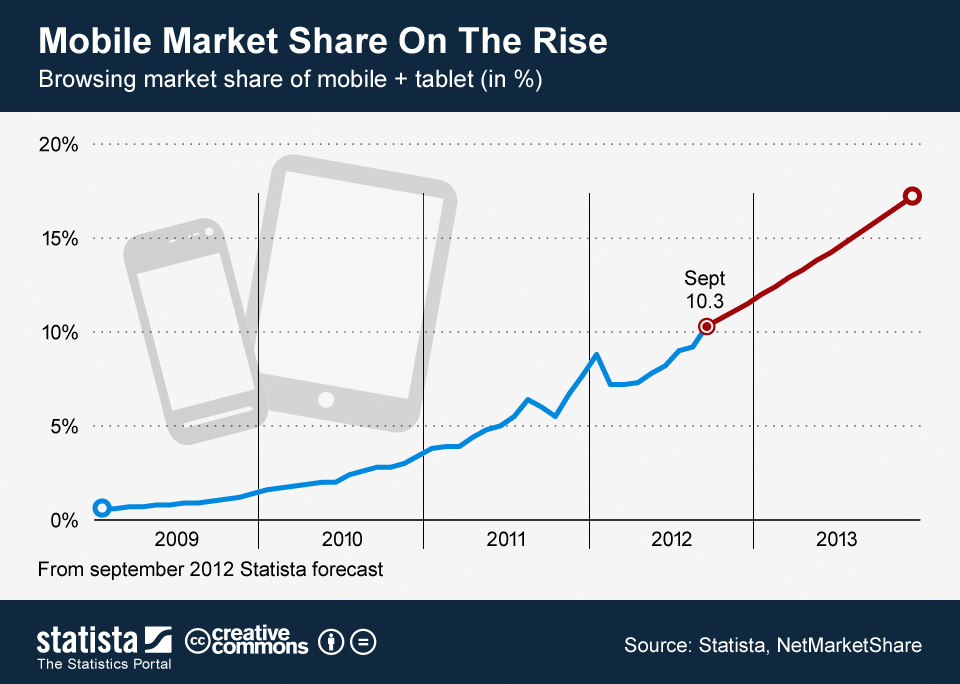
URL: http://www.statista.com/topics/779/mobile-internet/chart/598/mobile-market-share-on-the-rise/
Related articles
- Google launches a new initiative to help businesses reach out to mobile Internet users (buzzom.com)
- Mobile Internet Industry Discussed and Analysed in New Topical Report Now Available at MarketPublishers.com (prweb.com)
- Sina Exec: 'We're Frightened By Shift to Mobile Internet' (techinasia.com)
- Mobile marketing infographic (intomobile.com)
Wednesday, September 5, 2012
How not to miss a beat all day long.
You know technology is moving fast. So are customer expectations. Adoption of multiple devices is now the norm. I connect from my work laptop, iPad, iPhone, and home iMac on any given day. Most of what I connect to is pervasive from device to device. Just today I have used a "to do" manager on the web via a laptop, my iPhone and my iPad. Everything I need to do is always synched and up to date. I love it. But that is also my expectation now for how things work.
Consider this from Forrester Research:
We can all connect and interact from multiple devices all day long without missing a beat. What opportunities does this present for us to improve the customer experience?
Consider this from Forrester Research:
- Thirty-two percent of US online adults accessed the Internet from multiple physical locations using a PC only; for example, from home, work, and the sidelines of a son's soccer game.
- Forty-five percent of all US mobile subscribers owned a smartphone in 2011, slightly less than doubling from just two years before, when only 24% owned one. Forrester forecasts that more than half of US mobile subscribers will own smartphones by the end of 2012. And, in Western Europe, they expect smartphone penetration to jump from 34% in 2011 to 67% by 2016.
- Thirty-six percent of US adults with a mobile phone access the mobile Internet at least monthly or more often. In 2010, only 23% engaged in this behavior. Western European adults with a mobile phone accessing the mobile Internet at least monthly or more often grew from 9% to 18% from 2009 to 2011.
We can all connect and interact from multiple devices all day long without missing a beat. What opportunities does this present for us to improve the customer experience?
Related articles
- Intel partners with LG on mobile Internet devices (reviews.cnet.com)
- Keep Your Mobile Internet On When Visiting France (prweb.com)
- Cord Cutting: Has Your Home Gone Mobile? (mycricket.com)
Subscribe to:
Posts (Atom)