We all know it. We all hear it. Leadership loves to talk about change. Employees love to ignore it. Talk is very cheap. If we are honest however, we all know it is true. Change is inevitable. The real question is what we will do about it. Will we lead it or will we be a victim?
The biggest challenge is knowing the right time to change. Often, by the time we realize we need to change, the moment has passed us by. The worst possible scenario is that others' realize it before us and beat us to the punch. Rather than being strategic, we are impulsive and reactionary. Our perceived nonprofit competitor builds a website that does X and we have to do it to. Why? Maybe they have just wasted a ton of money. Mimicking others is not a strategy.
Are you inspired by technology or overwhelmed? Are you keeping up with technology or are you getting left behind? Have you see what a three-year-old can do with an iPhone? Does that intimidate you? This is all very disruptive. You know it and your constituents know it. The difference is that our constituents are embracing it.
As a nonprofit, is someone else about to displace you in the marketplace? Are you staying up with the pace of change with technology or are you about to get left behind? Do you have strategies, systems, processes, and protocols in place that will recognize that this is disruption? We need to assess opportunity, and we will need to facilitate the testing of Ideas? Is this your job? How much time and resources that you control are you devoting to it quarterly?
These are very serious questions. They need to be answered now. From the point of view of your mission, is this a case of only the strongest surviving? What will happen if the pace of change is so fast that your constituents adapt and change before you can? This is the reality we all need to face. We all know the role that technology plays in our personal lives. Do our digital properties at work match up to our personal experiences?
This might be a time for humility. Is the economy really our problem? If your nonprofit did well before the downturn of 2009 during bad economic times, why didn't they do well during the downturn turn of 2009?
All nonprofits are facing disruption. Have you been displaced in the marketplace and simply don't know it yet? There are nonprofits who are thriving and growing.
In the for-profit world, this is clear. Over 40% of the companies that were at the top of the Fortune 500, in 2000 were no longer there in 2010. Who are some of the top nonprofits today that weren’t on the list 10 or 20 years ago? I talked with a nonprofit leader recently that illustrates this perfectly I think. They probably aren’t on anybody’s list of top nonprofits. They are a $5 billion dollar international nonprofit. They are a single corporation with no separately incorporate chapters. They have a laser focus on the digital world. Their marketing is absolutely unified. Why doesn’t anyone know about them as a leader in the nonprofit space?
So as a nonprofit, you have established a presence on Facebook and Twitter. And so? Is the constituent experience and relationship any better than it was before? Perhaps so or perhaps not. Do you know?
This may be about survival. It could take more than a presence in new channels to improve the overall experience and relationship with those who can support us the best. It may take more courage than you think. It will certainly take more persistence to break through the resistance. In the end, it could be about how you work with your leaders and we're back to you about how you personally lead.
Are you leading a movement towards empowered and constituent – centric culture? Are you setting in motion real business transformation?
You have a special path you can follow. You can set in motion the change that opens the door to an improved experience both inside and outside your nonprofit. You can lead the change you need your nonprofit to experience!
Showing posts with label iPhone. Show all posts
Showing posts with label iPhone. Show all posts
Sunday, May 26, 2013


Friday, May 17, 2013
Relevance is defined by how relevant the experience is
The constituent journey is evolving (albeit very, very fast). That shouldn’t surprise you but it is good news. You haven’t been left behind completely. Your constituents are changing though. Their experience of you and your mission may not be what any of us would want. In this case, relevance is defined by how relevant the experience is. Passion for the mission is contingent on amazing experiences.
How you personally decide to react or lead is up to you. It, of course, is not about technology. What is the journey of getting closer to constituents and staying relevant really about? Here are some ideas:
Saying we want to get closer to constituent won’t get senior management on board. While a constituent revolution is at the C-Suite doors, someone (meaning you) needs to convince the top that change is imperative. Without that we will fail.
You know that most executives don’t use social networks personally. While they have smartphones the primarily utilization is for email and looking at the calendar to know where to go to next. The reality is that most won’t read this. Trying to make a case that this is about technology will be a losing battle.
What is the future of nonprofits built on? It isn’t about how Facebook, Twitter, iPhones, tablets or real time-time geolocation check-ins evolve. The future of nonprofits does depend on relevance and the ability to at least understand technology to be able to make decisions about new opportunities. It does require the ability to strategically adapt to the new opportunities to create a competitive advantage.
So much of this is about change. There is a technology revolution occurring. Other nonprofits (and for-profits that you compete with) understand this. But it is also about a whole series of real-world revolutions that are seizing how our constituents live which impacts their experience with us. Expectations are moving fast. We can’t afford to get left behind. The kind of change we are talking about involves three things:
How you personally decide to react or lead is up to you. It, of course, is not about technology. What is the journey of getting closer to constituents and staying relevant really about? Here are some ideas:
- Creating a culture built around the constituent and their experience being the focus of all you do.
- Empowering employees to do what it takes to create amazing experiences.
- Opening up the floodgates of innovation.
Saying we want to get closer to constituent won’t get senior management on board. While a constituent revolution is at the C-Suite doors, someone (meaning you) needs to convince the top that change is imperative. Without that we will fail.
You know that most executives don’t use social networks personally. While they have smartphones the primarily utilization is for email and looking at the calendar to know where to go to next. The reality is that most won’t read this. Trying to make a case that this is about technology will be a losing battle.
What is the future of nonprofits built on? It isn’t about how Facebook, Twitter, iPhones, tablets or real time-time geolocation check-ins evolve. The future of nonprofits does depend on relevance and the ability to at least understand technology to be able to make decisions about new opportunities. It does require the ability to strategically adapt to the new opportunities to create a competitive advantage.
So much of this is about change. There is a technology revolution occurring. Other nonprofits (and for-profits that you compete with) understand this. But it is also about a whole series of real-world revolutions that are seizing how our constituents live which impacts their experience with us. Expectations are moving fast. We can’t afford to get left behind. The kind of change we are talking about involves three things:
- Listening
- Learning
- Adapting
Thursday, May 9, 2013
Does your nonprofit have a LinkedIn strategy?
Is your nonprofit a part of the LinkedIn phenomena? If not, it is time to have a discrete strategy for it's use. It is evolving fast. Are you?
We are seeing the evolution of the LinkedIn platform in a move that is positioning it to become a central node of professional collaboration beyond an online identity. The company wants to draw additional web traffic, and by looking at the numbers it appears to have succeeded. According to the web traffic analyzer Alexa, LinkedIn now ranks as the 10th-most visited website in the U.S. and fourteenth internationally. Many of us in the recruiting industry have considered LinkedIn no more than a glorified resume database … granted, a very large resume database! But this influencer capability seems to be a game-changer to me that is drawing even more visitors to the site, and changing behaviors of how professionals interact. The effect has only sped up the rate at which unique profiles are being created to more than 200,000+ a day.
via LinkedIn May Become the Central Home for Collaboration - ERE.net.
Friday, April 5, 2013
Win a Copy of 'Lean In' by Sheryl Sandberg, Facebook's Chief Operating Officer and Learn About Mobile Fundraising!
To celebrate Artez Interactive's brand new whitepaper, Mobile Matters, they're giving away a copy of Lean In, the #1 bestselling book by Sheryl Sandberg, Facebook's Chief Operating Officer and one of Time Magazine's 2012 Most Influential People!
Want to win? Here's how!
1) Download a free copy of their Mobile Matters whitepaper!
2) Head to Twitter and tweet the following, while filling in the blank:
"I learned about _________________________ from @artezonline's #MobileMatters whitepaper http://bit.ly/14j9eep"
The first 50 responses will be entered into a drawing, and they'll send the winner a free copy of Lean In!
Here is what they have discovered:
Learn more here: Win a Copy of 'Lean In' and Learn About Mobile Fundraising! - Artez Interactive
Want to win? Here's how!
1) Download a free copy of their Mobile Matters whitepaper!
2) Head to Twitter and tweet the following, while filling in the blank:
"I learned about _________________________ from @artezonline's #MobileMatters whitepaper http://bit.ly/14j9eep"
The first 50 responses will be entered into a drawing, and they'll send the winner a free copy of Lean In!
Here is what they have discovered:
- 15% of traffic to fundraising and donation pages comes from mobile devices like smartphones and tablets.
- 23% of participants in peer-driven events and campaigns choose to use mobile technology to help them fundraise for good causes.
- Participants who use mobile technology to fundraise in a campaign raise up to 2.95x more than those who do not.
- The percentage of donations made on mobile web browsers has grown 205% in the last 12 months!
- Event participants using iPhones raise just slightly more than participants on Android devices.
Learn more here: Win a Copy of 'Lean In' and Learn About Mobile Fundraising! - Artez Interactive
Wednesday, January 16, 2013
What is on consumers wish list for 2013?
The iPhone ranks first on Americans’ 2013 consumer technology wish list. 23.5 percent of 2,285 U.S. consumers surveyed in October 2012 by Strategy Analytics said they are somewhat or very likely to buy Apple's smartphone during the next twelve months. A smartphone with Android comes second, with 21.6 percent. This is followed by a portable PC (17.4 percent) and again an Apple product, the iPad (15.3 percent).
The top 10 consumer electronics buying intentions list is rounded off with Android Tablets (10,7 percent) and E-Readers (10,6 percent). You can find the full list including 22 key consumer electronics products on strategyanalytics.com.

http://www.statista.com/markets/15/topic/126/electronics/chart/815/top-10-consumer-electronic-products-in-the-u.s.-2013/
The top 10 consumer electronics buying intentions list is rounded off with Android Tablets (10,7 percent) and E-Readers (10,6 percent). You can find the full list including 22 key consumer electronics products on strategyanalytics.com.

http://www.statista.com/markets/15/topic/126/electronics/chart/815/top-10-consumer-electronic-products-in-the-u.s.-2013/
Related articles
- Consumer Reports Ranks iPhone 5 Worst Top Smartphone (usnews.com)
- iPad eclipses iPhone launch (businesstechnologypartner.wordpress.com)
- Report: Apple may build less expensive iPhone (kfwbam.com)
- In 2013, Americans want to buy an iPhone, followed by an Android phone, portable PC, and then iPad (thenextweb.com)
Thursday, December 6, 2012
iPad eclipses iPhone launch
When Apple introduced the original iPad in January 2010, many analysts were sceptical whether the new device could replicate the iPhone’s success in establishing a new product category. Two and a half years and 100 million shipped iPads later, the answer has to be: yes!
Not only has the iPad redefined (or reignited) the tablet market, it even eclipsed the iPhone in terms of launch sales. In the first ten quarters after the iPad’s launch in April 2010, Apple shipped 98.16 million units of its popular tablet. During the same period after the iPhone’s launch in 2007, Apple shipped 33.75 million units of its popular smartphone. I.e. the iPad outsold the iPhone 3 to 1 in its first two and a half years on the market, making it one of the fastest consumer electronics launches ever.
The recently launched iPad Mini could give iPad sales another boost, as the entry price to Apple’s tablet products dropped from $399 to $329. This chart shows cumulative global unit shipments in the first 10 quarters after the launches of Apple's mobile gadgets: the iPod, the iPhone and the iPad.

http://www.statista.com/topics/847/apple/chart/753/apple-s-mobile-product-launches/
Not only has the iPad redefined (or reignited) the tablet market, it even eclipsed the iPhone in terms of launch sales. In the first ten quarters after the iPad’s launch in April 2010, Apple shipped 98.16 million units of its popular tablet. During the same period after the iPhone’s launch in 2007, Apple shipped 33.75 million units of its popular smartphone. I.e. the iPad outsold the iPhone 3 to 1 in its first two and a half years on the market, making it one of the fastest consumer electronics launches ever.
The recently launched iPad Mini could give iPad sales another boost, as the entry price to Apple’s tablet products dropped from $399 to $329. This chart shows cumulative global unit shipments in the first 10 quarters after the launches of Apple's mobile gadgets: the iPod, the iPhone and the iPad.
http://www.statista.com/topics/847/apple/chart/753/apple-s-mobile-product-launches/
Related articles
- YouTube updates iOS app with iPad and iPhone 5 support, adds AirPlay, faster video loading, improved playlist management (9to5mac.com)
- Apple's iPad Grabs 98% Of Tablet Web Traffic (misco.co.uk)
- The New iPad vs. iPad 2 - What's Different & Should You Switch? (epicagear.com)
- iPad mini before Christmas has limitations (product-reviews.net)
Friday, November 30, 2012
Which mobile platform should you pick? Android, iOS, Windows 8 or HTML5?
The last month has introduced much new food for thought if you are trying to decide which mobile platform to build on first:
Thirty days ago, you were probably thinking to start with iOS, not just because of the launch of the iPad Mini but also the preponderance of Apps in iTunes
Then Microsoft launched Windows 8 (and the Surface), driving a full-court press to get developers to build apps for the Windows Store
A few days later, IDC came out with the latest numbers, showing Android was crushing everyone, with a 75% market share of new phones sold in Q3.
As a result, some declared that iOS was going the way of the Dodo–until last week, when iOS (especially the iPad) crushed the competition in online purposes purchases on Black Friday.
It has definitely been an eventful pre-Holiday Season in mobile.
With all these different metrics and shifts in leadership, which platform do you pick? The market share leader (Android)? The eCommerce leader (iOS)? The one most familiar to enterprise (Windows)? The one most open of all (HTML5)?
If you are Fortune-500 company with a big mobile budget the decision is easy: build on several. If you are smaller, you probably can only build one or two at most (or at least one to start on first). Which one do pick?
Thirty days ago, you were probably thinking to start with iOS, not just because of the launch of the iPad Mini but also the preponderance of Apps in iTunes
Then Microsoft launched Windows 8 (and the Surface), driving a full-court press to get developers to build apps for the Windows Store
A few days later, IDC came out with the latest numbers, showing Android was crushing everyone, with a 75% market share of new phones sold in Q3.
As a result, some declared that iOS was going the way of the Dodo–until last week, when iOS (especially the iPad) crushed the competition in online purposes purchases on Black Friday.
It has definitely been an eventful pre-Holiday Season in mobile.
With all these different metrics and shifts in leadership, which platform do you pick? The market share leader (Android)? The eCommerce leader (iOS)? The one most familiar to enterprise (Windows)? The one most open of all (HTML5)?
If you are Fortune-500 company with a big mobile budget the decision is easy: build on several. If you are smaller, you probably can only build one or two at most (or at least one to start on first). Which one do pick?
Question 1: What is the (Intended) Usage Pattern of Your Customers?
Question 2: If You ARE Building an App, What Are Your Customer Demographics?
Wednesday, November 14, 2012
Guest blog: Vinay Nadig - Have you checked on the health of your Operating System lately?
Vinay Nadig is my guest blogger today. Vinay's mission in life is to help people practice leadership as a daily behavior and enable themselves and their teams to achieve exceptional outcomes. 
Vinay has spent more than 2 decades building companies, delivering value, serving clients, sometimes failing and ultimately succeeding on his own terms. From a serial entrepreneur, to the leader of a business unit in a corporation, and entrepreneurial positions in technology startups, Vinay constantly “lives leadership daily.” Vinay is usually engaged with a select group of client companies, doing meaningful work to help them grow the next generation of leaders. On occasion, he works with motivated individuals who wish to take their performance to the next level and live exceptional lives. He enjoys speaking at conferences and company events and discussing his opinions on his blog.
Vinay lives in the Dallas, TX area with his wife and two children. Here are his thoughts.
i.e. Your Core Operating System - the "software" that helps your leadership behavior.....
 No, I don’t mean your version of Windows or Macintosh or Ubuntu. I am listening to Daniel Pink’s Drive on audio, and he talks about the “operating system” for motivation (and the fact that it is outdated to fit today’s workplace). It is fascinating and provoked me to apply it to the area of my particular passion – that of daily leadership behavior.
I believe that each of us has to design, build and polish our Cores – and the concept of Operating Systems (OS) fits right into this! What kind of Core have we built? Do we think it is sufficiently refreshed to keep us relevant today? Are there parts missing? To wit:
So, take a few minutes and reflect on your Core. You will be able to figure out that “upgrade path” as the technology mavens are always talking about – only this time it is your own internal “software”………

Vinay has spent more than 2 decades building companies, delivering value, serving clients, sometimes failing and ultimately succeeding on his own terms. From a serial entrepreneur, to the leader of a business unit in a corporation, and entrepreneurial positions in technology startups, Vinay constantly “lives leadership daily.” Vinay is usually engaged with a select group of client companies, doing meaningful work to help them grow the next generation of leaders. On occasion, he works with motivated individuals who wish to take their performance to the next level and live exceptional lives. He enjoys speaking at conferences and company events and discussing his opinions on his blog.
Vinay lives in the Dallas, TX area with his wife and two children. Here are his thoughts.
Have you checked on the health of your Operating System lately?
i.e. Your Core Operating System - the "software" that helps your leadership behavior.....
 No, I don’t mean your version of Windows or Macintosh or Ubuntu. I am listening to Daniel Pink’s Drive on audio, and he talks about the “operating system” for motivation (and the fact that it is outdated to fit today’s workplace). It is fascinating and provoked me to apply it to the area of my particular passion – that of daily leadership behavior.
I believe that each of us has to design, build and polish our Cores – and the concept of Operating Systems (OS) fits right into this! What kind of Core have we built? Do we think it is sufficiently refreshed to keep us relevant today? Are there parts missing? To wit:
- Is your Operating System Open Source or Commerical? – {Are you in this for purely monetary rewards or a longer term sustainable objective? Listen, be honest – both models obviously work in the computer industry}.
- Does your Operating System perform fast and reliably under peak loads? – {Do you have a Core set of competencies that you rely on to execute at exceptional levels, especially under pressure?}.
- Does your Operating System support a large number of applications? – {Do you know how to enable, rather than direct and control? Do you know how to play well with others?}.
- Does your Operating System try to occupy a lot of space and features and try to gobble up single feature tools? – {Are you able to rely on your peers//teams//bosses and trust them to perform their roles as you perform yours? Or do you have to do it all and always be at the forefront?}.
- Can your Operating System be upgraded smoothly, with a minimum amount of loss to existing features and capabilities? – {Do you have the capacity to continue refreshing your Core, learning new skills, while retaining an unflagging Core?}.
So, take a few minutes and reflect on your Core. You will be able to figure out that “upgrade path” as the technology mavens are always talking about – only this time it is your own internal “software”………
You can connect with Vinay:
Twitter: @vinaynadig
Thursday, November 8, 2012
No mobile -- no future | Inspiring Generosity
Everything we do must begin with the mobile experience. It is that clear? Without that, from a business perspective, we have no future.

Now that is something to think about. Are we ready?

Now that is something to think about. Are we ready?
Much has been made about the necessity of developing a mobile web strategy. Mobile now comprises 10% of global web traffic. This year’s Millennial Impact Report shows how important mobile has become for U.S. nonprofits. Without a mobile strategy, nonprofits have no online future. Why? Because millennials use their smartphone like a computer, reading e-newsletters, emailing people, and engaging in social media.
via No Mobile, No Future | Inspiring Generosity.
Related articles
- 8 Things Small Businesses Must Know About the Future of Mobile Marketing (blogs.constantcontact.com)
- iPad is king of mobile web traffic, plus more intriguing data from OnSwipe (venturebeat.com)
- Tablets, smartphones account for 20 percent of US web traffic (lenovo.com)
- Tablets, smartphones account for 20 percent of US web traffic (lenovo.com)
Monday, November 5, 2012
Apple iPad market share is dropping as rivals are catching up
The global tablet market continues to grow. According to market research group IDC, Apple, Samsung and co. shipped 27.8 million tablets in the past quarter, almost reaching the record of 28.2 million from last year’s holiday quarter.
With the iPad Mini, the first Windows 8 tablets and the popular $199 tablets from Google and Amazon all lined up for holiday season, the fourth quarter is likely going to be a blowout quarter for tablet vendors.
This chart shows global tablet shipments since the second quarter of 2012, the quarter in which Apple released the first iPad.

http://www.statista.com/topics/841/tablets/chart/695/global-tablet-shipments-since-q2-2010/
Meanwhile Apple’s market share in the global tablet market begins to erode. In the third quarter, Apple accounted for 50 percent of global tablet shipments, down from 66 percent in the June quarter and a new low since the introduction of the first iPad in April 2010. The launch of Google’s $199 Nexus 7 tablet and Amazon’s refresh of its popular Kindle Fire have clearly hurt Apple and the upcoming holiday quarter will show whether the iPad Mini can help Apple to re-strengthen its position. Starting at $329, Apple’s lower-end tablet is priced significantly higher than the entry models of Google and Amazon, a strategy that hasn’t fared well with many consumers.
This second chart shows global tablet market share in the third quarter of 2012, based on unit shipments.

http://www.statista.com/topics/841/tablets/chart/696/global-tablet-market-share-in-q3-2012/
With the iPad Mini, the first Windows 8 tablets and the popular $199 tablets from Google and Amazon all lined up for holiday season, the fourth quarter is likely going to be a blowout quarter for tablet vendors.
This chart shows global tablet shipments since the second quarter of 2012, the quarter in which Apple released the first iPad.

http://www.statista.com/topics/841/tablets/chart/695/global-tablet-shipments-since-q2-2010/
Meanwhile Apple’s market share in the global tablet market begins to erode. In the third quarter, Apple accounted for 50 percent of global tablet shipments, down from 66 percent in the June quarter and a new low since the introduction of the first iPad in April 2010. The launch of Google’s $199 Nexus 7 tablet and Amazon’s refresh of its popular Kindle Fire have clearly hurt Apple and the upcoming holiday quarter will show whether the iPad Mini can help Apple to re-strengthen its position. Starting at $329, Apple’s lower-end tablet is priced significantly higher than the entry models of Google and Amazon, a strategy that hasn’t fared well with many consumers.
This second chart shows global tablet market share in the third quarter of 2012, based on unit shipments.

http://www.statista.com/topics/841/tablets/chart/696/global-tablet-market-share-in-q3-2012/
Related articles
- Android gains momentum in the tablet market as Apple loses ground (itpro.co.uk)
- iPad dominance slides as Samsung and Amazon tap tablet sales (slashgear.com)
- IDC report: Tablet market grows nearly 50 percent, Apple loses iPad share (zdnet.com)
- Apple says it sold 3 million iPads over the weekend (kansascity.com)
- Apple loses ground in the tablet market to Android devices (neowin.net)
Sunday, November 4, 2012
Microsoft may be down but are they out?
The new mobile wars are about an ecosystem across devices. Microsoft is obviously not in a great position. I have casually looked at Windows 8 devices the last few days. I am encouraged by what I see. That said, in my house we have 2 iPads, 3 iPhones and 2 Android phones. I will buy a Windows 8 device soon. Probably a laptop/tablet combo. Here are the contenders from a recent Forrester report.

- Amazon puts content — and commerce — first. Amazon's strongest asset is its ability to deliver a rich assortment of content seamlessly to its customers, who are very comfortable with buying from the big retailer on any device, not just those from Amazon. In addition, the company is a powerhouse in cloud computing and provides seamless access to purchased and personal content across any device. Yet Amazon's device offerings are limited, and its use of a modified variant of the Android platform requires a devoted effort to entice developers to create application versions tuned to that variant. While Amazon has global ambitions, its reach today is much more limited than its competitors; additionally, its method of working with mobile operators challenges its expansion rate.
- Apple exerts by far the strongest loyalty gravitational pull. Apple's collective offerings are demonstrably attractive to its customers, anchored most firmly by its most popular product, the iPhone. Consider that, compared with the total US online population, iPhone owners are 156% more likely to own an iPad, 188% more likely to own a Mac, and 235% more likely to own both. Apple has succeeded in providing digital distribution for nearly every major owner of music, video, books, newspapers, and magazines; additionally, while some media companies have publicly complained about Apple's perceived stranglehold on the market, by and large Apple has helped those companies benefit from digital disruption. Apple customers have warmly embraced the company's personal cloud services — but these services still have gaps to fill versus, for example, Google Docs.
- Google touches the greatest number of mobile customers, but its loyalty force is less strong. The company's Android software has skyrocketed to become the leading smartphone platform, but Android phone owners are not as strongly drawn to other Android devices as is the case for Apple. Online adults in the US who own an Android phone are twice as likely to own an Android tablet than the total US online population — but also 13% more likely to own an iPad. Google's range of content partnerships has grown rapidly in the past year. However, its library still falls short of both Apple's and Amazon's, and some media companies have shown reluctance to embrace Google as a partner given past collisions such as that between YouTube and Viacom. The company's greatest strength is in its broad reach via cloud services and its Chrome browser, which is now available on the vast majority of connected devices.
- Microsoft has the steepest mountain to climb. Microsoft has been singularly unsuccessful in translating its dominance in PCs to the mobile market, in fact suffering from a loss of smartphone market share since the introduction of its revamped Windows Phone 7 OS. The company has no presence so far in the vital tablet market and, as a result, has struggled to attract developers to its mobile platforms. While Microsoft has released a wide range of personal cloud services such as SkyDrive, it has not effectively communicated the value of those services to its customers. Microsoft's greatest strength in content and media resides on the Xbox, whose connections to other devices powered by the company's software is nearly invisible. With the release of Windows 8 and Windows Phone 8, Microsoft hopes to translate a common user experience into loyalty across multiple devices — a tall order given its competitors' positions.
- Others face a daunting task in building from (almost) scratch. It's clear that many companies seek to establish a competitive ecosystem. RIM promises that its upcoming OS revamp, BlackBerry 10, and associated devices will revitalize the once-dominant smartphone maker. Samsung, the world leader in phone shipments, has invested in its own bada OS, has a range of content partnerships and its own media store, and has also hedged its bets by joining Intel's Tizen development effort. Companies like HP, with strong ties to the enterprise, recognize the importance of having a diverse mobile offering, including smartphones. But we consider it highly unlikely that any of these companies can craft and unite all of the requisite components and then lure customers who have already placed their significant investments. Therefore their hope lies in those customers whose assets remain on the table — and there are billions of them.
Saturday, November 3, 2012
R & D spending to perceived innovation. Is Apple the best?
For the third year in a row, Apple has been voted most innovative company in the world by R&D professionals. In the survey, conducted by Booz & Company, almost 80 percent of the respondents named Apple as one of the three most innovative companies in the world. Google is a distant second with 43 percent of the respondents naming the search engine provider in their top three. This result comes at a time when many are starting to wonder whether Apple has lost its magical innovative touch. Although the company recently updated its entire product range, people are missing revolutionary new features from the company that re-imagined the mobile phone with the iPhone.
What’s interesting is the fact that Apple has the lowest R&D intensity (the ratio of R&D investments to a company’s sales) of all companies in the top ten. In fiscal 2011, Apple spent 2.2 percent of sales ($2.4 billion) on research and development. Google and Microsoft, two of Apples main competitors, each invested more than 10 percent of sales in R&D. Overall there is surprisingly little correlation between R&D expenditure and perceived innovativeness. Only three of the top ten R&D spenders in 2011 made the list of most innovative companies as perceived by the industry experts.
This chart shows a ranking of the most innovative companies in the world, based on a survey among 700 high-level R&D professionals.

http://www.statista.com/markets/15/technology-telecommunication/chart/686/the-most-innovative-companies-in-the-world/
What’s interesting is the fact that Apple has the lowest R&D intensity (the ratio of R&D investments to a company’s sales) of all companies in the top ten. In fiscal 2011, Apple spent 2.2 percent of sales ($2.4 billion) on research and development. Google and Microsoft, two of Apples main competitors, each invested more than 10 percent of sales in R&D. Overall there is surprisingly little correlation between R&D expenditure and perceived innovativeness. Only three of the top ten R&D spenders in 2011 made the list of most innovative companies as perceived by the industry experts.
This chart shows a ranking of the most innovative companies in the world, based on a survey among 700 high-level R&D professionals.

http://www.statista.com/markets/15/technology-telecommunication/chart/686/the-most-innovative-companies-in-the-world/
Friday, October 19, 2012
Are Smartphones the new wallets?
eMarketer expects the transaction volume of mobile payments in the United States to reach $640 million this year and predicts a 100-fold increase until 2016. But are we really ready to ditch our wallets in favor of our smartphones?
When Apple released the iPhone 5 last month, some people were disappointed that Apple chose not to include a Near Field Communication chip for mobile payments. Others interpreted Apple’s omission of an NFC chip as proof that the time has yet to come for the technology to become relevant to the mass market. After all, Apple has a history of dismissing technologies until they have proven their viability. eMarketer expects 8 million Americans to make a point-of-sale purchase with their smartphone this year. That’s roughly seven percent of U.S. smartphone users and clearly shows that mobile payments are still in the early stages of adoption. If eMarketer is right, almost 50 million Americans will be using their phones to make in-store purchases by 2016. So the iPhone 7 will probably have NFC.

http://www.statista.com/topics/840/smartphones/chart/665/mobile-payment-forecast/
When Apple released the iPhone 5 last month, some people were disappointed that Apple chose not to include a Near Field Communication chip for mobile payments. Others interpreted Apple’s omission of an NFC chip as proof that the time has yet to come for the technology to become relevant to the mass market. After all, Apple has a history of dismissing technologies until they have proven their viability. eMarketer expects 8 million Americans to make a point-of-sale purchase with their smartphone this year. That’s roughly seven percent of U.S. smartphone users and clearly shows that mobile payments are still in the early stages of adoption. If eMarketer is right, almost 50 million Americans will be using their phones to make in-store purchases by 2016. So the iPhone 7 will probably have NFC.

http://www.statista.com/topics/840/smartphones/chart/665/mobile-payment-forecast/
Related articles
- Banks still upbeat on NFC despite iPhone 5 disappointment (computerworld.co.nz)
- NatWest tests NFC iPhone case and app in mobile payments trial (zdnet.com)
- Visa and RBS launch program to bring NFC mobile payments to the iPhone (mobileburn.com)
- App turns Google Nexus phone into payment tool (reviews.cnet.com)
- NFC mobile payment spend to hit $100 billion in 2016 (pcadvisor.co.uk)
Wednesday, October 17, 2012
Motivate millennials, bill customers later, Klout perks, LinkedIn recruting and more
Motivate Millennials: Take a Cue From Video Games Millennials don't readily accept doing tasks just because "I said so." They want to understand why they should do something--the overall objective, goal, or purpose. And they want to wrap their heads around how the work that we do as a company impacts our customers. To keep millenials engaged, take time to explain the purpose, and cause and effect of how their role is important. Just like popular video games, they need a princess or a kingdom to save.
Bill Customers Later, Get Paid Now Just in time for the holiday shopping season, PayPal will let you offer customers a buy now, pay later option. Bonus: You get paid right away.
Klout Makes Perks Easier to Claim Klout announced several enhancements to its Perks program Wednesday, including an update to its iPhone app as well as a new Passbook card.
How Small Businesses Can Use LinkedIn to Recruit In one sense, LinkedIn has revolutionized job recruiting, but in another sense it hasn't. After all, the social network is just a giant database of potential employees. To actually recruit, you still have to email or even -- gulp -- pick up the phone. If you're a small business, you have to do some number-crunching to determine how much to invest in LinkedIn. If you're looking to fill just one or two positions, then spending $7,000 or so for LinkedIn Recruiter might be a bit extravagant. However, if you considered hiring a specialist or firm to fill those positions, that 15% to 30% of a hire's first-year salary might go to the recruiter.
Applying Customer Centricity Beyond the Private Sector Customer centricity is often associated with steps that companies in the private sector can take to build closer relationships with their customers and to deliver products, services, and experiences that are designed with the customer in mind. But customer centricity doesn't just apply to the business world. As a Peppers & Rogers Group white paper points out, a growing number of governments, associations, and non-profits around the world are adopting best practices from the business community and designing citizen-centric offerings and experiences for its constituents.
Bill Customers Later, Get Paid Now Just in time for the holiday shopping season, PayPal will let you offer customers a buy now, pay later option. Bonus: You get paid right away.
Klout Makes Perks Easier to Claim Klout announced several enhancements to its Perks program Wednesday, including an update to its iPhone app as well as a new Passbook card.
How Small Businesses Can Use LinkedIn to Recruit In one sense, LinkedIn has revolutionized job recruiting, but in another sense it hasn't. After all, the social network is just a giant database of potential employees. To actually recruit, you still have to email or even -- gulp -- pick up the phone. If you're a small business, you have to do some number-crunching to determine how much to invest in LinkedIn. If you're looking to fill just one or two positions, then spending $7,000 or so for LinkedIn Recruiter might be a bit extravagant. However, if you considered hiring a specialist or firm to fill those positions, that 15% to 30% of a hire's first-year salary might go to the recruiter.
Applying Customer Centricity Beyond the Private Sector Customer centricity is often associated with steps that companies in the private sector can take to build closer relationships with their customers and to deliver products, services, and experiences that are designed with the customer in mind. But customer centricity doesn't just apply to the business world. As a Peppers & Rogers Group white paper points out, a growing number of governments, associations, and non-profits around the world are adopting best practices from the business community and designing citizen-centric offerings and experiences for its constituents.
Digital media is fragmented globally
In our globalized world, it is strange how fragmented the world of digital media still is. Graham Spencer of MacStories has compiled data showing that many of the services we have become accustomed to, are only available in a handful of countries. Take iTunes music for example: Apple’s music store is by far the largest digital music store out there. Yet, it is only available to 27 percent of the world’s population. All those Chinese lining up to buy iPhones and iPads currently have no chance of purchasing music or movies for their iDevices (unless they get an American iTunes account, which is impossible without violating Apple’s terms of service).
Also interesting is the fact that people from no more than six countries can get TV content from Amazon and co., speaking volumes of the difficulties in licensing content from content creators (e.g. cable companies) who own a distribution channel (cable TV).
This chart provides a nice overview of the international availability of the content offerings of Apple, Google, Amazon and Microsoft.

http://www.statista.com/markets/14/media-advertising/chart/661/international-availability-of-digital-media-offerings/
Also interesting is the fact that people from no more than six countries can get TV content from Amazon and co., speaking volumes of the difficulties in licensing content from content creators (e.g. cable companies) who own a distribution channel (cable TV).
This chart provides a nice overview of the international availability of the content offerings of Apple, Google, Amazon and Microsoft.

http://www.statista.com/markets/14/media-advertising/chart/661/international-availability-of-digital-media-offerings/
Related articles
- Mapping The Entertainment Ecosystems of Apple, Microsoft, Google & Amazon (macstories.net)
- Xbox Music: Microsoft launches challenger to Apple's iTunes (guardian.co.uk)
- [News] Playing iPhone media through iTunes (pcworld.in)
- Streaming Wars: Apple TV vs Google, Boxee, Roku, XBox360, PS3 [Comparison] (methodshop.com)
Saturday, October 6, 2012
Remember when the family gathered in the living room to watch TV?
The old idea of families gathering in the living room to watch TV together undistracted is on its way out, if not gone already. Today, people actively use tablets and smartphones while they watch, and sometimes even watch TV entirely on these mobile devices. This is more than a fad.
Last night I wanted to watch the Atlanta Braves and the Texas Rangers. I also had a local homecoming game to go to. Not a problem. I subscribe to MLB.tv. I stated on cable. Moved (still at home) to my iPad as I got ready to go. Switched again to my iPhone at the game.
I have one child who gave up their set top box in their room. All they do is stream. Two others stream Netflix a lot on their phones. My wife and I use Apple TV a lot.
[caption id="" align="alignright" width="240"] Intel Mobile Device (Photo credit: Frank Gruber)[/caption]
Is traditional TV and cable going the way of newspapers? What are the implication for advertising?
Last night I wanted to watch the Atlanta Braves and the Texas Rangers. I also had a local homecoming game to go to. Not a problem. I subscribe to MLB.tv. I stated on cable. Moved (still at home) to my iPad as I got ready to go. Switched again to my iPhone at the game.
I have one child who gave up their set top box in their room. All they do is stream. Two others stream Netflix a lot on their phones. My wife and I use Apple TV a lot.
[caption id="" align="alignright" width="240"]
Intel Mobile Device (Photo credit: Frank Gruber)[/caption]Is traditional TV and cable going the way of newspapers? What are the implication for advertising?
Related articles
- Half of Canada's Internet users also using mobile device, TV to get online (ctvnews.ca)
- Report: Mobile device users consume more news (utsandiego.com)
- Televisions in the Digital Age | Ebuyer HQ (ebuyer.com)
- TV viewing on tablets is rising among older viewers, finds survey (lostremote.com)
Friday, September 21, 2012
Mapplegate: A Brief Take On Apple Vs. Google Maps
The mobile world is very fickle. Apple consumers are throwing a fit because of the change in map providers. I must admit I was reluctant to download myself but jumped in anyway. Others don't seem too inclined. On our internal Yammer feed there was a lot of chatter about what a good alternative was to the Apple offering. This was before the IOS was released.

Maps are strategic IP because they capture consumers' intent of where they want to go, which creates the opportunity to intervene and shape consumers' paths. Apple doesn't want Google to have that data on its users and doesn't want to give Google the opportunity to serve location-based guidance. The problem is that maps are difficult to build -- Nokia and Google (the two main map providers) have been building their map IP for years. Nokia maps, for example, are on nine of 10 in-car GPS systems, each of which acts as a probe that continuously improves Nokia's maps. Apple can't catch up overnight, and it seems as if Apple was premature in pulling the plug on Google Maps -- it has produced a consumer backlash, at least among early adopters.
via Mapplegate: A Brief Take On Apple Vs. Google Maps | Forrester Blogs.
Related articles
- Mapplegate Update: Apple Responds To Maps Criticisms (pocketnow.com)
- Here's How To Instantly Get Google Maps Back On Your iPhone (AAPL, GOOG) (businessinsider.com)
- Apple's Maps App: Just How Bad Is It? (mashable.com)
- Microsoft, now is the time to promote Bing maps on iOS (neowin.net)
- Google Effectively No-Comments Regarding New Google Maps App for iOS (searchengineland.com)
Tuesday, September 11, 2012
Mobile internet browsing takes off
Mobile internet browsing continues to take off. It certainly highlights the need to make sure everything is mobile ready. Our internal data shows essentially the same trend.
In September 2012, mobile phones and tablets will for the first time be responsible for ten percent of internet browsing. For the calculation of usage development, Statista has taken figures from web analytics provider NetMarketShare. By the end of 2013, the share of mobile end devices will increase to over 17 percent.
URL: http://www.statista.com/topics/779/mobile-internet/chart/598/mobile-market-share-on-the-rise/
In September 2012, mobile phones and tablets will for the first time be responsible for ten percent of internet browsing. For the calculation of usage development, Statista has taken figures from web analytics provider NetMarketShare. By the end of 2013, the share of mobile end devices will increase to over 17 percent.
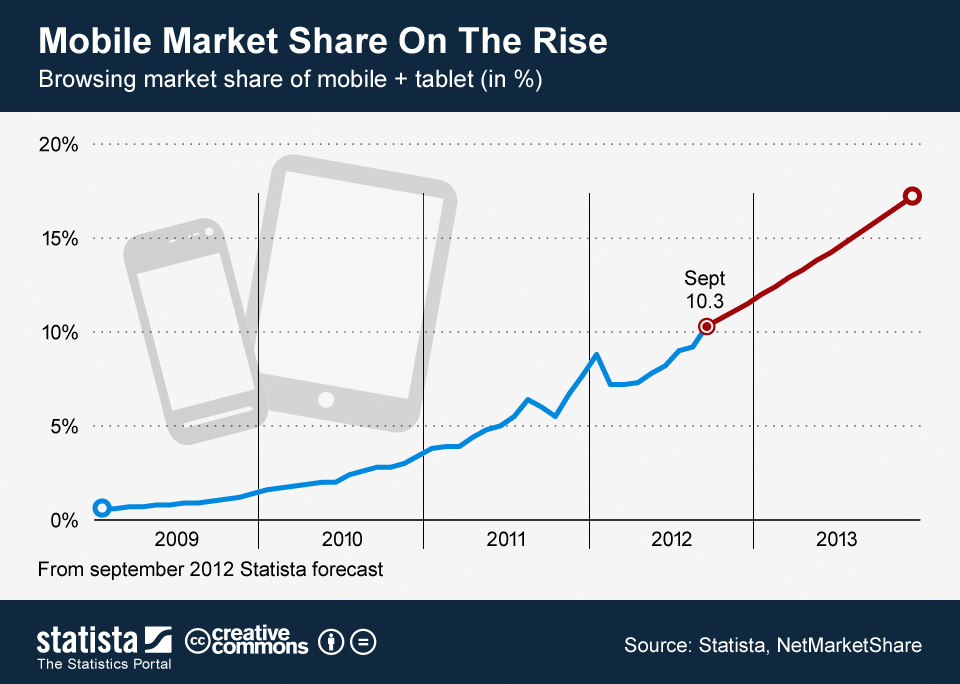
URL: http://www.statista.com/topics/779/mobile-internet/chart/598/mobile-market-share-on-the-rise/
Related articles
- Google launches a new initiative to help businesses reach out to mobile Internet users (buzzom.com)
- Mobile Internet Industry Discussed and Analysed in New Topical Report Now Available at MarketPublishers.com (prweb.com)
- Sina Exec: 'We're Frightened By Shift to Mobile Internet' (techinasia.com)
- Mobile marketing infographic (intomobile.com)
Wednesday, September 5, 2012
How not to miss a beat all day long.
You know technology is moving fast. So are customer expectations. Adoption of multiple devices is now the norm. I connect from my work laptop, iPad, iPhone, and home iMac on any given day. Most of what I connect to is pervasive from device to device. Just today I have used a "to do" manager on the web via a laptop, my iPhone and my iPad. Everything I need to do is always synched and up to date. I love it. But that is also my expectation now for how things work.
Consider this from Forrester Research:
We can all connect and interact from multiple devices all day long without missing a beat. What opportunities does this present for us to improve the customer experience?
Consider this from Forrester Research:
- Thirty-two percent of US online adults accessed the Internet from multiple physical locations using a PC only; for example, from home, work, and the sidelines of a son's soccer game.
- Forty-five percent of all US mobile subscribers owned a smartphone in 2011, slightly less than doubling from just two years before, when only 24% owned one. Forrester forecasts that more than half of US mobile subscribers will own smartphones by the end of 2012. And, in Western Europe, they expect smartphone penetration to jump from 34% in 2011 to 67% by 2016.
- Thirty-six percent of US adults with a mobile phone access the mobile Internet at least monthly or more often. In 2010, only 23% engaged in this behavior. Western European adults with a mobile phone accessing the mobile Internet at least monthly or more often grew from 9% to 18% from 2009 to 2011.
We can all connect and interact from multiple devices all day long without missing a beat. What opportunities does this present for us to improve the customer experience?
Related articles
- Intel partners with LG on mobile Internet devices (reviews.cnet.com)
- Keep Your Mobile Internet On When Visiting France (prweb.com)
- Cord Cutting: Has Your Home Gone Mobile? (mycricket.com)
Subscribe to:
Posts (Atom)