Earning relevance with your constituents requires much more than the adoption of the latest technology or being on the social media flavor of the month. All of that can be for naught if the experience wasn’t enjoyable, didn’t meet the constituent’s needs or was too complex. All of your innovation should about the user experience and simple design. All of your innovation should be about understanding what constituents need and then solving them in a simple, enjoyable way. Technology and channels must be chosen with the fact that it will enable the constituent journey and engage them in your mission. If you don’t know that it will, perhaps a small test is in order. Channels should be chosen with an end in mind for the constituent. What difference does it make if you are on Pinterest but none of your constituents find that helpful?
With all the technology opportunities you have in front of you, where do you start? This is where your goals and strategies come into play. The key is to match technology investments with goals to improve the overall unified experience your constituents want and need. The tough work is to prioritize opportunities with investments that have a constituent experience return. That will help develop a culture for recognizing an emerging technology to adapt to the right platform before someone else uses it to disrupt you.
Technology can be very disruptive if someone else solves a constituent problem or obstacle before you do. If the technology they use makes it easier, more enjoyable for your constituent, loyalty will go out the window. They become relevant and you lose relevance. If it happens enough with enough constituents, your mission suffers tremendously. Is that happening now?
It is important to leverage investments in disruptive technology through the filter of your long-term strategy combined with a deep knowledge of your constituents needs.
If you are investing in every social and mobile platform, are you becoming a jack-of-all trades and a master of none?
Solving a real constituent problem, with the right emerging technology that is enjoyable and simple is in fact a game changer.
Showing posts with label Nonprofit. Show all posts
Showing posts with label Nonprofit. Show all posts
Wednesday, June 5, 2013


Tuesday, June 4, 2013
Is constituent experience an art or science?
Is constituent experience an art or science? It is part art and part science and a whole lot of social science. It is more social science than technology. In understanding how constituents connect with you mission, it helps to understand a little about psychology, sociology, and anthropology. It is all about experience. Understanding “why” an experience wasn’t enjoyable is important. Falling into the trap that it is all about “likes” on social media can be misleading. It doesn’t matter how many like you if the other experiences aren’t enjoyable, simple and meet what the constituent needs.
The digital experience is about people. It is about how they feel about all their interactions with us. They may have just attended an amazing event and had a lot of fun. They enjoyed it. When they went to your website afterward to find out how the event did, they could find what they wanted. Then, no one bothered to thank them. Then a few days after the event, they got an email asking them to give clearly indicating you don’t know them. What is their overall experience with you? Both digital and real world experiences add up to answer that question. Focusing on what people said to you on the way out the door of the event can give a false impression.
A totally branded constituent experience will come down to the role you play in listening, engaging, and meeting the needs (translate deliver value) before, during and after a transaction. That is precisely why the habit of direct mail applied to the connected constituent is so dangerous.
Being thoughtful and intentional about unifying the constituent experience ensures we are listening and connecting. The kind of content we create or curate needs to be engaging and consistent with our brand promise. Do we understand the psychology of why a constituent experience was inconsistent with a constituent expectation and hence unenjoyable?
Monday, June 3, 2013
Are you ready for the journey? Your passion for your mission and your constituents can turn you into a hero
You have a passion for your mission. You want to do the right thing for your constituents. You believe in a better constituent experience. You are on a journey. This is a world that brings about radical change for your nonprofit. Your journey will require that you master “change management”. “Change management” is your primary role as a visionary who truly believes your nonprofit can end up in a better place with more reach for your mission and with an improved bottom line to fund it.
You are a champion of transformation and innovation in your nonprofit. You will face a lot of challenges. It will require hard work, perseverance and support from many. You will discover many allies and a few enemies.
Part of your work is about discovery. Much of it is about communication and formulation of strategy. A focus on going from strategy to a few actionable next steps is critical. This is definitely hard work. If you are up to it, that is precisely why it is interesting. Not everyone can lead the way.
All the hard work will lead to the reward. Unparalleled growth is the promise of an enriched customer experience. (Yes, there is data to support this.)
Too often, the constituent’s experience of your brand is an afterthought. Your main focus is to become intentional about everything you can. To bring the issues front and center, you and others need to champion internal transformation. It doesn’t matter that you are unclear where to begin right now. Getting started will help you figure it out. You are going to need lots of helpers. And you probably need at least one mentor.
Acknowledging that the world is changing may be a wonderful place to start. We know consumer behavior is changing rapidly. It is impacting how constituents view your nonprofit. Documenting how it is impacting your nonprofit is another key focus area. It is already impacting your bottom line.
Another focus of the journey may be to break a few deadly habits. We all have habits. One nonprofit habit is seeing donors from the view of a single donation transaction. This is called direct response. This habit can cause you to miss the donor (they are a millionaire) who has recently made a series of small donation transactions. What experience did they just have with you? As a result that experience, are they on a journey with you to engagement with your mission? Moving from a transaction mindset to a relational and engagement mindset can remarkably impact the experience the donor has. This has huge rippling effects into loyalty and total giving.
And so … it is a journey. Constituent behavior is changing and changing fast. As a hero leading the journey internally, it is your role to help leaders see the impact to your bottom line and help everyone keep up.
Sunday, June 2, 2013
Do you know you are a global nonprofit?
You are a global nonprofit. Do you act like it?
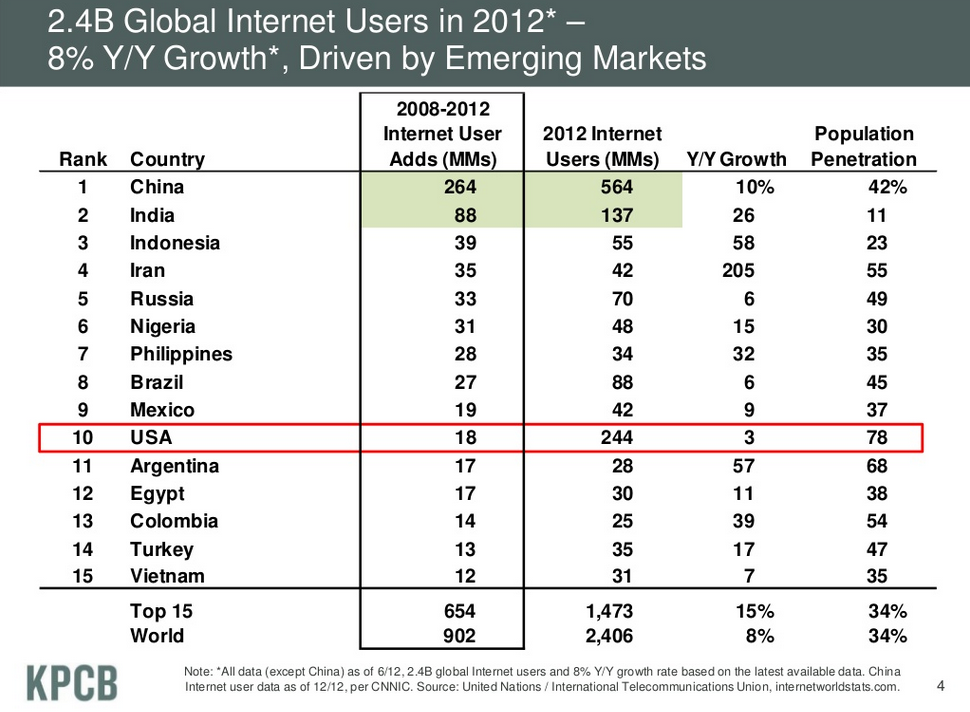
Your audience is 2.4 billion potential constituents. You have international reach. Are you designing experiences with that audience in mind? The top 15 countries saw year to year growth of about 15% new users in 2012. Much of that is in emerging markets. The U.S has the highest penetration with 78% of the population connected. China added 264 million new users last year with only 42% penetration.
Key takeaway: You are a global nonprofit. Keep that in mind as you design the constituent experience.
Why should I invest in improving the Constituent experience at my nonprofit?
It is reasonable to ask, if my nonprofit invests in the constituent experience, will it work? If you are in the C-Suite, that is the question.
I only know of one nonprofit that uses something like the Forrester Customer Experience Index to measure things so I don’t have any benchmark data. I would love to learn there are more nonprofits using this measure and I would give anything to analyze the data. Here is what we know from the for profit world.
This question drove Watermark Consulting to evaluate the macro impact of customer experience excellence. They’ve accomplished this over the years by studying the total returns for two model stock portfolios comprised of the Top 10 (“Leaders”) and Bottom 10 (“Laggards”) publicly traded companies in Forrester Research’s annual Customer Experience Index ranking. The results are stunning.
For the 6-year period from 2007 to 2012, the Customer Experience Leaders in their study outperformed the broader market, generating a total return that was three times higher on average than the S&P 500 Index. Furthermore, while the Customer Experience Leaders handily beat the S&P 500, the Laggards trailed it by a wide margin.
Keep in mind, this analysis reflects more than half a decade of performance results. It spans an entire economic cycle, from the pre-recession market peak in 2007 to the post-recession recovery that continues today. The Customer Experience Leaders in this study are clearly enjoying the many benefits that happy, loyal customers deliver: better retention, greater wallet share, lower acquisition costs and more cost-efficient service.
And the Laggards? They are being crushed under the weight of high customer turnover, escalating acquisition costs and an uncompetitive cost structure that is inflated by each customer complaint and avoidable inquiry.
Do you want to be a leader or a laggard?
I only know of one nonprofit that uses something like the Forrester Customer Experience Index to measure things so I don’t have any benchmark data. I would love to learn there are more nonprofits using this measure and I would give anything to analyze the data. Here is what we know from the for profit world.
This question drove Watermark Consulting to evaluate the macro impact of customer experience excellence. They’ve accomplished this over the years by studying the total returns for two model stock portfolios comprised of the Top 10 (“Leaders”) and Bottom 10 (“Laggards”) publicly traded companies in Forrester Research’s annual Customer Experience Index ranking. The results are stunning.
For the 6-year period from 2007 to 2012, the Customer Experience Leaders in their study outperformed the broader market, generating a total return that was three times higher on average than the S&P 500 Index. Furthermore, while the Customer Experience Leaders handily beat the S&P 500, the Laggards trailed it by a wide margin.
Keep in mind, this analysis reflects more than half a decade of performance results. It spans an entire economic cycle, from the pre-recession market peak in 2007 to the post-recession recovery that continues today. The Customer Experience Leaders in this study are clearly enjoying the many benefits that happy, loyal customers deliver: better retention, greater wallet share, lower acquisition costs and more cost-efficient service.
And the Laggards? They are being crushed under the weight of high customer turnover, escalating acquisition costs and an uncompetitive cost structure that is inflated by each customer complaint and avoidable inquiry.

Do you want to be a leader or a laggard?
Constituent Experience 101: There is a reality called silos. How should we deal with it in the best interest of our constituents?
We all see it all the time. It is time to put together the annual budget. Or, it is time to update our plans. Each department puts its own plan together and then defends it before the group. At a certain level that makes sense. The question any department leader needs to ask is will this approach serve our constituents best? Is it at odds with the overall constituent experience we are trying to build? To get an enterprise wide constituent investment plan, we may need to do a few things differently. If you have a Chief Constituent Officer, it is their role to make it happen.
The premise here is that constituents are being lost in the hand offs between departments. The constituent walks away thinking do they truly understand my needs? Are they there when I need them? Are they really my partner? If I am a donor and an advocate, how come it doesn’t feel like you know that and treat me differently?
The first thing the Chief Constituent Officer needs to do is make sure they are aligned with the CFO, CIO, CDO and CMO. Investing in a constituent experience plan will take the support of the CFO from the beginning. The CFO will probably welcome an approach that brings together resources for a common goal and eliminates duplicate spending.
If you are the Chief Constituent Officer, you also need to align with the CIO. In this day and age, as a digital nonprofit, nothing happens without the IT department. If you get a jump on aligning with the IT department and their PMO, you will save yourself a lot of time and rework. You will also gain an ally in gaining financial support when the senior team reviews your plans.
Who owns the constituent data in your nonprofit? In some nonprofits that isn’t clear but the CMO will probably be a big stakeholder, along with the Chief Development Officer. If is critical that they both have a seat at the table as you put your plans together. Do they own with your constituent targets, data and plans for improving the experience with you?
One unique role you play as the Chief Constituent Officer is the ability to aggregate intelligence to identify the most important investments. You are the only one who can breathe life into the annual constituent plan. It will take time to bring together the right people to agree on the most pressing constituent challenges and opportunities. Once identified, you can work with senior management to gain agreement to work on solving the issues. Here are a couple of things to look for:
Now you are ready to pull an investment budget together. The emphasis here is on investment. It is critical to be able to identify the return these investments will bring to your mission. Now that you have a more integrated view of constituent priorities, you can make your case better. Since you are taking an enterprise wide view, all of the items for investment may actually live in other department budgets. This will drive greater levels of collaboration with your colleagues. As Chief Constituent Officer, you will be providing a great service that is really lacking to your nonprofit. The budgeting process is always where the rubber hits the road. It will help you gain traction and will help you identify roadblocks. It will also help everyone set a few critical priorities since it is highly likely there is a whole lot of extra money sitting around the table.
This type of action on your part as Chief Constituent Officer will help solidify your role as constituent zealot. It will also help everyone see the importance of the overall constituent experience.
What if your nonprofit doesn’t have a Chief Constituent Officer? This is the opportunity for some department (and its leader) to seize the day. It could be the CMO or the CDO. No matter what, someone needs to seize the role.
The premise here is that constituents are being lost in the hand offs between departments. The constituent walks away thinking do they truly understand my needs? Are they there when I need them? Are they really my partner? If I am a donor and an advocate, how come it doesn’t feel like you know that and treat me differently?
The first thing the Chief Constituent Officer needs to do is make sure they are aligned with the CFO, CIO, CDO and CMO. Investing in a constituent experience plan will take the support of the CFO from the beginning. The CFO will probably welcome an approach that brings together resources for a common goal and eliminates duplicate spending.
If you are the Chief Constituent Officer, you also need to align with the CIO. In this day and age, as a digital nonprofit, nothing happens without the IT department. If you get a jump on aligning with the IT department and their PMO, you will save yourself a lot of time and rework. You will also gain an ally in gaining financial support when the senior team reviews your plans.
Who owns the constituent data in your nonprofit? In some nonprofits that isn’t clear but the CMO will probably be a big stakeholder, along with the Chief Development Officer. If is critical that they both have a seat at the table as you put your plans together. Do they own with your constituent targets, data and plans for improving the experience with you?
One unique role you play as the Chief Constituent Officer is the ability to aggregate intelligence to identify the most important investments. You are the only one who can breathe life into the annual constituent plan. It will take time to bring together the right people to agree on the most pressing constituent challenges and opportunities. Once identified, you can work with senior management to gain agreement to work on solving the issues. Here are a couple of things to look for:
- Building relationships with priority constituents. Some of these will be obvious like high level donors but others may not.
- Fixing issues that impede the overall constituent experience. As the Chief Constituent Officer, you are probably the only one that knows what these are.
- Points of differentiation and the big bets your nonprofit should make.
Now you are ready to pull an investment budget together. The emphasis here is on investment. It is critical to be able to identify the return these investments will bring to your mission. Now that you have a more integrated view of constituent priorities, you can make your case better. Since you are taking an enterprise wide view, all of the items for investment may actually live in other department budgets. This will drive greater levels of collaboration with your colleagues. As Chief Constituent Officer, you will be providing a great service that is really lacking to your nonprofit. The budgeting process is always where the rubber hits the road. It will help you gain traction and will help you identify roadblocks. It will also help everyone set a few critical priorities since it is highly likely there is a whole lot of extra money sitting around the table.
This type of action on your part as Chief Constituent Officer will help solidify your role as constituent zealot. It will also help everyone see the importance of the overall constituent experience.
What if your nonprofit doesn’t have a Chief Constituent Officer? This is the opportunity for some department (and its leader) to seize the day. It could be the CMO or the CDO. No matter what, someone needs to seize the role.
Saturday, June 1, 2013
Do you touch a cord with your nonprofit constituents?
Connecting with your constituents and creating engagement in your mission requires considering a few issues.
Nonprofits that are loved by their constituents break down the barriers between corporate image and the needs of the constituent. One of the keys is the perception that the nonprofit met my needs. This is very personal. It requires an investment in simplifying the experience for the constituent.
It isn’t always easy to be real and transparent with your constituents. It may take some courage and guts. It is one thing to send an automated receipt to donor within 5 seconds after a transaction. It is another thing, the next day, to send a personal email (with a real email address) from the CEO and include a real phone number to call if they want to chat. It would be stunning to answer the phone if they call.
- Do you touch a cord with your constituents?
- Do you encourage personality and creativity with your employees?
- Is your communication personal, without the veneer of the corporate lingo?
- Do you make decisions with the focus of improving the constituent experience?
Nonprofits that are loved by their constituents break down the barriers between corporate image and the needs of the constituent. One of the keys is the perception that the nonprofit met my needs. This is very personal. It requires an investment in simplifying the experience for the constituent.
It isn’t always easy to be real and transparent with your constituents. It may take some courage and guts. It is one thing to send an automated receipt to donor within 5 seconds after a transaction. It is another thing, the next day, to send a personal email (with a real email address) from the CEO and include a real phone number to call if they want to chat. It would be stunning to answer the phone if they call.
Friday, May 31, 2013
Do you have an innovators heart for your nonprofit mission?
There is a gap that is growing in your nonprofit. It is the gap between the connected constituent, their expectations and the programs, products and services you are offering. 80% of the U. S. adult population uses the internet. Most of them have smart phones or will soon. Most of your constituents are constantly connected from the time they wake up to the time they go to sleep. As nonprofits, our reality is a digital world. And so do you have a sense of urgency to bridge the gap?
What does it take to compete for the hearts of your connected constituents? Do you have a plan? Is that plan funded?
One thing to think through very carefully is the urgency to create a culture of innovation to be able to compete for the connected constituent. Someone is going to do it. Will it be your nonprofit?
You will be a hero if you take up that mantle. You will lead a journey to a new level of engagement for the connected constituent and their engagement with your mission. Do you have a heart for innovation? If so, then you will be a hero. You will be the champion for the new world. You will create amazing experiences to generate new loyalty to your cause.
So here is a challenge. Primarily for the C-Suite. Think through it carefully. One of the greatest opportunities before you is the evolution of the connected constituent. How your nonprofit is designed and structured today will work against you if nonprofit digital transformation is not on your agenda. As a leader, you know that management structure, goals, strategies, people, processes, systems, and rewards are all constructed to improve “what is” today. Typically we ignore “how it should be” for the new connected constituent. To innovate requires an innovators heart. Do you have one? Who else at your nonprofit does?
Thursday, May 30, 2013
Your journey to change and transformation
You are on a hero’s journey. I am writing for you and your passionate desire to learn how to harness disruption, innovate in completely new ways and most importantly, transform your nonprofit into a constituent focused machine. You are being introduced to new connected constituents. You are seeing how they progress through a dynamic journey. You are discovering how they respond and behave at each moment of truth about your mission. Generation C’ers are different than their traditional counterparts. You can’t reach them through direct mail. Their phone numbers (remember land lines) aren’t published. They may or may not subscribe to your eNewsletter. You can only reach them if they choose to be reached. They are in control of who they do (or don’t) connect with.
We are learning that our constituents are far more informed than we ever imagined. They are very, very sophisticated in their decision making. They are extremely savvy in their digital prowess. They have a capacity to multitask across multiple platforms and devices during the day and pick up right where they left off at night. We have to adapt to this new world.
We all want to improve the experience for our constituents. We know that experience right now it can be very disjointed. We yearn for our leadership to be innovative and visionary. We want it to be meaningful and not fanciful.
We have this sense that innovation starts with something perhaps simpler than transformation. We must go back to the basics of our mission and vision and align them with desirable outcomes and significant experiences. We may need to invest in programs and services that our constituents may not even know they need yet.
Here is a summary of some of the things we know:
Simply saying we need to change probably isn’t the most helpful statement. We know that. Change takes, at a minimum, at least two things. First, you really have to want to. Desire and aspiration are essential. Second, it takes determination, stamina, fortitude and sheer will. It all however starts with a vision.
Most nonprofits are exploring new media, different technology, and alternative channels for better constituent engagement. To start with vision may sound trivial. Without vision, I would advocate, there probably won’t be any significant transformation. Transformation follows vision. Your next step may be to be the one to press pause. We can easily fall into the trap of chaotically rushing to the next big thing with understanding “Why are we doing this?” Be the leader to stop and ask why?
We are learning that our constituents are far more informed than we ever imagined. They are very, very sophisticated in their decision making. They are extremely savvy in their digital prowess. They have a capacity to multitask across multiple platforms and devices during the day and pick up right where they left off at night. We have to adapt to this new world.
We all want to improve the experience for our constituents. We know that experience right now it can be very disjointed. We yearn for our leadership to be innovative and visionary. We want it to be meaningful and not fanciful.
We have this sense that innovation starts with something perhaps simpler than transformation. We must go back to the basics of our mission and vision and align them with desirable outcomes and significant experiences. We may need to invest in programs and services that our constituents may not even know they need yet.
Here is a summary of some of the things we know:
- The new reality is the connected constituent that is opening up new touch points for our mission.
- How connected constituents are influenced and influence isn’t anything like our traditional constituents are.
- They expect something different. They are aligning with our missions for different reasons than we think. Think quality of experience. Think about how we treat our employees and constituents. Consider how sustainable the footprint you are leaving is visible. Obsess over engagement. This is what is important to our new constituents.
- The channels they use may never cross other channels. They can be fully contained from beginning to end on one device in one network. My children will sit in front of a very nice iMac searching for content on their smartphone.
- On the other hand, sometimes constituents will hop channels. They may look something up on the web and call you. What they expect is a seamless experience. It must be integrated. We have to bring these constituents with common goals together and intentionally design a seamless experience.
- Connected constituents value highly being valued. How can we find a new way express value and measure it?
- What does it take to connect with connected constituents?
- An understanding of how they behave and what they prefer.
- Some ability to read between the lines and innovate programs and services.
- Define the constituent experience and what it will look like across every channel and journey.
- A blueprint on how to change the philosophy, culture and technology to lead (champion) a new era of constituent experiences and engagement.
Simply saying we need to change probably isn’t the most helpful statement. We know that. Change takes, at a minimum, at least two things. First, you really have to want to. Desire and aspiration are essential. Second, it takes determination, stamina, fortitude and sheer will. It all however starts with a vision.
Most nonprofits are exploring new media, different technology, and alternative channels for better constituent engagement. To start with vision may sound trivial. Without vision, I would advocate, there probably won’t be any significant transformation. Transformation follows vision. Your next step may be to be the one to press pause. We can easily fall into the trap of chaotically rushing to the next big thing with understanding “Why are we doing this?” Be the leader to stop and ask why?
Wednesday, May 29, 2013
In the age of communities, how important is our nonprofit brand?
What does your nonprofit stand for? What (and who) does it represent? Now, more than ever before, our brand is vitally important. More time needs to be spent making sure it is clear. Our constituents are connected when our brand is clear. The values we share, the personal believes that we hold in common, the life experiences that are combined with personal and professional objectives are creating a need for personal engagement with our mission.
Is it about apathy? Is it about empathy? It isn’t either/or. We have to align with constituents in order for them to be passionate about us. We have to go beyond being constituent-centric. Notice I didn’t say our constituents need to align with us. This isn’t about us. It is about what our constituents love and can connect to in terms of our mission.
The best way to think about it is to think of community. That can mean a group of people living in the same place or it can mean having some characteristics in common. As nonprofits, we need to understand communities. We need to know why our constituents align with our community or they don’t. In most nonprofits, there isn’t a single view of the constituent because we are in siloes. And so we slice up the constituent by department and by desired result. Are they a donor? Have they given recently? Did they renew this year?
Or … are they an advocate? Did they respond to our last alert?
The list goes on. We wish it wasn’t true but while nonprofits truly value collaboration we typically aren’t measured by collaboration results. One way to think about it is if you are in the Advocacy department, do you have performance standards for the number of advocates who are also donors?
The traditional opportunity funnel is no longer working with the connected constituent. What is happening with the connected constituent is very dynamic and can feel like it is spinning out of control to you as a leader. We will need to adapt our mission, vision and models to react faster. Speed is paramount to the digital nonprofit.
There really can’t be a “top-down” movement to create a singular experience for the constituent. When you dissect the nature of a transactional relationship, there is never to be found a unified experience. Movements don’t create unity.
In deciding to be intentional and design a better experience, we need to dig deeper and understand more about community. A simple example is Twitter. What are #hashtags if not a simple way to create a community around a topic? And it works.
Now community is much more than that. It is about doing something that matters and being a part of it. Why has the revenue of Habitat for Humanity exploded at a time when other nonprofits are in decline? Formed in 1976, the last revenue totals I saw placed them at $1.491 billion in total revenue. My niece can tell you about her experience. She gives her time and money to make a difference. And she does. That is what she wants to do. Habitat for Humanity simple aligns itself with that passionate desire she has.
So let’s think intentionally and design it from start to finish. To build a community starts with the passion of the constituent and then our nonprofit vision aligns with that passion. That is unified with our mission. It comes to life with our brand commitment. We must then define the experience we want people to have with our brand (the embodiment of their passion and our vision / mission). We then must align that experience with everything we do. From development to marketing to advocacy to events, it must fill everything we design. It must be on the whiteboards in our conference rooms. It must be aspirational. It has to be something worthy of the communities we are building. Our constituents have to feel at their core that they personally and the entire world can’t live without our nonprofit.
The “old world” of branding has moved on. It isn’t about the jingle or tagline anymore. Today we have to build an identity, a persona, the essence of a feeling, a promise and most important, deliver on all those things. This is the new world of branding. And, thanks to technology and the deeper connections it can facilitate, it can happen.
How we as nonprofits connect with our constituents is directly impacted by technology. If you don’t believe it just look at the controversies that Susan G. Komen, LiveStrong or the Boy Scouts have/are dealing with. These great nonprofits have seen issues escalated as a result of blogging, social media, texting, etc. Look at how fast Blockbuster declined. It really wasn’t about finance. It was all about deep changes in how we all watch video.
Increasingly, in all these cases, the role of technology means that a nonprofit’s brand is very important. It is probably more important than it has ever been before. Brand is all about being intentional and design. Constituents want certainty. They rely heavily on the symbolism our nonprofit brand offers. Do you think nonprofit controversies are linked to a brand promise? Did technology accelerate the firestorm?
Nonprofit brands that fail to instill core confidence in their donors run the risk of failing and failing fast. Nonprofit brands that survive (even during economic downturns) will be the ones that are best able to evolve because they recognize the need to do so before their competitors do.
Is it about apathy? Is it about empathy? It isn’t either/or. We have to align with constituents in order for them to be passionate about us. We have to go beyond being constituent-centric. Notice I didn’t say our constituents need to align with us. This isn’t about us. It is about what our constituents love and can connect to in terms of our mission.
The best way to think about it is to think of community. That can mean a group of people living in the same place or it can mean having some characteristics in common. As nonprofits, we need to understand communities. We need to know why our constituents align with our community or they don’t. In most nonprofits, there isn’t a single view of the constituent because we are in siloes. And so we slice up the constituent by department and by desired result. Are they a donor? Have they given recently? Did they renew this year?
Or … are they an advocate? Did they respond to our last alert?
The list goes on. We wish it wasn’t true but while nonprofits truly value collaboration we typically aren’t measured by collaboration results. One way to think about it is if you are in the Advocacy department, do you have performance standards for the number of advocates who are also donors?
The traditional opportunity funnel is no longer working with the connected constituent. What is happening with the connected constituent is very dynamic and can feel like it is spinning out of control to you as a leader. We will need to adapt our mission, vision and models to react faster. Speed is paramount to the digital nonprofit.
There really can’t be a “top-down” movement to create a singular experience for the constituent. When you dissect the nature of a transactional relationship, there is never to be found a unified experience. Movements don’t create unity.
We have to change our minds.
In deciding to be intentional and design a better experience, we need to dig deeper and understand more about community. A simple example is Twitter. What are #hashtags if not a simple way to create a community around a topic? And it works.
Now community is much more than that. It is about doing something that matters and being a part of it. Why has the revenue of Habitat for Humanity exploded at a time when other nonprofits are in decline? Formed in 1976, the last revenue totals I saw placed them at $1.491 billion in total revenue. My niece can tell you about her experience. She gives her time and money to make a difference. And she does. That is what she wants to do. Habitat for Humanity simple aligns itself with that passionate desire she has.
So let’s think intentionally and design it from start to finish. To build a community starts with the passion of the constituent and then our nonprofit vision aligns with that passion. That is unified with our mission. It comes to life with our brand commitment. We must then define the experience we want people to have with our brand (the embodiment of their passion and our vision / mission). We then must align that experience with everything we do. From development to marketing to advocacy to events, it must fill everything we design. It must be on the whiteboards in our conference rooms. It must be aspirational. It has to be something worthy of the communities we are building. Our constituents have to feel at their core that they personally and the entire world can’t live without our nonprofit.
The “old world” of branding has moved on. It isn’t about the jingle or tagline anymore. Today we have to build an identity, a persona, the essence of a feeling, a promise and most important, deliver on all those things. This is the new world of branding. And, thanks to technology and the deeper connections it can facilitate, it can happen.
How we as nonprofits connect with our constituents is directly impacted by technology. If you don’t believe it just look at the controversies that Susan G. Komen, LiveStrong or the Boy Scouts have/are dealing with. These great nonprofits have seen issues escalated as a result of blogging, social media, texting, etc. Look at how fast Blockbuster declined. It really wasn’t about finance. It was all about deep changes in how we all watch video.
Increasingly, in all these cases, the role of technology means that a nonprofit’s brand is very important. It is probably more important than it has ever been before. Brand is all about being intentional and design. Constituents want certainty. They rely heavily on the symbolism our nonprofit brand offers. Do you think nonprofit controversies are linked to a brand promise? Did technology accelerate the firestorm?
Nonprofit brands that fail to instill core confidence in their donors run the risk of failing and failing fast. Nonprofit brands that survive (even during economic downturns) will be the ones that are best able to evolve because they recognize the need to do so before their competitors do.
Tuesday, May 28, 2013
Should you take a second look at your nonprofit 990 form?
In the digital age, don't forget that all your important information that the IRS has about you is VERY public. With that in mind, you make want to take a second look at your 990 form from a different perspective.
Here are the five reasons but number one may be the most important.
With charity-evaluating websites forming and growing with every day, it’s no wonder so many donors and stakeholders are reviewing the publicly disclosed Form 990. One website has over 6.2 million views in 2012 alone. That being said, the 990 has many opportunities for you to tout the accomplishments of your organization. It all starts with page one and each page has an opportunity for you. Review your return carefully for these chances to make your organization shine.
via 5 Reasons You Should Take a Second Look at Your Form 990…Today | GuideStar Blog.
Here are the five reasons but number one may be the most important.
- Marketing Opportunities
- Governance Check
- IRS Red Flags
- Appropriate Allocations
- Does the return make sense? If not, explain it.
Sunday, May 26, 2013
Is the reason for change about technology or more engagement in your mission?
We all know it. We all hear it. Leadership loves to talk about change. Employees love to ignore it. Talk is very cheap. If we are honest however, we all know it is true. Change is inevitable. The real question is what we will do about it. Will we lead it or will we be a victim?
The biggest challenge is knowing the right time to change. Often, by the time we realize we need to change, the moment has passed us by. The worst possible scenario is that others' realize it before us and beat us to the punch. Rather than being strategic, we are impulsive and reactionary. Our perceived nonprofit competitor builds a website that does X and we have to do it to. Why? Maybe they have just wasted a ton of money. Mimicking others is not a strategy.
Are you inspired by technology or overwhelmed? Are you keeping up with technology or are you getting left behind? Have you see what a three-year-old can do with an iPhone? Does that intimidate you? This is all very disruptive. You know it and your constituents know it. The difference is that our constituents are embracing it.
As a nonprofit, is someone else about to displace you in the marketplace? Are you staying up with the pace of change with technology or are you about to get left behind? Do you have strategies, systems, processes, and protocols in place that will recognize that this is disruption? We need to assess opportunity, and we will need to facilitate the testing of Ideas? Is this your job? How much time and resources that you control are you devoting to it quarterly?
These are very serious questions. They need to be answered now. From the point of view of your mission, is this a case of only the strongest surviving? What will happen if the pace of change is so fast that your constituents adapt and change before you can? This is the reality we all need to face. We all know the role that technology plays in our personal lives. Do our digital properties at work match up to our personal experiences?
This might be a time for humility. Is the economy really our problem? If your nonprofit did well before the downturn of 2009 during bad economic times, why didn't they do well during the downturn turn of 2009?
All nonprofits are facing disruption. Have you been displaced in the marketplace and simply don't know it yet? There are nonprofits who are thriving and growing.
In the for-profit world, this is clear. Over 40% of the companies that were at the top of the Fortune 500, in 2000 were no longer there in 2010. Who are some of the top nonprofits today that weren’t on the list 10 or 20 years ago? I talked with a nonprofit leader recently that illustrates this perfectly I think. They probably aren’t on anybody’s list of top nonprofits. They are a $5 billion dollar international nonprofit. They are a single corporation with no separately incorporate chapters. They have a laser focus on the digital world. Their marketing is absolutely unified. Why doesn’t anyone know about them as a leader in the nonprofit space?
So as a nonprofit, you have established a presence on Facebook and Twitter. And so? Is the constituent experience and relationship any better than it was before? Perhaps so or perhaps not. Do you know?
This may be about survival. It could take more than a presence in new channels to improve the overall experience and relationship with those who can support us the best. It may take more courage than you think. It will certainly take more persistence to break through the resistance. In the end, it could be about how you work with your leaders and we're back to you about how you personally lead.
Are you leading a movement towards empowered and constituent – centric culture? Are you setting in motion real business transformation?
You have a special path you can follow. You can set in motion the change that opens the door to an improved experience both inside and outside your nonprofit. You can lead the change you need your nonprofit to experience!
Saturday, May 25, 2013
So is it possible that it is time for us as nonprofit leaders to refuse to play nice?
The reality for most nonprofit executives is that we have fewer resources and more competition for those shrinking resources than ever before. But it’s not going to change anytime soon. So it is up to nonprofit leaders to embrace and adapt to that new reality. Instead of beating our heads against the wall of change, let’s adapt to meet it.
In fact, it is time for a new kind of nonprofit leader, one who has the confidence, ability, foresight, energy, and strength of will to really lead the nonprofit sector forward. That requires skill at having the tough conversations. For example, what are you going to do about the Board leader who will only give their time, rarely gives their talent and refuses to give their treasure (money)?
So is it possible that it is time for us as nonprofit leaders to refuse to play nice? The culture of nonprofits is one of collaboration and diversity. We bend over backwards to make sure everyone has a voice. And that is a very good thing. The new leader, however, may need to overcome the nonprofit norm of politeness at all costs and gets real with funders, board members, or staff who are standing in the way of the mission and impact of the organization.
It is called tough love. It isn't always easy but it works.
Wednesday, May 22, 2013
The Wilson Nonprofit Report for Wednesday, May 22, 2013
New Book: I am working on a soon to be published book. The working title is “The Digital Nonprofit: A Manifesto”. Here are some excerpts from the introduction (with links to the full draft). I would love any input, thoughts or suggestions you might have.
Again, any feedback on “The Digital Nonprofit: A Manifesto” would be greatly appreciated.
Are our nonprofit constituent experiences intentional? What does the future of your nonprofit look like? Is it focused on your mission AND design?
The premise of this manifesto is all about being intentional about the experiences our constituents are having.
How many programs, products and services do you have? How many channels (Web, Social, Mobile, Call Center, Direct Mail, etc.) are you focused on? Do they all have a unified design and experience?
Mission + Design = Intentional experiences.
We are clear about our mission. Are we clear about our design? More …
Our nonprofit constituents are empowered and we can’t control that: Consumers are absolutely empowered through technology now. That means our constituents are as well. It has happened and it is a fact. We can’t control that. Sorry to point that out but that is our starting reality.
Our constituents are empowered. They know it. Do we?
They know they have influence. Do we?
Our constituents know they have voice that is powerful. They know they have more power than ever before. Do we know that and act that way? More …
Are we creating heartfelt experiences at our nonprofit or not? Is that experience stunning? There comes a time where we have to make a decision. What will we invest in? It is a serious question and not a budget exercise. If we are going to be intentional and proactive, we need to make an investment. At first that may be just time. Eventually it will be about people, our processes, our strategies and our technology. If we don’t become intentional in our approach to our digital constituent experiences we will continue to be haphazard in our approach; reacting, responding, solving toxic experiences in real time. This intention however must be about heartfelt experiences. It must create a passion for our mission. More …
Relevance is defined by how relevant the experience is: The constituent journey is evolving (albeit very, very fast). That shouldn’t surprise you but it is good news. You haven’t been left behind completely. Your constituents are changing though. Their experience of you and your mission may not be what any of us would want. In this case, relevance is defined by how relevant the experience is. Passion for the mission is contingent on amazing experiences.
How you personally decide to react or lead is up to you. It, of course, is not about technology. What is the journey of getting closer to constituents and staying relevant really about? Here are some ideas:
- Creating a culture built around the constituent and their experience being the focus of all you do.
- Empowering employees to do what it takes to create amazing experiences.
- Opening up the floodgates of innovation.
Saying we want to get closer to constituent won’t get senior management on board. While a constituent revolution is at the C-Suite doors, someone (meaning you) needs to convince the top that change is imperative. Without that we will fail. More …
Again, any feedback on “The Digital Nonprofit: A Manifesto” would be greatly appreciated.
Sunday, May 19, 2013
How can you make your nonprofit press releases social and shareable?
Social media has forever changed how nonprofits and journalists distribute and consume news stories, yet the format of nonprofit press releases has not evolved at all. Almost every communication medium out there has been impacted by the rise of social and mobile media, but not press releases.
Enterprising nonprofits should be eager to try something new to help your nonprofit stand out from the hundreds of traditional press releases that journalists and media outlets are bombarded with on a weekly or even daily basis. There is no proof these tips will help your nonprofit get more media coverage, but at the very least they will help your nonprofit’s press release get more exposure on the Social Web.
More via 11 Tips for Making Nonprofit Press Releases Social and Shareable | Nonprofit Tech 2.0 Blog :: A Social Media Guide for Nonprofits.
Friday, May 17, 2013
Relevance is defined by how relevant the experience is
The constituent journey is evolving (albeit very, very fast). That shouldn’t surprise you but it is good news. You haven’t been left behind completely. Your constituents are changing though. Their experience of you and your mission may not be what any of us would want. In this case, relevance is defined by how relevant the experience is. Passion for the mission is contingent on amazing experiences.
How you personally decide to react or lead is up to you. It, of course, is not about technology. What is the journey of getting closer to constituents and staying relevant really about? Here are some ideas:
Saying we want to get closer to constituent won’t get senior management on board. While a constituent revolution is at the C-Suite doors, someone (meaning you) needs to convince the top that change is imperative. Without that we will fail.
You know that most executives don’t use social networks personally. While they have smartphones the primarily utilization is for email and looking at the calendar to know where to go to next. The reality is that most won’t read this. Trying to make a case that this is about technology will be a losing battle.
What is the future of nonprofits built on? It isn’t about how Facebook, Twitter, iPhones, tablets or real time-time geolocation check-ins evolve. The future of nonprofits does depend on relevance and the ability to at least understand technology to be able to make decisions about new opportunities. It does require the ability to strategically adapt to the new opportunities to create a competitive advantage.
So much of this is about change. There is a technology revolution occurring. Other nonprofits (and for-profits that you compete with) understand this. But it is also about a whole series of real-world revolutions that are seizing how our constituents live which impacts their experience with us. Expectations are moving fast. We can’t afford to get left behind. The kind of change we are talking about involves three things:
How you personally decide to react or lead is up to you. It, of course, is not about technology. What is the journey of getting closer to constituents and staying relevant really about? Here are some ideas:
- Creating a culture built around the constituent and their experience being the focus of all you do.
- Empowering employees to do what it takes to create amazing experiences.
- Opening up the floodgates of innovation.
Saying we want to get closer to constituent won’t get senior management on board. While a constituent revolution is at the C-Suite doors, someone (meaning you) needs to convince the top that change is imperative. Without that we will fail.
You know that most executives don’t use social networks personally. While they have smartphones the primarily utilization is for email and looking at the calendar to know where to go to next. The reality is that most won’t read this. Trying to make a case that this is about technology will be a losing battle.
What is the future of nonprofits built on? It isn’t about how Facebook, Twitter, iPhones, tablets or real time-time geolocation check-ins evolve. The future of nonprofits does depend on relevance and the ability to at least understand technology to be able to make decisions about new opportunities. It does require the ability to strategically adapt to the new opportunities to create a competitive advantage.
So much of this is about change. There is a technology revolution occurring. Other nonprofits (and for-profits that you compete with) understand this. But it is also about a whole series of real-world revolutions that are seizing how our constituents live which impacts their experience with us. Expectations are moving fast. We can’t afford to get left behind. The kind of change we are talking about involves three things:
- Listening
- Learning
- Adapting
Thursday, May 16, 2013
Are we creating heartfelt experiences at our nonprofit or not? Is that experience stunning?
There comes a time where we have to make a decision. What will we invest in? It is a serious question and not a budget exercise. If we are going to be intentional and proactive, we need to make an investment. At first that may be just time. Eventually it will be about people, our processes, our strategies and our technology. If we don’t become intentional in our approach to our digital constituent experiences we will continue to be haphazard in our approach; reacting, responding, solving toxic experiences in real time. This intention however must be about heartfelt experiences. It must create a passion for our mission.
There is of course, a very real cost to reacting. Scrutinize your budget and you will see that most of our fixed expenses are reactionary. What if we invested in proactive and intentional experiences of the heart up front? Could we radically reduce our reactionary and bloated fixed expenses? In fact, my guess is the reactionary expenses vastly exceed proactive expenses. I know nonprofits that are ramping up their expenses in reactionary engagement and relationships. The good news is that they are succeeding in shifting the negative to neutral or even the positive.
So what is the outcome of taking a negative and balancing it with a positive? Is it engagement or damage control? So what is the cost and value of neutralizing the negative? Shouldn’t we start with the amazing? What is the return on that investment in the stunning? What is probably most concerning is that most nonprofits are not measuring much of this. And why are we struggling to raise more money? Now think about that question. Why is our revenue flat? Why are donors not engaged and renewing their contributions?
Is the experience we are creating wonderfully sharable? If not, what is our investment over the next 3 months going to be in changing that? We must invest in not only a positive experience but an experience that screams out for our members, volunteers and donors to share it with everyone they know. That encourages others to join in. It also offsets any negative experiences anyone else has shared. Think about it. We all read the ratings and comments. If there are 100 over the top ones we can ignore the one that is virally negative writing it off to a weirdo.
What is the biggest deal? Trying to offset the negative experiences or proactively creating amazing ones? Creating amazing ones is everything. That is not an exaggeration. You know, from your own experiences that it is true. The cost of reacting is always eclipsed by the upside of the stunning.
Think of what you want. You are a consumer. You are the constituent who wants something from your nonprofit. Are you looking for the ordinary? No, you are looking for an experience, no, the experience.
Any nonprofit that recognizes you, remembers you, and gives you an amazing service experience will win your heart. And it is all about your heart. You will be loyal to them no matter what. That is what we know as relevance. A passion of our heart that transcends anything else.
And so, that heartfelt experience is not just a so-so something. It is everything. That kind of vision is the father of innovation. Who needs the mother of invention in that kind of world?
Friday, May 10, 2013
Why is your nonprofit struggling to bring money in the door?
The majority of nonprofits struggle to bring money in the door. And they often don't know why. When you are on the inside of an organization that is used to doing things a certain way it can be nearly impossible to see new opportunities, to understand what you could do differently. There can be many reasons why a nonprofit doesn't bring enough money in the door.
Here are several things to think about:
Too Many Programs Drain Money From Your Organization. It sounds like a truism -- you struggle with money because your programs cost money. But the reality is that few nonprofits analyze their programs to determine each one's individual impact on the bottom line. Often they will add a new program because it has an impact on the mission (or because a single funder wants the program), without understanding how the new program fits into the organization's overall financial picture. The end result is an organization that is stretched to the breaking point. Nonprofits must analyze all of their programs to understand their impact not just on mission, but also on finances, then they can make decisions about where to more sustainably focus resources.
You're Leaving Money Up to One Person. The financial engine of a nonprofit must be a team effort. Yes, it is important, if you are large enough, to have a staff member whose sole job is to think about money, but you cannot leave it all up to her. The entire organization, from the front line program staff all the way up to the chair of the board must understand the critical importance of money and what role they individually play in securing it. Although program staff won't actively solicit donors, they can still share client stories with donors, write blog or newsletter articles, participate in program tours with donors, and even suggest new ideas for tying money to their programs. And there are countless ways for board members to bring money in the door, but you have to make sure they are aware of and doing their part.
You're Not Effectively Telling Your Story. It is so common for nonprofit staff and board members, who believe so passionately in their cause, to think that it's obvious to outsiders why they should get involved. But it isn't. And in an increasingly crowded social change marketplace it is more important than ever that nonprofits be able to articulate, in a compelling way, what value they are providing a community.
You're Doing What Everyone Else Does. If you are struggling financially and witness another nonprofit's fundraising activity and try to replicate that perceived success, without analyzing if it makes sense, will it work for you? Just because it looks like a recent gala or a new thrift store rakes in the money doesn't mean a) that it did actually make a profit for the nonprofit and b) that it would make a similar profit for your nonprofit. The key is to make the best use of your specific assets as an organization. Think about what value you have to offer and who might be interested in paying for that value. For example, a homeless shelter could financially partner with local businesses to move people away from storefronts and into more stable and life-changing accommodations. You have to analyze what you have to offer and who specifically would be willing to pay for that value.
You're Not Investing In Your Money Raising Function. If you don't have enough or the right kind of staff in place to raise money it is little wonder that you struggle. And if you're not giving them effective tools they will be at a loss. Think about your financial engine and the various revenue streams you employ. Do you have the technology, staffing, systems, materials, space you need to raise money well in those ways? For example, if you want to raise money from individuals you need an effective database system that tracks contact information, interactions, history, interests. Whatever ways you bring money in the door, you need to ensure you have enough and the right kind of tools to do it well.
Thursday, May 9, 2013
Some basics of nonprofit grantwriting
Many nonprofits can't afford a full time grant writer. Odds are that at some point in your career it may fall to you to do it. There are some basics.
Seek support for a “fundable” project: Grants are usually awarded to projects, not to unrestricted annual support. Funders will want to measure the project’s success, not that of the organization. And, just because a foundation believes in your mission doesn’t mean they are going to say yes to your request. Identify projects based on your organization’s goals and objectives that align with the funding priorities of local grantmakers.
Identify suitable funding prospects: Having a board member that sits on XYZ Foundation doesn’t ensure funding success. And, if the “fit” isn’t right, it might put that board member in an awkward situation. Capitalize on connections you have, but take care to match your project to funders who support similar needs. Most states, often in partnership with the Foundation Center, publish comprehensive funder directories. Typically available online, these are excellent sources of grantmakers and their priorities. .
Focus locally first: This increases the likelihood that you will find a connection to champion your efforts. And, there is less competition for these dollars. Finally, a smaller local funder may have a simpler submission process than that of a national profile one.
Follow the directions: Make sure you submit the right information to the right person by the right deadline. Don’t give the funder a reason to eliminate you from the consideration process before they even read the proposal. Consider how you evaluate cover letters and resumes: Misspellings or missed deadlines make it easy to trim your list. Grantmakers will do the same.
Write, re-write and proofread: If you are not a good writer, find someone on your team who is. Proposals have to be well written. This goes beyond just correct spelling and good grammar. You need to clearly articulate your project in a sincere and compelling manner. This is the quintessential sales job—and you want the reader to buy what you are selling. All of the clichés hold true: tell a story, paint a picture. At the end of the day, you want the funder to invest in your organization. They aren’t going to do that if you haven’t touched them.
Submit required reports: Every funder has reporting guidelines. Do not overlook this step! Mark your calendar, gather needed information and do not ask for an extension on the due date. Most funders will be open to ongoing relationships with organizations they have funded. Don’t close this door because you missed a deadline.
Does your nonprofit have a LinkedIn strategy?
Is your nonprofit a part of the LinkedIn phenomena? If not, it is time to have a discrete strategy for it's use. It is evolving fast. Are you?
We are seeing the evolution of the LinkedIn platform in a move that is positioning it to become a central node of professional collaboration beyond an online identity. The company wants to draw additional web traffic, and by looking at the numbers it appears to have succeeded. According to the web traffic analyzer Alexa, LinkedIn now ranks as the 10th-most visited website in the U.S. and fourteenth internationally. Many of us in the recruiting industry have considered LinkedIn no more than a glorified resume database … granted, a very large resume database! But this influencer capability seems to be a game-changer to me that is drawing even more visitors to the site, and changing behaviors of how professionals interact. The effect has only sped up the rate at which unique profiles are being created to more than 200,000+ a day.
via LinkedIn May Become the Central Home for Collaboration - ERE.net.
Subscribe to:
Posts (Atom)