Earning relevance with your constituents requires much more than the adoption of the latest technology or being on the social media flavor of the month. All of that can be for naught if the experience wasn’t enjoyable, didn’t meet the constituent’s needs or was too complex. All of your innovation should about the user experience and simple design. All of your innovation should be about understanding what constituents need and then solving them in a simple, enjoyable way. Technology and channels must be chosen with the fact that it will enable the constituent journey and engage them in your mission. If you don’t know that it will, perhaps a small test is in order. Channels should be chosen with an end in mind for the constituent. What difference does it make if you are on Pinterest but none of your constituents find that helpful?
With all the technology opportunities you have in front of you, where do you start? This is where your goals and strategies come into play. The key is to match technology investments with goals to improve the overall unified experience your constituents want and need. The tough work is to prioritize opportunities with investments that have a constituent experience return. That will help develop a culture for recognizing an emerging technology to adapt to the right platform before someone else uses it to disrupt you.
Technology can be very disruptive if someone else solves a constituent problem or obstacle before you do. If the technology they use makes it easier, more enjoyable for your constituent, loyalty will go out the window. They become relevant and you lose relevance. If it happens enough with enough constituents, your mission suffers tremendously. Is that happening now?
It is important to leverage investments in disruptive technology through the filter of your long-term strategy combined with a deep knowledge of your constituents needs.
If you are investing in every social and mobile platform, are you becoming a jack-of-all trades and a master of none?
Solving a real constituent problem, with the right emerging technology that is enjoyable and simple is in fact a game changer.
Showing posts with label Customer Experience. Show all posts
Showing posts with label Customer Experience. Show all posts
Wednesday, June 5, 2013


Tuesday, June 4, 2013
Is constituent experience an art or science?
Is constituent experience an art or science? It is part art and part science and a whole lot of social science. It is more social science than technology. In understanding how constituents connect with you mission, it helps to understand a little about psychology, sociology, and anthropology. It is all about experience. Understanding “why” an experience wasn’t enjoyable is important. Falling into the trap that it is all about “likes” on social media can be misleading. It doesn’t matter how many like you if the other experiences aren’t enjoyable, simple and meet what the constituent needs.
The digital experience is about people. It is about how they feel about all their interactions with us. They may have just attended an amazing event and had a lot of fun. They enjoyed it. When they went to your website afterward to find out how the event did, they could find what they wanted. Then, no one bothered to thank them. Then a few days after the event, they got an email asking them to give clearly indicating you don’t know them. What is their overall experience with you? Both digital and real world experiences add up to answer that question. Focusing on what people said to you on the way out the door of the event can give a false impression.
A totally branded constituent experience will come down to the role you play in listening, engaging, and meeting the needs (translate deliver value) before, during and after a transaction. That is precisely why the habit of direct mail applied to the connected constituent is so dangerous.
Being thoughtful and intentional about unifying the constituent experience ensures we are listening and connecting. The kind of content we create or curate needs to be engaging and consistent with our brand promise. Do we understand the psychology of why a constituent experience was inconsistent with a constituent expectation and hence unenjoyable?
The digital experience is about people. It is about how they feel about all their interactions with us. They may have just attended an amazing event and had a lot of fun. They enjoyed it. When they went to your website afterward to find out how the event did, they could find what they wanted. Then, no one bothered to thank them. Then a few days after the event, they got an email asking them to give clearly indicating you don’t know them. What is their overall experience with you? Both digital and real world experiences add up to answer that question. Focusing on what people said to you on the way out the door of the event can give a false impression.
A totally branded constituent experience will come down to the role you play in listening, engaging, and meeting the needs (translate deliver value) before, during and after a transaction. That is precisely why the habit of direct mail applied to the connected constituent is so dangerous.
Being thoughtful and intentional about unifying the constituent experience ensures we are listening and connecting. The kind of content we create or curate needs to be engaging and consistent with our brand promise. Do we understand the psychology of why a constituent experience was inconsistent with a constituent expectation and hence unenjoyable?
Monday, June 3, 2013
Are you ready for a new generation of constituents?
Are you ready for a new generation of constituents? Nonprofit leaders, meet the Millennials. Millennials, met XYZ nonprofit. Oops, there is a gap here. Most nonprofit leaders aren’t a part of Generation Y (also known as Millennials). Generation Y is considered to be individuals born in the early 1980s to 2000s. They come after Generation X. Millennials represent an important emerging group of potential constituents as they are also sometimes referred to as “echo boomers”. This refers to their size relative to the large group of Baby Boomers. In the US, birth rates peaked in 1990. It is helpful to know that Millennials have distinctly different behaviors, values and attitudes from previous generations as a response to the technological and economic implications of the internet.
Society and technology is evolving faster than many nonprofits can adapt. We have to come to grips with the fact that constituent landscapes are not only changing, they are evolving beyond our grasp. You and your leadership team are not dealing with constituents you know and recognize. You are in fact talking to strangers.
Society and technology is evolving faster than many nonprofits can adapt. We have to come to grips with the fact that constituent landscapes are not only changing, they are evolving beyond our grasp. You and your leadership team are not dealing with constituents you know and recognize. You are in fact talking to strangers.
Are you ready for the journey? Your passion for your mission and your constituents can turn you into a hero
You have a passion for your mission. You want to do the right thing for your constituents. You believe in a better constituent experience. You are on a journey. This is a world that brings about radical change for your nonprofit. Your journey will require that you master “change management”. “Change management” is your primary role as a visionary who truly believes your nonprofit can end up in a better place with more reach for your mission and with an improved bottom line to fund it.
You are a champion of transformation and innovation in your nonprofit. You will face a lot of challenges. It will require hard work, perseverance and support from many. You will discover many allies and a few enemies.
Part of your work is about discovery. Much of it is about communication and formulation of strategy. A focus on going from strategy to a few actionable next steps is critical. This is definitely hard work. If you are up to it, that is precisely why it is interesting. Not everyone can lead the way.
All the hard work will lead to the reward. Unparalleled growth is the promise of an enriched customer experience. (Yes, there is data to support this.)
Too often, the constituent’s experience of your brand is an afterthought. Your main focus is to become intentional about everything you can. To bring the issues front and center, you and others need to champion internal transformation. It doesn’t matter that you are unclear where to begin right now. Getting started will help you figure it out. You are going to need lots of helpers. And you probably need at least one mentor.
Acknowledging that the world is changing may be a wonderful place to start. We know consumer behavior is changing rapidly. It is impacting how constituents view your nonprofit. Documenting how it is impacting your nonprofit is another key focus area. It is already impacting your bottom line.
Another focus of the journey may be to break a few deadly habits. We all have habits. One nonprofit habit is seeing donors from the view of a single donation transaction. This is called direct response. This habit can cause you to miss the donor (they are a millionaire) who has recently made a series of small donation transactions. What experience did they just have with you? As a result that experience, are they on a journey with you to engagement with your mission? Moving from a transaction mindset to a relational and engagement mindset can remarkably impact the experience the donor has. This has huge rippling effects into loyalty and total giving.
And so … it is a journey. Constituent behavior is changing and changing fast. As a hero leading the journey internally, it is your role to help leaders see the impact to your bottom line and help everyone keep up.
Sunday, June 2, 2013
Do you know you are a global nonprofit?
You are a global nonprofit. Do you act like it?
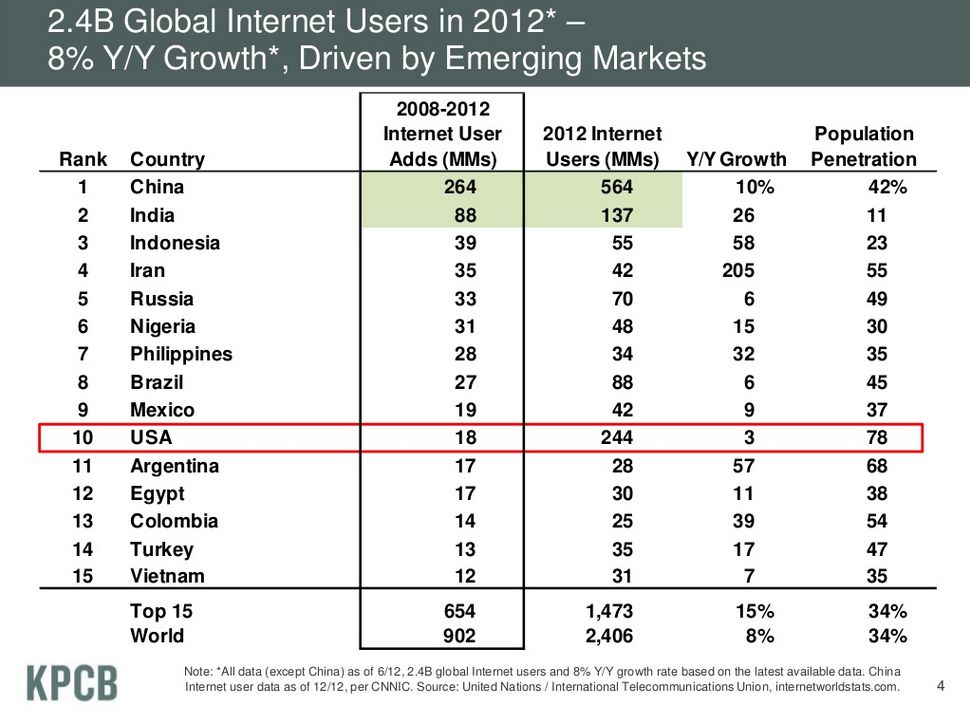
Your audience is 2.4 billion potential constituents. You have international reach. Are you designing experiences with that audience in mind? The top 15 countries saw year to year growth of about 15% new users in 2012. Much of that is in emerging markets. The U.S has the highest penetration with 78% of the population connected. China added 264 million new users last year with only 42% penetration.
Key takeaway: You are a global nonprofit. Keep that in mind as you design the constituent experience.

Your audience is 2.4 billion potential constituents. You have international reach. Are you designing experiences with that audience in mind? The top 15 countries saw year to year growth of about 15% new users in 2012. Much of that is in emerging markets. The U.S has the highest penetration with 78% of the population connected. China added 264 million new users last year with only 42% penetration.
Key takeaway: You are a global nonprofit. Keep that in mind as you design the constituent experience.
Why should I invest in improving the Constituent experience at my nonprofit?
It is reasonable to ask, if my nonprofit invests in the constituent experience, will it work? If you are in the C-Suite, that is the question.
I only know of one nonprofit that uses something like the Forrester Customer Experience Index to measure things so I don’t have any benchmark data. I would love to learn there are more nonprofits using this measure and I would give anything to analyze the data. Here is what we know from the for profit world.
This question drove Watermark Consulting to evaluate the macro impact of customer experience excellence. They’ve accomplished this over the years by studying the total returns for two model stock portfolios comprised of the Top 10 (“Leaders”) and Bottom 10 (“Laggards”) publicly traded companies in Forrester Research’s annual Customer Experience Index ranking. The results are stunning.
For the 6-year period from 2007 to 2012, the Customer Experience Leaders in their study outperformed the broader market, generating a total return that was three times higher on average than the S&P 500 Index. Furthermore, while the Customer Experience Leaders handily beat the S&P 500, the Laggards trailed it by a wide margin.
Keep in mind, this analysis reflects more than half a decade of performance results. It spans an entire economic cycle, from the pre-recession market peak in 2007 to the post-recession recovery that continues today. The Customer Experience Leaders in this study are clearly enjoying the many benefits that happy, loyal customers deliver: better retention, greater wallet share, lower acquisition costs and more cost-efficient service.
And the Laggards? They are being crushed under the weight of high customer turnover, escalating acquisition costs and an uncompetitive cost structure that is inflated by each customer complaint and avoidable inquiry.
Do you want to be a leader or a laggard?
I only know of one nonprofit that uses something like the Forrester Customer Experience Index to measure things so I don’t have any benchmark data. I would love to learn there are more nonprofits using this measure and I would give anything to analyze the data. Here is what we know from the for profit world.
This question drove Watermark Consulting to evaluate the macro impact of customer experience excellence. They’ve accomplished this over the years by studying the total returns for two model stock portfolios comprised of the Top 10 (“Leaders”) and Bottom 10 (“Laggards”) publicly traded companies in Forrester Research’s annual Customer Experience Index ranking. The results are stunning.
For the 6-year period from 2007 to 2012, the Customer Experience Leaders in their study outperformed the broader market, generating a total return that was three times higher on average than the S&P 500 Index. Furthermore, while the Customer Experience Leaders handily beat the S&P 500, the Laggards trailed it by a wide margin.
Keep in mind, this analysis reflects more than half a decade of performance results. It spans an entire economic cycle, from the pre-recession market peak in 2007 to the post-recession recovery that continues today. The Customer Experience Leaders in this study are clearly enjoying the many benefits that happy, loyal customers deliver: better retention, greater wallet share, lower acquisition costs and more cost-efficient service.
And the Laggards? They are being crushed under the weight of high customer turnover, escalating acquisition costs and an uncompetitive cost structure that is inflated by each customer complaint and avoidable inquiry.

Do you want to be a leader or a laggard?
Constituent Experience 101: There is a reality called silos. How should we deal with it in the best interest of our constituents?
We all see it all the time. It is time to put together the annual budget. Or, it is time to update our plans. Each department puts its own plan together and then defends it before the group. At a certain level that makes sense. The question any department leader needs to ask is will this approach serve our constituents best? Is it at odds with the overall constituent experience we are trying to build? To get an enterprise wide constituent investment plan, we may need to do a few things differently. If you have a Chief Constituent Officer, it is their role to make it happen.
The premise here is that constituents are being lost in the hand offs between departments. The constituent walks away thinking do they truly understand my needs? Are they there when I need them? Are they really my partner? If I am a donor and an advocate, how come it doesn’t feel like you know that and treat me differently?
The first thing the Chief Constituent Officer needs to do is make sure they are aligned with the CFO, CIO, CDO and CMO. Investing in a constituent experience plan will take the support of the CFO from the beginning. The CFO will probably welcome an approach that brings together resources for a common goal and eliminates duplicate spending.
If you are the Chief Constituent Officer, you also need to align with the CIO. In this day and age, as a digital nonprofit, nothing happens without the IT department. If you get a jump on aligning with the IT department and their PMO, you will save yourself a lot of time and rework. You will also gain an ally in gaining financial support when the senior team reviews your plans.
Who owns the constituent data in your nonprofit? In some nonprofits that isn’t clear but the CMO will probably be a big stakeholder, along with the Chief Development Officer. If is critical that they both have a seat at the table as you put your plans together. Do they own with your constituent targets, data and plans for improving the experience with you?
One unique role you play as the Chief Constituent Officer is the ability to aggregate intelligence to identify the most important investments. You are the only one who can breathe life into the annual constituent plan. It will take time to bring together the right people to agree on the most pressing constituent challenges and opportunities. Once identified, you can work with senior management to gain agreement to work on solving the issues. Here are a couple of things to look for:
Now you are ready to pull an investment budget together. The emphasis here is on investment. It is critical to be able to identify the return these investments will bring to your mission. Now that you have a more integrated view of constituent priorities, you can make your case better. Since you are taking an enterprise wide view, all of the items for investment may actually live in other department budgets. This will drive greater levels of collaboration with your colleagues. As Chief Constituent Officer, you will be providing a great service that is really lacking to your nonprofit. The budgeting process is always where the rubber hits the road. It will help you gain traction and will help you identify roadblocks. It will also help everyone set a few critical priorities since it is highly likely there is a whole lot of extra money sitting around the table.
This type of action on your part as Chief Constituent Officer will help solidify your role as constituent zealot. It will also help everyone see the importance of the overall constituent experience.
What if your nonprofit doesn’t have a Chief Constituent Officer? This is the opportunity for some department (and its leader) to seize the day. It could be the CMO or the CDO. No matter what, someone needs to seize the role.
The premise here is that constituents are being lost in the hand offs between departments. The constituent walks away thinking do they truly understand my needs? Are they there when I need them? Are they really my partner? If I am a donor and an advocate, how come it doesn’t feel like you know that and treat me differently?
The first thing the Chief Constituent Officer needs to do is make sure they are aligned with the CFO, CIO, CDO and CMO. Investing in a constituent experience plan will take the support of the CFO from the beginning. The CFO will probably welcome an approach that brings together resources for a common goal and eliminates duplicate spending.
If you are the Chief Constituent Officer, you also need to align with the CIO. In this day and age, as a digital nonprofit, nothing happens without the IT department. If you get a jump on aligning with the IT department and their PMO, you will save yourself a lot of time and rework. You will also gain an ally in gaining financial support when the senior team reviews your plans.
Who owns the constituent data in your nonprofit? In some nonprofits that isn’t clear but the CMO will probably be a big stakeholder, along with the Chief Development Officer. If is critical that they both have a seat at the table as you put your plans together. Do they own with your constituent targets, data and plans for improving the experience with you?
One unique role you play as the Chief Constituent Officer is the ability to aggregate intelligence to identify the most important investments. You are the only one who can breathe life into the annual constituent plan. It will take time to bring together the right people to agree on the most pressing constituent challenges and opportunities. Once identified, you can work with senior management to gain agreement to work on solving the issues. Here are a couple of things to look for:
- Building relationships with priority constituents. Some of these will be obvious like high level donors but others may not.
- Fixing issues that impede the overall constituent experience. As the Chief Constituent Officer, you are probably the only one that knows what these are.
- Points of differentiation and the big bets your nonprofit should make.
Now you are ready to pull an investment budget together. The emphasis here is on investment. It is critical to be able to identify the return these investments will bring to your mission. Now that you have a more integrated view of constituent priorities, you can make your case better. Since you are taking an enterprise wide view, all of the items for investment may actually live in other department budgets. This will drive greater levels of collaboration with your colleagues. As Chief Constituent Officer, you will be providing a great service that is really lacking to your nonprofit. The budgeting process is always where the rubber hits the road. It will help you gain traction and will help you identify roadblocks. It will also help everyone set a few critical priorities since it is highly likely there is a whole lot of extra money sitting around the table.
This type of action on your part as Chief Constituent Officer will help solidify your role as constituent zealot. It will also help everyone see the importance of the overall constituent experience.
What if your nonprofit doesn’t have a Chief Constituent Officer? This is the opportunity for some department (and its leader) to seize the day. It could be the CMO or the CDO. No matter what, someone needs to seize the role.
Saturday, June 1, 2013
Do you touch a cord with your nonprofit constituents?
Connecting with your constituents and creating engagement in your mission requires considering a few issues.
Nonprofits that are loved by their constituents break down the barriers between corporate image and the needs of the constituent. One of the keys is the perception that the nonprofit met my needs. This is very personal. It requires an investment in simplifying the experience for the constituent.
It isn’t always easy to be real and transparent with your constituents. It may take some courage and guts. It is one thing to send an automated receipt to donor within 5 seconds after a transaction. It is another thing, the next day, to send a personal email (with a real email address) from the CEO and include a real phone number to call if they want to chat. It would be stunning to answer the phone if they call.
- Do you touch a cord with your constituents?
- Do you encourage personality and creativity with your employees?
- Is your communication personal, without the veneer of the corporate lingo?
- Do you make decisions with the focus of improving the constituent experience?
Nonprofits that are loved by their constituents break down the barriers between corporate image and the needs of the constituent. One of the keys is the perception that the nonprofit met my needs. This is very personal. It requires an investment in simplifying the experience for the constituent.
It isn’t always easy to be real and transparent with your constituents. It may take some courage and guts. It is one thing to send an automated receipt to donor within 5 seconds after a transaction. It is another thing, the next day, to send a personal email (with a real email address) from the CEO and include a real phone number to call if they want to chat. It would be stunning to answer the phone if they call.
The Watermark Consulting 2013 Customer Experience ROI Study
What’s a great, differentiated customer experience really worth to a company? It’s a question that seems to vex lots of business executives – many of whom publicly tout their commitment to the customer, but then are reluctant to invest in customer experience improvements.As a result, companies continue to subject consumers to complicated sales processes, cluttered websites, dizzying 800-line menus, long wait times, incompetent customer service, unintelligible correspondence and products that are just plain difficult to use.Admittedly, it can sometimes be difficult to quantify the return on customer experience improvements. What’s the dollar value of a better trained front-line staff? Or a streamlined sales process? Or a voice-of-the-customer program? The financials surrounding such initiatives are often less precise than those of hard-dollar initiatives, like the renegotiation of real estate leases or the consolidation of corporate functions.Yet executives routinely make big investments in other types of initiatives that are notorious for their vague and questionable ROIs: corporate re-brandings, advertising programs, “synergistic” mergers, and even the hiring of highly compensated, star CEOs.It suggests a double-standard, perhaps reflecting executives’ deep-seated skepticism around the benefits associated with customer experience differentiation.It was this dichotomy that drove Watermark Consulting to elevate the dialogue – getting executives, even for just a moment, to focus less on project-by-project justifications and more on the macro impact of customer experience excellence.We’ve accomplished this over the years by studying the total returns for two model stock portfolios comprised of the Top 10 “Leaders” and Bottom 10 “Laggards” publicly traded companies in Forrester Research’s annual Customer Experience Index ranking.
The results of our latest analysis are in, and they are, in a word, striking: For the 6-year period from 2007 to 2012, the Customer Experience Leaders in our study outperformed the broader market, generating a total return that was three times higher on average than the S&P 500 Index.Furthermore, while the Customer Experience Leaders handily beat the S&P 500, the Laggards trailed it by a wide margin.Keep in mind, this analysis reflects more than half a decade of performance results. It spans an entire economic cycle, from the pre-recession market peak in 2007 to the post-recession recovery that continues today.The Customer Experience Leaders in this study are clearly enjoying the many benefits that happy, loyal customers deliver: better retention, greater wallet share, lower acquisition costs and more cost-efficient service.And the Laggards? They are being crushed under the weight of high customer turnover, escalating acquisition costs and an uncompetitive cost structure that is inflated by each customer complaint and avoidable inquiry.In the pecking order of strategic business investments, customer experience often gets short shrift. Perhaps it’s that executives view these projects as less glamorous than other initiatives. Or maybe they just don’t intuitively believe that a better customer experience will drive business results.Watermark’s analysis demonstrates that the ROI of a great customer experience isn’t soft and sketchy. Companies that excel in this regard are rewarded, by consumers and investors alike.And that’s a finding that even the most skeptical executives should find hard to ignore.
via The Watermark Consulting 2013 Customer Experience ROI Study.

The results of our latest analysis are in, and they are, in a word, striking: For the 6-year period from 2007 to 2012, the Customer Experience Leaders in our study outperformed the broader market, generating a total return that was three times higher on average than the S&P 500 Index.Furthermore, while the Customer Experience Leaders handily beat the S&P 500, the Laggards trailed it by a wide margin.Keep in mind, this analysis reflects more than half a decade of performance results. It spans an entire economic cycle, from the pre-recession market peak in 2007 to the post-recession recovery that continues today.The Customer Experience Leaders in this study are clearly enjoying the many benefits that happy, loyal customers deliver: better retention, greater wallet share, lower acquisition costs and more cost-efficient service.And the Laggards? They are being crushed under the weight of high customer turnover, escalating acquisition costs and an uncompetitive cost structure that is inflated by each customer complaint and avoidable inquiry.In the pecking order of strategic business investments, customer experience often gets short shrift. Perhaps it’s that executives view these projects as less glamorous than other initiatives. Or maybe they just don’t intuitively believe that a better customer experience will drive business results.Watermark’s analysis demonstrates that the ROI of a great customer experience isn’t soft and sketchy. Companies that excel in this regard are rewarded, by consumers and investors alike.And that’s a finding that even the most skeptical executives should find hard to ignore.
via The Watermark Consulting 2013 Customer Experience ROI Study.
Friday, May 31, 2013
Do you have an innovators heart for your nonprofit mission?
There is a gap that is growing in your nonprofit. It is the gap between the connected constituent, their expectations and the programs, products and services you are offering. 80% of the U. S. adult population uses the internet. Most of them have smart phones or will soon. Most of your constituents are constantly connected from the time they wake up to the time they go to sleep. As nonprofits, our reality is a digital world. And so do you have a sense of urgency to bridge the gap?
What does it take to compete for the hearts of your connected constituents? Do you have a plan? Is that plan funded?
One thing to think through very carefully is the urgency to create a culture of innovation to be able to compete for the connected constituent. Someone is going to do it. Will it be your nonprofit?
You will be a hero if you take up that mantle. You will lead a journey to a new level of engagement for the connected constituent and their engagement with your mission. Do you have a heart for innovation? If so, then you will be a hero. You will be the champion for the new world. You will create amazing experiences to generate new loyalty to your cause.
So here is a challenge. Primarily for the C-Suite. Think through it carefully. One of the greatest opportunities before you is the evolution of the connected constituent. How your nonprofit is designed and structured today will work against you if nonprofit digital transformation is not on your agenda. As a leader, you know that management structure, goals, strategies, people, processes, systems, and rewards are all constructed to improve “what is” today. Typically we ignore “how it should be” for the new connected constituent. To innovate requires an innovators heart. Do you have one? Who else at your nonprofit does?
What does it take to compete for the hearts of your connected constituents? Do you have a plan? Is that plan funded?
One thing to think through very carefully is the urgency to create a culture of innovation to be able to compete for the connected constituent. Someone is going to do it. Will it be your nonprofit?
You will be a hero if you take up that mantle. You will lead a journey to a new level of engagement for the connected constituent and their engagement with your mission. Do you have a heart for innovation? If so, then you will be a hero. You will be the champion for the new world. You will create amazing experiences to generate new loyalty to your cause.
So here is a challenge. Primarily for the C-Suite. Think through it carefully. One of the greatest opportunities before you is the evolution of the connected constituent. How your nonprofit is designed and structured today will work against you if nonprofit digital transformation is not on your agenda. As a leader, you know that management structure, goals, strategies, people, processes, systems, and rewards are all constructed to improve “what is” today. Typically we ignore “how it should be” for the new connected constituent. To innovate requires an innovators heart. Do you have one? Who else at your nonprofit does?
Wednesday, May 29, 2013
In the age of communities, how important is our nonprofit brand?
What does your nonprofit stand for? What (and who) does it represent? Now, more than ever before, our brand is vitally important. More time needs to be spent making sure it is clear. Our constituents are connected when our brand is clear. The values we share, the personal believes that we hold in common, the life experiences that are combined with personal and professional objectives are creating a need for personal engagement with our mission.
Is it about apathy? Is it about empathy? It isn’t either/or. We have to align with constituents in order for them to be passionate about us. We have to go beyond being constituent-centric. Notice I didn’t say our constituents need to align with us. This isn’t about us. It is about what our constituents love and can connect to in terms of our mission.
The best way to think about it is to think of community. That can mean a group of people living in the same place or it can mean having some characteristics in common. As nonprofits, we need to understand communities. We need to know why our constituents align with our community or they don’t. In most nonprofits, there isn’t a single view of the constituent because we are in siloes. And so we slice up the constituent by department and by desired result. Are they a donor? Have they given recently? Did they renew this year?
Or … are they an advocate? Did they respond to our last alert?
The list goes on. We wish it wasn’t true but while nonprofits truly value collaboration we typically aren’t measured by collaboration results. One way to think about it is if you are in the Advocacy department, do you have performance standards for the number of advocates who are also donors?
The traditional opportunity funnel is no longer working with the connected constituent. What is happening with the connected constituent is very dynamic and can feel like it is spinning out of control to you as a leader. We will need to adapt our mission, vision and models to react faster. Speed is paramount to the digital nonprofit.
There really can’t be a “top-down” movement to create a singular experience for the constituent. When you dissect the nature of a transactional relationship, there is never to be found a unified experience. Movements don’t create unity.
In deciding to be intentional and design a better experience, we need to dig deeper and understand more about community. A simple example is Twitter. What are #hashtags if not a simple way to create a community around a topic? And it works.
Now community is much more than that. It is about doing something that matters and being a part of it. Why has the revenue of Habitat for Humanity exploded at a time when other nonprofits are in decline? Formed in 1976, the last revenue totals I saw placed them at $1.491 billion in total revenue. My niece can tell you about her experience. She gives her time and money to make a difference. And she does. That is what she wants to do. Habitat for Humanity simple aligns itself with that passionate desire she has.
So let’s think intentionally and design it from start to finish. To build a community starts with the passion of the constituent and then our nonprofit vision aligns with that passion. That is unified with our mission. It comes to life with our brand commitment. We must then define the experience we want people to have with our brand (the embodiment of their passion and our vision / mission). We then must align that experience with everything we do. From development to marketing to advocacy to events, it must fill everything we design. It must be on the whiteboards in our conference rooms. It must be aspirational. It has to be something worthy of the communities we are building. Our constituents have to feel at their core that they personally and the entire world can’t live without our nonprofit.
The “old world” of branding has moved on. It isn’t about the jingle or tagline anymore. Today we have to build an identity, a persona, the essence of a feeling, a promise and most important, deliver on all those things. This is the new world of branding. And, thanks to technology and the deeper connections it can facilitate, it can happen.
How we as nonprofits connect with our constituents is directly impacted by technology. If you don’t believe it just look at the controversies that Susan G. Komen, LiveStrong or the Boy Scouts have/are dealing with. These great nonprofits have seen issues escalated as a result of blogging, social media, texting, etc. Look at how fast Blockbuster declined. It really wasn’t about finance. It was all about deep changes in how we all watch video.
Increasingly, in all these cases, the role of technology means that a nonprofit’s brand is very important. It is probably more important than it has ever been before. Brand is all about being intentional and design. Constituents want certainty. They rely heavily on the symbolism our nonprofit brand offers. Do you think nonprofit controversies are linked to a brand promise? Did technology accelerate the firestorm?
Nonprofit brands that fail to instill core confidence in their donors run the risk of failing and failing fast. Nonprofit brands that survive (even during economic downturns) will be the ones that are best able to evolve because they recognize the need to do so before their competitors do.
Is it about apathy? Is it about empathy? It isn’t either/or. We have to align with constituents in order for them to be passionate about us. We have to go beyond being constituent-centric. Notice I didn’t say our constituents need to align with us. This isn’t about us. It is about what our constituents love and can connect to in terms of our mission.
The best way to think about it is to think of community. That can mean a group of people living in the same place or it can mean having some characteristics in common. As nonprofits, we need to understand communities. We need to know why our constituents align with our community or they don’t. In most nonprofits, there isn’t a single view of the constituent because we are in siloes. And so we slice up the constituent by department and by desired result. Are they a donor? Have they given recently? Did they renew this year?
Or … are they an advocate? Did they respond to our last alert?
The list goes on. We wish it wasn’t true but while nonprofits truly value collaboration we typically aren’t measured by collaboration results. One way to think about it is if you are in the Advocacy department, do you have performance standards for the number of advocates who are also donors?
The traditional opportunity funnel is no longer working with the connected constituent. What is happening with the connected constituent is very dynamic and can feel like it is spinning out of control to you as a leader. We will need to adapt our mission, vision and models to react faster. Speed is paramount to the digital nonprofit.
There really can’t be a “top-down” movement to create a singular experience for the constituent. When you dissect the nature of a transactional relationship, there is never to be found a unified experience. Movements don’t create unity.
We have to change our minds.
In deciding to be intentional and design a better experience, we need to dig deeper and understand more about community. A simple example is Twitter. What are #hashtags if not a simple way to create a community around a topic? And it works.
Now community is much more than that. It is about doing something that matters and being a part of it. Why has the revenue of Habitat for Humanity exploded at a time when other nonprofits are in decline? Formed in 1976, the last revenue totals I saw placed them at $1.491 billion in total revenue. My niece can tell you about her experience. She gives her time and money to make a difference. And she does. That is what she wants to do. Habitat for Humanity simple aligns itself with that passionate desire she has.
So let’s think intentionally and design it from start to finish. To build a community starts with the passion of the constituent and then our nonprofit vision aligns with that passion. That is unified with our mission. It comes to life with our brand commitment. We must then define the experience we want people to have with our brand (the embodiment of their passion and our vision / mission). We then must align that experience with everything we do. From development to marketing to advocacy to events, it must fill everything we design. It must be on the whiteboards in our conference rooms. It must be aspirational. It has to be something worthy of the communities we are building. Our constituents have to feel at their core that they personally and the entire world can’t live without our nonprofit.
The “old world” of branding has moved on. It isn’t about the jingle or tagline anymore. Today we have to build an identity, a persona, the essence of a feeling, a promise and most important, deliver on all those things. This is the new world of branding. And, thanks to technology and the deeper connections it can facilitate, it can happen.
How we as nonprofits connect with our constituents is directly impacted by technology. If you don’t believe it just look at the controversies that Susan G. Komen, LiveStrong or the Boy Scouts have/are dealing with. These great nonprofits have seen issues escalated as a result of blogging, social media, texting, etc. Look at how fast Blockbuster declined. It really wasn’t about finance. It was all about deep changes in how we all watch video.
Increasingly, in all these cases, the role of technology means that a nonprofit’s brand is very important. It is probably more important than it has ever been before. Brand is all about being intentional and design. Constituents want certainty. They rely heavily on the symbolism our nonprofit brand offers. Do you think nonprofit controversies are linked to a brand promise? Did technology accelerate the firestorm?
Nonprofit brands that fail to instill core confidence in their donors run the risk of failing and failing fast. Nonprofit brands that survive (even during economic downturns) will be the ones that are best able to evolve because they recognize the need to do so before their competitors do.
Sunday, May 26, 2013
Is the reason for change about technology or more engagement in your mission?
We all know it. We all hear it. Leadership loves to talk about change. Employees love to ignore it. Talk is very cheap. If we are honest however, we all know it is true. Change is inevitable. The real question is what we will do about it. Will we lead it or will we be a victim?
The biggest challenge is knowing the right time to change. Often, by the time we realize we need to change, the moment has passed us by. The worst possible scenario is that others' realize it before us and beat us to the punch. Rather than being strategic, we are impulsive and reactionary. Our perceived nonprofit competitor builds a website that does X and we have to do it to. Why? Maybe they have just wasted a ton of money. Mimicking others is not a strategy.
Are you inspired by technology or overwhelmed? Are you keeping up with technology or are you getting left behind? Have you see what a three-year-old can do with an iPhone? Does that intimidate you? This is all very disruptive. You know it and your constituents know it. The difference is that our constituents are embracing it.
As a nonprofit, is someone else about to displace you in the marketplace? Are you staying up with the pace of change with technology or are you about to get left behind? Do you have strategies, systems, processes, and protocols in place that will recognize that this is disruption? We need to assess opportunity, and we will need to facilitate the testing of Ideas? Is this your job? How much time and resources that you control are you devoting to it quarterly?
These are very serious questions. They need to be answered now. From the point of view of your mission, is this a case of only the strongest surviving? What will happen if the pace of change is so fast that your constituents adapt and change before you can? This is the reality we all need to face. We all know the role that technology plays in our personal lives. Do our digital properties at work match up to our personal experiences?
This might be a time for humility. Is the economy really our problem? If your nonprofit did well before the downturn of 2009 during bad economic times, why didn't they do well during the downturn turn of 2009?
All nonprofits are facing disruption. Have you been displaced in the marketplace and simply don't know it yet? There are nonprofits who are thriving and growing.
In the for-profit world, this is clear. Over 40% of the companies that were at the top of the Fortune 500, in 2000 were no longer there in 2010. Who are some of the top nonprofits today that weren’t on the list 10 or 20 years ago? I talked with a nonprofit leader recently that illustrates this perfectly I think. They probably aren’t on anybody’s list of top nonprofits. They are a $5 billion dollar international nonprofit. They are a single corporation with no separately incorporate chapters. They have a laser focus on the digital world. Their marketing is absolutely unified. Why doesn’t anyone know about them as a leader in the nonprofit space?
So as a nonprofit, you have established a presence on Facebook and Twitter. And so? Is the constituent experience and relationship any better than it was before? Perhaps so or perhaps not. Do you know?
This may be about survival. It could take more than a presence in new channels to improve the overall experience and relationship with those who can support us the best. It may take more courage than you think. It will certainly take more persistence to break through the resistance. In the end, it could be about how you work with your leaders and we're back to you about how you personally lead.
Are you leading a movement towards empowered and constituent – centric culture? Are you setting in motion real business transformation?
You have a special path you can follow. You can set in motion the change that opens the door to an improved experience both inside and outside your nonprofit. You can lead the change you need your nonprofit to experience!
The biggest challenge is knowing the right time to change. Often, by the time we realize we need to change, the moment has passed us by. The worst possible scenario is that others' realize it before us and beat us to the punch. Rather than being strategic, we are impulsive and reactionary. Our perceived nonprofit competitor builds a website that does X and we have to do it to. Why? Maybe they have just wasted a ton of money. Mimicking others is not a strategy.
Are you inspired by technology or overwhelmed? Are you keeping up with technology or are you getting left behind? Have you see what a three-year-old can do with an iPhone? Does that intimidate you? This is all very disruptive. You know it and your constituents know it. The difference is that our constituents are embracing it.
As a nonprofit, is someone else about to displace you in the marketplace? Are you staying up with the pace of change with technology or are you about to get left behind? Do you have strategies, systems, processes, and protocols in place that will recognize that this is disruption? We need to assess opportunity, and we will need to facilitate the testing of Ideas? Is this your job? How much time and resources that you control are you devoting to it quarterly?
These are very serious questions. They need to be answered now. From the point of view of your mission, is this a case of only the strongest surviving? What will happen if the pace of change is so fast that your constituents adapt and change before you can? This is the reality we all need to face. We all know the role that technology plays in our personal lives. Do our digital properties at work match up to our personal experiences?
This might be a time for humility. Is the economy really our problem? If your nonprofit did well before the downturn of 2009 during bad economic times, why didn't they do well during the downturn turn of 2009?
All nonprofits are facing disruption. Have you been displaced in the marketplace and simply don't know it yet? There are nonprofits who are thriving and growing.
In the for-profit world, this is clear. Over 40% of the companies that were at the top of the Fortune 500, in 2000 were no longer there in 2010. Who are some of the top nonprofits today that weren’t on the list 10 or 20 years ago? I talked with a nonprofit leader recently that illustrates this perfectly I think. They probably aren’t on anybody’s list of top nonprofits. They are a $5 billion dollar international nonprofit. They are a single corporation with no separately incorporate chapters. They have a laser focus on the digital world. Their marketing is absolutely unified. Why doesn’t anyone know about them as a leader in the nonprofit space?
So as a nonprofit, you have established a presence on Facebook and Twitter. And so? Is the constituent experience and relationship any better than it was before? Perhaps so or perhaps not. Do you know?
This may be about survival. It could take more than a presence in new channels to improve the overall experience and relationship with those who can support us the best. It may take more courage than you think. It will certainly take more persistence to break through the resistance. In the end, it could be about how you work with your leaders and we're back to you about how you personally lead.
Are you leading a movement towards empowered and constituent – centric culture? Are you setting in motion real business transformation?
You have a special path you can follow. You can set in motion the change that opens the door to an improved experience both inside and outside your nonprofit. You can lead the change you need your nonprofit to experience!
Friday, May 17, 2013
Relevance is defined by how relevant the experience is
The constituent journey is evolving (albeit very, very fast). That shouldn’t surprise you but it is good news. You haven’t been left behind completely. Your constituents are changing though. Their experience of you and your mission may not be what any of us would want. In this case, relevance is defined by how relevant the experience is. Passion for the mission is contingent on amazing experiences.
How you personally decide to react or lead is up to you. It, of course, is not about technology. What is the journey of getting closer to constituents and staying relevant really about? Here are some ideas:
Saying we want to get closer to constituent won’t get senior management on board. While a constituent revolution is at the C-Suite doors, someone (meaning you) needs to convince the top that change is imperative. Without that we will fail.
You know that most executives don’t use social networks personally. While they have smartphones the primarily utilization is for email and looking at the calendar to know where to go to next. The reality is that most won’t read this. Trying to make a case that this is about technology will be a losing battle.
What is the future of nonprofits built on? It isn’t about how Facebook, Twitter, iPhones, tablets or real time-time geolocation check-ins evolve. The future of nonprofits does depend on relevance and the ability to at least understand technology to be able to make decisions about new opportunities. It does require the ability to strategically adapt to the new opportunities to create a competitive advantage.
So much of this is about change. There is a technology revolution occurring. Other nonprofits (and for-profits that you compete with) understand this. But it is also about a whole series of real-world revolutions that are seizing how our constituents live which impacts their experience with us. Expectations are moving fast. We can’t afford to get left behind. The kind of change we are talking about involves three things:
How you personally decide to react or lead is up to you. It, of course, is not about technology. What is the journey of getting closer to constituents and staying relevant really about? Here are some ideas:
- Creating a culture built around the constituent and their experience being the focus of all you do.
- Empowering employees to do what it takes to create amazing experiences.
- Opening up the floodgates of innovation.
Saying we want to get closer to constituent won’t get senior management on board. While a constituent revolution is at the C-Suite doors, someone (meaning you) needs to convince the top that change is imperative. Without that we will fail.
You know that most executives don’t use social networks personally. While they have smartphones the primarily utilization is for email and looking at the calendar to know where to go to next. The reality is that most won’t read this. Trying to make a case that this is about technology will be a losing battle.
What is the future of nonprofits built on? It isn’t about how Facebook, Twitter, iPhones, tablets or real time-time geolocation check-ins evolve. The future of nonprofits does depend on relevance and the ability to at least understand technology to be able to make decisions about new opportunities. It does require the ability to strategically adapt to the new opportunities to create a competitive advantage.
So much of this is about change. There is a technology revolution occurring. Other nonprofits (and for-profits that you compete with) understand this. But it is also about a whole series of real-world revolutions that are seizing how our constituents live which impacts their experience with us. Expectations are moving fast. We can’t afford to get left behind. The kind of change we are talking about involves three things:
- Listening
- Learning
- Adapting
Thursday, May 16, 2013
Are we creating heartfelt experiences at our nonprofit or not? Is that experience stunning?
There comes a time where we have to make a decision. What will we invest in? It is a serious question and not a budget exercise. If we are going to be intentional and proactive, we need to make an investment. At first that may be just time. Eventually it will be about people, our processes, our strategies and our technology. If we don’t become intentional in our approach to our digital constituent experiences we will continue to be haphazard in our approach; reacting, responding, solving toxic experiences in real time. This intention however must be about heartfelt experiences. It must create a passion for our mission.
There is of course, a very real cost to reacting. Scrutinize your budget and you will see that most of our fixed expenses are reactionary. What if we invested in proactive and intentional experiences of the heart up front? Could we radically reduce our reactionary and bloated fixed expenses? In fact, my guess is the reactionary expenses vastly exceed proactive expenses. I know nonprofits that are ramping up their expenses in reactionary engagement and relationships. The good news is that they are succeeding in shifting the negative to neutral or even the positive.
So what is the outcome of taking a negative and balancing it with a positive? Is it engagement or damage control? So what is the cost and value of neutralizing the negative? Shouldn’t we start with the amazing? What is the return on that investment in the stunning? What is probably most concerning is that most nonprofits are not measuring much of this. And why are we struggling to raise more money? Now think about that question. Why is our revenue flat? Why are donors not engaged and renewing their contributions?
Is the experience we are creating wonderfully sharable? If not, what is our investment over the next 3 months going to be in changing that? We must invest in not only a positive experience but an experience that screams out for our members, volunteers and donors to share it with everyone they know. That encourages others to join in. It also offsets any negative experiences anyone else has shared. Think about it. We all read the ratings and comments. If there are 100 over the top ones we can ignore the one that is virally negative writing it off to a weirdo.
What is the biggest deal? Trying to offset the negative experiences or proactively creating amazing ones? Creating amazing ones is everything. That is not an exaggeration. You know, from your own experiences that it is true. The cost of reacting is always eclipsed by the upside of the stunning.
Think of what you want. You are a consumer. You are the constituent who wants something from your nonprofit. Are you looking for the ordinary? No, you are looking for an experience, no, the experience.
Any nonprofit that recognizes you, remembers you, and gives you an amazing service experience will win your heart. And it is all about your heart. You will be loyal to them no matter what. That is what we know as relevance. A passion of our heart that transcends anything else.
And so, that heartfelt experience is not just a so-so something. It is everything. That kind of vision is the father of innovation. Who needs the mother of invention in that kind of world?
Wednesday, May 1, 2013
What should you do to start the journey of constituent experience?
The effect of everyone jumping on the constituent experience bandwagon is a slowdown in the maturation of this new business discipline. Confusion abounds as does disbelief. No one wants to risk exposing their constituents (and their job security) to new engagement practices that might increase instead of decrease frustration and churn.
However, the growing confusion opens unique opportunities. Here are a couple of strategies to start action plans around.
If you haven't begun the journey, now would be the time to start.
However, the growing confusion opens unique opportunities. Here are a couple of strategies to start action plans around.
- Creating a disruptive mindset by reimagining your business and constituent relationships in a digital world.
- Making trusted content the center of your business strategy and constituent experience.
- Infusing social constituent experience across all business functional and digital touch points.
- Repeatedly measuring and proving the financial results.
If you haven't begun the journey, now would be the time to start.
“Lithium’s blueprint is in direct response to customer requests for advisory and insight services to help them make their social customer experience strategy a reality.” He defines social customer experience as “unlocking the passions of your customers in the digital world in a way you can capture those insights, measure them and empower your organization to bring your customers along.” ~~Rob Tarkoff, Lithium Technologies President and CEO
Saturday, April 27, 2013
How to Deliver Patient-Centered Care: Learn from Service Industries
According the to the HBR, over the past decade, patient-centered care has become a mantra for high-quality health care. Policymakers, researchers, physician-leaders, and patients have all cited the need for care to be tailored to patients' unique needs and preferences. And there is solid evidence that patient-centered care can help improve care quality and reduce costs. However, in the rush to become more patient-centered, the health care system has misplaced its focus.
More here: How to Deliver Patient-Centered Care: Learn from Service Industries - Brian Powers, Amol S. Navathe, and Sachin H. Jain - Harvard Business Review.
More here: How to Deliver Patient-Centered Care: Learn from Service Industries - Brian Powers, Amol S. Navathe, and Sachin H. Jain - Harvard Business Review.
Monday, April 22, 2013
How to Build an Online 'Cult' of Constituents
Speaking at Inc.'s 2013 GrowCo conference in New Orleans, Baratunde Thurston shared tips on how businesses can use personal stories online to attract customers, motivate friends and customers, and ultimately drive business results. The comedian, founder of social media consultancy Cultivated Wit, and author of the best-selling book “How to Be Black,” used examples from his own youth, his time running the digital arm of satirical news website The Onion, and from his efforts to sell and promote his book online using everything from Twitter and Facebook to live broadcasts of his open word processor as he wrote it.
[caption id="" align="alignright" width="300"] Baratunde Thurston[/caption]
Here are highlights from his talk:
Use the entire animal. Don’t be afraid to multipurpose things you already have created. After he wrote his book, for example, Thurston created a spreadsheet of its funniest sentences, and then edited each one down to a Twitter-length message. “Don't be afraid to recycle,” he said. “I wrote 60,000 words, you think I need to write new tweets? They’re already in the book.”
Piggyback on a bigger story. The most efficient way to gain visibility for your product or service is to find a conversation that's already happening online, and join it. “There is very little value in going totally against the grain, creating extra work,” said Thurston. “How to Be Black,” for example, was published during Black History Month. “It just made sense.”
Start a cult. Or an army. To promote his book, Thurston sought help from friends, family, even “the people who used to rob me.” In one promotional activity he sent out advance copies of the book, asking the recipient to discuss the book over Thanksgiving dinner, and then report back on the book’s Facebook page. The promotion didn’t drive a lot of sales—but it did result in many 5-star reviews on Amazon.com.
Ask for help. “Specifically, make it easy for people to help,” Thurston said. “You already know them, you went to school with them, you worked with them...they are already invested. They really care.” Even if they don’t have money, there's probably something else they can do, Thurston said.
[caption id="" align="alignright" width="300"]
 Baratunde Thurston[/caption]
“Tell your story. For any new business, that story is a big part of how customers will find themselves connected to you”
Here are highlights from his talk:
Use the entire animal. Don’t be afraid to multipurpose things you already have created. After he wrote his book, for example, Thurston created a spreadsheet of its funniest sentences, and then edited each one down to a Twitter-length message. “Don't be afraid to recycle,” he said. “I wrote 60,000 words, you think I need to write new tweets? They’re already in the book.”
Piggyback on a bigger story. The most efficient way to gain visibility for your product or service is to find a conversation that's already happening online, and join it. “There is very little value in going totally against the grain, creating extra work,” said Thurston. “How to Be Black,” for example, was published during Black History Month. “It just made sense.”
Start a cult. Or an army. To promote his book, Thurston sought help from friends, family, even “the people who used to rob me.” In one promotional activity he sent out advance copies of the book, asking the recipient to discuss the book over Thanksgiving dinner, and then report back on the book’s Facebook page. The promotion didn’t drive a lot of sales—but it did result in many 5-star reviews on Amazon.com.
Ask for help. “Specifically, make it easy for people to help,” Thurston said. “You already know them, you went to school with them, you worked with them...they are already invested. They really care.” Even if they don’t have money, there's probably something else they can do, Thurston said.
Thursday, April 18, 2013
Growing Constituents And Revenues Are Top Priorities For 2013
As more signs point to strengthening economic activity in the US and selected regions of other parts of the world, corporate austerity is fading and growth is back in the spotlight. Acquiring customers, improving the customer experience, and growing revenues have returned to center stage. Forrester Research recently asked more than 2,000 global business decision-makers at large organizations what their “critical” and “high” priorities are for the next 12 months. We found that:
- Their top priority is acquiring and retaining customers (73%).
- Tied for the top spot is growing overall company revenue (73%).
- The third most important priority is addressing the rising expectations of customers and improving customer satisfaction (68%).
- Lowering operating costs now only takes sixth place on the priority list (63%).
It is evident from these data that effectively managing customer relationships has become the top priority for business success.
Better customer experiences drive improvement for three types of loyalty: willingness to consider another purchase, likelihood to switch business to a competitor, and likelihood to recommend to a friend or colleague. Forrester's models estimate that the revenue impact from a 10-percentage-point improvement in a company’s performance, as measured by Forrester's Customer Experience Index (CXi) score, could exceed $1 billion.
Wednesday, April 17, 2013
What do good nonprofit supporter engagement strategies look like?
What do good nonprofit supporter engagement strategies look like? Here is a great visual from the recent NTEN conference.


Tuesday, April 16, 2013
Are there risks to mobile CRM?
There's no stopping the mobile CRM revolution, but those who rush into it headlong with an eye only to the many benefits may be in for an unpleasant shock. As if we didn't have enough to worry about, mobile CRM is laden with risks, too -- from getting on the wrong side of the customer to getting on the wrong side of the federal government. Then there are the myriad security concerns that go along with making sensitive company data accessible on a device that may be woefully insecure.
More here: The Hidden Risks of Mobile CRM, Part 1 | Mobile CRM | CRM Buyer.
More here: The Hidden Risks of Mobile CRM, Part 1 | Mobile CRM | CRM Buyer.
Subscribe to:
Posts (Atom)