Heartfelt criticism of your idea or your art is usually right (except when it isn't...)
Check out this letter from the publisher of a magazine you've never heard of to the founder of a little magazine called Readers Digest:
But, personally, I don't see how you will be able to get enough subscribers to support it. It is expensive for its size. It isn't illustrated... I have my doubts about the undertaking as a publishing venture.
Of course, he was right--given his assumptions. And that's the except part.
Criticism of your idea is usually based on assumptions about the world as it is. Jackson Pollock could never have made it as an painter in the world as it was. And Harry Potter was rejected by just about everyone because for it to succeed the way kids read would have to change.
The useful element of this sort of criticism isn't that the fact that people in the status quo don't like your idea. Of course they don't. The interesting question is: what about the world as it is would have to change for your idea to be important?
In the case of Readers Digest, the key thing that changed was the makeup of who was reading magazines. Most of the people (and it was a lot of people) who subscribed to the Digest didn't read other magazines. And so comparing to other magazines made no sense, except to say, "this is so different from other magazines, the only way you're going to succeed is by selling it to millions of people who don't read those magazines." And Starbucks had no chance if they were going to focus on the sort of person who bought coffee at Dunkin Donuts or a diner, and the iPad couldn't possibly succeed if people were content to use computers the way they were already using them.
Keep that in mind the next time a gatekeeper or successful tastemaker explains why you're going to fail.
Seth's Blog: Interpreting criticism
Saturday, March 30, 2013
Why was Readers Digest bound to fail?
This blog by Seth Godin is worth reading in it's entirety. What is your Readers digest idea?


Thursday, March 28, 2013
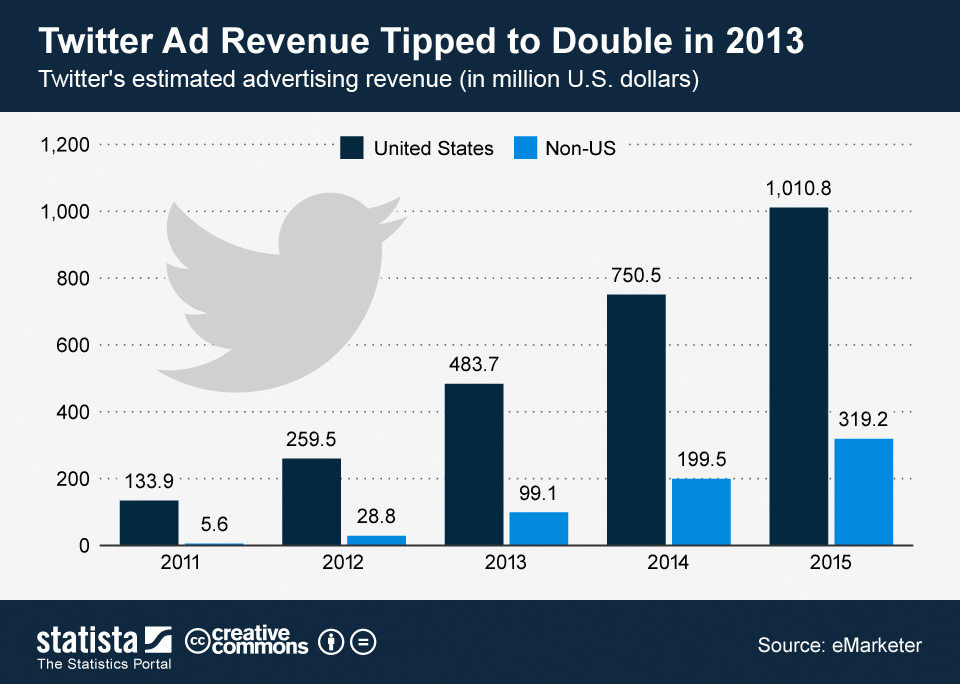
Twitter is set to grow it's income
Twitter is making some good progress. Much of this is coming from the mobile ad world.
The Wilson Nonprofit Report for March 28, 2013
Dan Pallotta: The way we think about charity is dead wrong: This is a “must see” video. Activist and fundraiser Dan Pallotta calls out the double standard that drives our broken relationship to charities. Too many nonprofits, he says, are rewarded for how little they spend — not for what they get done. Instead of equating frugality with morality, he asks us to start rewarding charities for their big goals and big accomplishments (even if that comes with big expenses). In this bold talk, he says: Let’s change the way we think about changing the world.
Everything the donating public has been taught about giving is dysfunctional, says AIDS Ride founder Dan Pallotta. He aims to transform the way society thinks about charity and giving and change. More …
New Study: Online giving is up; Email response is down: M+R Strategic Services & NTEN just released their annual online benchmark study for nonprofits, and they found online fundraising continues to grow - as does the social network reach of nonprofits. (The study is based on analysis of 55 large nonprofits, including the American Red Cross, Sierra Club, American Lung Association, AARP and Human Rights Campaign.) That’s the good news.
The bad news is that email response rates are declining. More …
What Does Community, Network and Crowd Really Mean Anyhow? Why is it important to know the difference between your nonprofits community, network, and crowd? These are terms that we seem to throw around frequently but haven’t yet clearly defined. John Haydon recently had the opportunity to hangout with Amy Sample Ward and Allyson Kapin who wrote Social Change Anytime Everywhere to define and discuss community, network, and crowd. In this video they talked about how organizations use the network to engage the crowd. They also talk about the strengths and weaknesses of Facebook and Twitter. More …
RIP Google Reader: Don’t Scream Who Moved My Cheese, Pivot Your Reading: Recently Google announced that it would close Google Reader on July 1st. This prompted a lot of angst for many who had grown dependent on this free software. More than 125,000 people signed this online petition at Change.Org and lists of alternatives to Google Reader started popping up like this one from Lifehacker and list.ly. In online discussions with nonprofit techies, Megan Keane pointed to the loss of an anti-censorship tool in places like Iran, and Nancy Schwartz noted in an online discussion, “this is a kick to independent content publishing, not just convenience on the readers side. It’s more corporate content control, but that’s what we get from relying on free (but privately held) tools.”
But is it really a big deal? When I thought about it, while I use RSS feeds daily, I myself had quit using Google Reader a while back. More …
Are You Listening and Paying Attention to Your Constituents? If one of your constituents were standing right in front of you talking would you talk to them? If they were complaining about something you did or a service you provided them not working, would you listen?
What if they wrote you a letter? What if they called you on the phone? What if they sent you a fax? What if they sent you an email? What if they wrote a review online? What if they put something on your Facebook wall? What if they tweeted you the message?
The first few are obvious hopefully. Of course you would, should be the expected answer. What about the last ones? Are you listening to those channels for feedback in your nonprofit? More …
Everything the donating public has been taught about giving is dysfunctional, says AIDS Ride founder Dan Pallotta. He aims to transform the way society thinks about charity and giving and change. More …
New Study: Online giving is up; Email response is down: M+R Strategic Services & NTEN just released their annual online benchmark study for nonprofits, and they found online fundraising continues to grow - as does the social network reach of nonprofits. (The study is based on analysis of 55 large nonprofits, including the American Red Cross, Sierra Club, American Lung Association, AARP and Human Rights Campaign.) That’s the good news.
The bad news is that email response rates are declining. More …
What Does Community, Network and Crowd Really Mean Anyhow? Why is it important to know the difference between your nonprofits community, network, and crowd? These are terms that we seem to throw around frequently but haven’t yet clearly defined. John Haydon recently had the opportunity to hangout with Amy Sample Ward and Allyson Kapin who wrote Social Change Anytime Everywhere to define and discuss community, network, and crowd. In this video they talked about how organizations use the network to engage the crowd. They also talk about the strengths and weaknesses of Facebook and Twitter. More …
RIP Google Reader: Don’t Scream Who Moved My Cheese, Pivot Your Reading: Recently Google announced that it would close Google Reader on July 1st. This prompted a lot of angst for many who had grown dependent on this free software. More than 125,000 people signed this online petition at Change.Org and lists of alternatives to Google Reader started popping up like this one from Lifehacker and list.ly. In online discussions with nonprofit techies, Megan Keane pointed to the loss of an anti-censorship tool in places like Iran, and Nancy Schwartz noted in an online discussion, “this is a kick to independent content publishing, not just convenience on the readers side. It’s more corporate content control, but that’s what we get from relying on free (but privately held) tools.”
But is it really a big deal? When I thought about it, while I use RSS feeds daily, I myself had quit using Google Reader a while back. More …
Are You Listening and Paying Attention to Your Constituents? If one of your constituents were standing right in front of you talking would you talk to them? If they were complaining about something you did or a service you provided them not working, would you listen?
What if they wrote you a letter? What if they called you on the phone? What if they sent you a fax? What if they sent you an email? What if they wrote a review online? What if they put something on your Facebook wall? What if they tweeted you the message?
The first few are obvious hopefully. Of course you would, should be the expected answer. What about the last ones? Are you listening to those channels for feedback in your nonprofit? More …
Wednesday, March 27, 2013
Connected devices in 2014
Interesting take on where the mobile world is heading. Seems pretty clear.

Friday, March 22, 2013
Can you eliminate the need for email?
With some careful application of social media tools, could you actually eliminate the need for email?
Luis Suarez, who works for IBM, ditched email. He still has an email account, but since 2008 he’s tried to wean himself off email.
Suarez documents the decreasing amounts of email he receives with blog posts tagged “A World Without Email“. When he started, Suarez received more than 30 emails per day; by 2011 he received 16 emails per week. (I always imagine the phrase being read with the deep voice of movie trailer narrators, “In a world without email, one man stands alone…”)
Headlines highlight Suarez’s lack of email as an oddity. In 2012, Wired ran a story titled “IBM Gives Birth to Amazing E-mail-less Man“. The idea that a tech professional could do actual work without email boggles! Bah. Nearly impossible!
Headlines about Suarez should read “Man Chooses to Work in Public”. Suarez replaced email with a mix of internal and external social networking tools. He posts to his Wordpress-powered blog at elsua.net several times a month. He uses Twitter and Tumblr to share what he’s doing. He even uses Google+ now and then.
Suarez’s choice to share his work came as a result of thinking and practice. He worked for years in the field of Knowledge Management. And he’s highly proficient at learning new tools and ways of working: he started blogging back in 2005.
So, can you eliminate email? Yes, with the careful use of social media and the willingness to "work in public", it can be done. What is the value? Knowledge is shared. Work is collaborative.
Luis Suarez, who works for IBM, ditched email. He still has an email account, but since 2008 he’s tried to wean himself off email.
Suarez documents the decreasing amounts of email he receives with blog posts tagged “A World Without Email“. When he started, Suarez received more than 30 emails per day; by 2011 he received 16 emails per week. (I always imagine the phrase being read with the deep voice of movie trailer narrators, “In a world without email, one man stands alone…”)
Headlines highlight Suarez’s lack of email as an oddity. In 2012, Wired ran a story titled “IBM Gives Birth to Amazing E-mail-less Man“. The idea that a tech professional could do actual work without email boggles! Bah. Nearly impossible!
Headlines about Suarez should read “Man Chooses to Work in Public”. Suarez replaced email with a mix of internal and external social networking tools. He posts to his Wordpress-powered blog at elsua.net several times a month. He uses Twitter and Tumblr to share what he’s doing. He even uses Google+ now and then.
Suarez’s choice to share his work came as a result of thinking and practice. He worked for years in the field of Knowledge Management. And he’s highly proficient at learning new tools and ways of working: he started blogging back in 2005.
So, can you eliminate email? Yes, with the careful use of social media and the willingness to "work in public", it can be done. What is the value? Knowledge is shared. Work is collaborative.
Tuesday, March 19, 2013
Is your contact center loyalty focused?
Is your contact center loyalty focused? One of the trends I am seeing is that as companies more fully understand the link between customer experience and loyalty, especially with customer service, they are increasingly viewing contact centers as value-creators and not just cost centers.
Some of the effects we are seeing is less focus on average-handle-time and other productivity metrics, more focus on customer feedback and quality metrics, more on-shoring of previously off-shored interactions, and more investment in agent training and coaching.
Tidbit: Consumers that are satisfied with customer service interactions are more than 4 times as likely to repurchase than those who are dissatisfied.
Some of the effects we are seeing is less focus on average-handle-time and other productivity metrics, more focus on customer feedback and quality metrics, more on-shoring of previously off-shored interactions, and more investment in agent training and coaching.
Tidbit: Consumers that are satisfied with customer service interactions are more than 4 times as likely to repurchase than those who are dissatisfied.
Monday, March 18, 2013
Are you shaping the digital world with agility?
Digital leaders shape digital enterprise with agility. They are all about doing things better and faster; with elasticity: scale up and down seamlessly and resilience.
A digital organization is empowered by digital tools and relying on a winning combination of face-to-face and virtual initiatives. It involves the creation of an interactive multi-channel communication and sharing process to generate awareness about new digital tools and processes to help accelerate and secure workforce buy-in.
Are you leading in this area regardless of your role?
A digital organization is empowered by digital tools and relying on a winning combination of face-to-face and virtual initiatives. It involves the creation of an interactive multi-channel communication and sharing process to generate awareness about new digital tools and processes to help accelerate and secure workforce buy-in.
Are you leading in this area regardless of your role?
Saturday, March 16, 2013
Author - The Digital Nonprofit: A Manifesto
Michael Wilson is the author of the soon to be released book "The Digital Nonprofit: A Manifesto". Here are some excerpts for your enjoyment.
- The Manifesto: Are we enabling a unified experience for the constituent?
- Are our constituent experiences intentional?
- Our constituents are empowered and we can't control that
- Are we creating heartfelt experiences?
- Why should I invest in improving the constituent experience at my nonprofit?
- Sorry, your mission isn't relevant anymore
- Are you ready for the journey?
- Your passion for your mission and your constituents can turn you into a hero
- Do you know you are a global nonprofit?
- Are you ready for a new generation of constituents?
- Is constituent experience an art or science?
- In the age of communities, how important is your nonprofit brand?
- Do you have a talented user experience team?
- Innovate for mission relevance and financial growth
- Do you have an innovators heart for your nonprofit mission?
- Your journey to change and transformation
- Constituent Experience 101 - The Basics
- Defining the need
- Defining the need
- Driving Culture Change
Dan Pallotta: The way we think about charity is dead wrong
Activist and fundraiser Dan Pallotta calls out the double standard that drives our broken relationship to charities. Too many nonprofits, he says, are rewarded for how little they spend -- not for what they get done. Instead of equating frugality with morality, he asks us to start rewarding charities for their big goals and big accomplishments (even if that comes with big expenses). In this bold talk, he says: Let's change the way we think about changing the world.
Everything the donating public has been taught about giving is dysfunctional, says AIDS Ride founder Dan Pallotta. He aims to transform the way society thinks about charity and giving and change.
[ted id=1688]
Friday, March 15, 2013
How to get ahead.I disagree.
This is a very disturbing article from Harvard Business Review. Here is one tidbit.
From there, a long list of pretty disagreeable items continue. I kept looking for something redeeming. Nothing. Hmmm. If this is the list of what to do, I object.
First, remember "A-B-D" — always be disagreeable:
People who are disagreeable earn more than people who are agreeable, and the gap is biggest among men, according to an analysis of four surveys spanning almost 20 years. Men who are significantly less agreeable than average earn 18.31% more than men who are significantly more agreeable than average, while the comparable figure for women is 5.47%, says the study, led by Beth A. Livingston of Cornell. Men's disagreeable behavior "conforms to expectations of 'masculine' behavior," the authors say.
via Ouch: A Year's Worth of Occasionally Disturbing Research on How to Get Ahead - Andrew O’Connell - Harvard Business Review.
From there, a long list of pretty disagreeable items continue. I kept looking for something redeeming. Nothing. Hmmm. If this is the list of what to do, I object.
Advisor Services
Advisor services are either short term or longer term engagements to focus on a specific area of specialty. They are provided one on one to executives. They can be by phone, video or on site.
Areas to consider:
All advisor engagements are custom designed to meet your challenges and create the action you want to take. Services can also include follow up and change management components to ensure success.
If you are not 100% satisfied with the advisory services, you pay nothing.
Other services include:
Areas to consider:
- Career planning
- Navigating the Social Media world
- Business Technology
- Strategic planning
- Talent development
- Succession planning
All advisor engagements are custom designed to meet your challenges and create the action you want to take. Services can also include follow up and change management components to ensure success.
If you are not 100% satisfied with the advisory services, you pay nothing.
Other services include:
Friday, March 1, 2013
What is architecture and governance?
I love simplicity. Sometimes we just make things too difficult to understand.
This quote simply explains architecture (and why it is important) and governance.
This quote simply explains architecture (and why it is important) and governance.
Architecture is a belief system. And then governance is having the discipline to put that belief system into action.
— Ralph Loura, CIO, Clorox
Speaking Engagements
Speaking engagements are usually short conversations with small to large groups. With over 35 years of speaking experience, Michael Wilson will, simply and with impact, engage your audience to take action. Some recent topics have been:
All speaking engagements are custom designed to meet your challenges and create the action you want the audience to take.
If you are not 100% satisfied with the conversation, you pay nothing.
Other services include:
- Constituent engagement metrics and how to move the needle
- Social media and how to catapult engagement to reach your mission
- What is an effective mobile strategy and why does it make a difference?
- What does Consumerization of IT mean to the nonprofit C-Suite?
- Organization wide alignment around the constituent experience
- Why more nonprofits are getting bigger, faster and what you need to know about ROI
- Are you ready to be a digital nonprofit?
- Do you need a Chief Constituent Officer? Will it make a difference in our new digital world?
- And many more ….
All speaking engagements are custom designed to meet your challenges and create the action you want the audience to take.
If you are not 100% satisfied with the conversation, you pay nothing.
Other services include:
Tuesday, February 26, 2013
The Wilson Nonprofit Report for February 26
Interested in a Voice of the Constituent Program? First build executive support. Those who have gone through the process all say it is critical. It is also consistent with research showing that executive support builds a foundation for VoC success. More …
If it’s good enough for Bob: Tom Peters is one of my favorite authors and speakers. If you ever have the opportunity, go see him. He has a friend, Bob Stone. Great quote from Bob: "Some people look for things that went wrong and try to fix them. I look for things that went right, and try to build off them." Tom’s point in this article is that there is great peril to a "systems first" approach to Big Change, arguing that systems are of the utmost importance, but mostly fail, or fail to reach their full potential by a country mile, because the organization's "culture" does not support them. You can also download for free his research on this. More …
How reliable is your constituent data? Customer data that's streaming in from numerous sources - social, mobile, email, chat, CRM, recorded contact center interactions, etc. - are providing nonprofits with a wealth of information about their constituents that can be used to fine-tune their experiences and develop highly-personalized offers and messaging. Yet despite all the buzz about the promise that Big Data holds, organizational leaders and front-line employees continue to be hindered by dirty constituent data that can hamper decision-making and potentially damage relationships. More …
Do consumers love to hate nonprofits? We all have this suspicion, as nonprofits, that we can be difficult to work with. We know it’s true. This is a thought provoking article and why that is true. A true 12 step program starts with “Hi, I’m Michael and I work for a nonprofit. J More …
Have you discovered Lollly Dascal? Lolly has an excellent blog. Some consultants parachute into an organization, like special forces, and take command of the situation. Lolly understands that in order to achieve lasting results, people must buy in to a vision, acquire the knowledge and skills to succeed, and be empowered to make the required changes. She understands that knowledge transfer from a consultant requires a careful balance between theory, real-world experience, and practical advice. Furthermore, leaders achieve greatness by cultivating trust and earning respect. These principles form the foundation of Lead from Within.
Her latest blog is on Leading Change Change is constant. But change is difficult. So what happens when an organizational change is handed down from the top and the people of the organization are not involved? Do you have a group of people who are accepting…or angry? Do you have a group of people who are focused…or frustrated? Do you have a group of people who are committed…or complaining? More …
If it’s good enough for Bob: Tom Peters is one of my favorite authors and speakers. If you ever have the opportunity, go see him. He has a friend, Bob Stone. Great quote from Bob: "Some people look for things that went wrong and try to fix them. I look for things that went right, and try to build off them." Tom’s point in this article is that there is great peril to a "systems first" approach to Big Change, arguing that systems are of the utmost importance, but mostly fail, or fail to reach their full potential by a country mile, because the organization's "culture" does not support them. You can also download for free his research on this. More …
How reliable is your constituent data? Customer data that's streaming in from numerous sources - social, mobile, email, chat, CRM, recorded contact center interactions, etc. - are providing nonprofits with a wealth of information about their constituents that can be used to fine-tune their experiences and develop highly-personalized offers and messaging. Yet despite all the buzz about the promise that Big Data holds, organizational leaders and front-line employees continue to be hindered by dirty constituent data that can hamper decision-making and potentially damage relationships. More …
Do consumers love to hate nonprofits? We all have this suspicion, as nonprofits, that we can be difficult to work with. We know it’s true. This is a thought provoking article and why that is true. A true 12 step program starts with “Hi, I’m Michael and I work for a nonprofit. J More …
Have you discovered Lollly Dascal? Lolly has an excellent blog. Some consultants parachute into an organization, like special forces, and take command of the situation. Lolly understands that in order to achieve lasting results, people must buy in to a vision, acquire the knowledge and skills to succeed, and be empowered to make the required changes. She understands that knowledge transfer from a consultant requires a careful balance between theory, real-world experience, and practical advice. Furthermore, leaders achieve greatness by cultivating trust and earning respect. These principles form the foundation of Lead from Within.
Her latest blog is on Leading Change Change is constant. But change is difficult. So what happens when an organizational change is handed down from the top and the people of the organization are not involved? Do you have a group of people who are accepting…or angry? Do you have a group of people who are focused…or frustrated? Do you have a group of people who are committed…or complaining? More …
Thursday, February 21, 2013
Interested in a Voice of the Customer Program? First build executive support
Interested in a Voice of the Customer Program? First build executive support. Those who have gone through the process all say it is critical. It is also consistent with research showing that executive support builds a foundation for VoC success.
Executive support helps Customer Experience pros put key building blocks in place, such as adequate tools to collect and analyze data and processes to systematically act on it.
How do you build support? Prove the value of the program by demonstrating tangible business value. Track the results of service recovery efforts to save unhappy customers and aggregate the results of improvement projects initiated by VoC-collected data.
So, get started fast but make sure the C-suite is on board.
Executive support helps Customer Experience pros put key building blocks in place, such as adequate tools to collect and analyze data and processes to systematically act on it.
How do you build support? Prove the value of the program by demonstrating tangible business value. Track the results of service recovery efforts to save unhappy customers and aggregate the results of improvement projects initiated by VoC-collected data.
So, get started fast but make sure the C-suite is on board.
Wednesday, February 20, 2013
Remember the Kodak moment? It is now the Instagram moment.
Remember the Kodak moment? It is now the Instagram moment. Great short video from Brian Solis promoting his new book, "The Future of Business".
http://www.youtube.com/watch?v=ZwtQpNCqWrQ
http://www.youtube.com/watch?v=ZwtQpNCqWrQ
Tuesday, February 19, 2013
Am I experimenting enough?
End of the day question: Am I experimenting enough?
Answer? Probably not.
Challenge? How do I do it more? How do I do it faster?
Answer? Probably not.
Challenge? How do I do it more? How do I do it faster?
Monday, February 18, 2013
Should you add things to your to-do list you've already done, just to cross them off?
I am a fan, to some extent, of to-do lists. I know of people who add things they've already done, so they can cross them off. Somehow I just can't wrap my arms around it though.
Do you do this? Does it really help?
Do you do this? Does it really help?
At the end of the day, add items to your list that weren't there but which you accomplished, just so you can cross them off. "This gives you a sense of productivity," Williams says.
via How to Conquer Your To-Do List CIO.com.
Sunday, February 17, 2013
Customers hold more power than ever before
If we don’t think customers are more powerful than ever before, just ask Bank of America or Netflix. Both are great examples of fast consumers empowered with social tools can flat out reverse corporate decisions that seem irrational to consumers.
And why shouldn't they. That it has taken this long to have the ability to get the attention of corporate decision makers is stunning. It is a new day. Swift economic impact to corporate decisions is good for the economy in the long run.
And why shouldn't they. That it has taken this long to have the ability to get the attention of corporate decision makers is stunning. It is a new day. Swift economic impact to corporate decisions is good for the economy in the long run.
“Today's consumers are empowered and are not afraid to use their social muscles.” ~~Mila D'Antonio, Peppers and Rogers
Customers Hold More Power Than Ever Before - Think customers: The 1to1 Blog
Saturday, February 16, 2013
How am I doing compared to a magical unicorn?
How am I doing compared to a magical unicorn?
We love to compare ourselves to those we know we are better than. It really makes us feel good. Seth Godin suggests there is a better standard. One the will make us feel uncomfortable.

Will we take up the challenge?
The easiest way to sell yourself short is to compare your work to the competition. To say that you are 5% cheaper or have one or two features that stand out--this is a formula for slightly better mediocrity.
The goal ought to be to compare yourself not to the best your peers or the competition has managed to get through a committee or down on paper, but to an unattainable, magical unicorn.
Compared to that, how are you doing?
via Seth's Blog: Compared to magical.
Related articles
- Seth's Blog: Learning how to see (sethgodin.typepad.com)
- Seth's Blog: A diet for your mind (sethgodin.typepad.com)
Friday, February 15, 2013
Are you leading a digital transformation?
Breakthroughs often begin by thinking differently about the company's mission. Pages Jaune, the French Yellow Pages, was losing business as paper books became less and less relevant. The CEO led the effort to re-conceptualize the business as one that connects small businesses with local customers, which led to new products and services, such as mobile apps and Web pages for its member companies.
We have all used the transformation of caterpillars into butterflies as a metaphor for this form of breakthrough thinking. Are you focused on speeding up the caterpillar's process? Or are you envisioning that totally new butterfly?
We have all used the transformation of caterpillars into butterflies as a metaphor for this form of breakthrough thinking. Are you focused on speeding up the caterpillar's process? Or are you envisioning that totally new butterfly?
Thursday, February 14, 2013
Best of Tom Peters Cool Friends -- Sally Helgesen
Tom Peters has some very cool friends. He is also very kind to introduce us to them. I haven't read much from Sally Helgesen yet but she is going on my list. I am particularly intrigued by "The Web of Inclusion".
With three interviews to her credit, Sally Helgesen is not only one of our favorite Cool Friends, she's tied for first place in frequency of Cool Friends solo interviews (with the prolific Seth Godin!). She also has a section of Tom's Mother of All Presentations devoted to her work. Best known for her 1990 classic, The Female Advantage, Sally has a focus on women's work issues, but her insights are universal—perhaps essential for all who would succeed at work in the 21st Century.
Interview No.1, posted 2000. Book under discussion: The Web of Inclusion: A New Architecture for Building Great Organizations.
Interview No.2, posted 2002, and the book: Thriving in 24/7: Six Strategies for Taming the New World of Work.
Interview No.3, posted 2010, and the book featured (coauthored with Julie Johnson): The Female Vision: Women's Real Power at Work.
We'd suggest you read all three interviews and maybe pick up a couple of Sally's books, too!
via Best of the Cool FriendsSally Helgesen | tompeters!.
Wednesday, February 13, 2013
Computers are magnificent tools but ....
“Computers are magnificent tools for the realization of our dreams, but no machine can replace the human spark of spirit, compassion, love, and understanding.” – Louis Gerstner
Tuesday, February 12, 2013
Am I making it safe for my employees to try things?
Am I making it safe for my employees to try things? We hear a lot about risk taking. That sounds very "risky". Probably sounds that way to my staff as well.
What if I talked about safety? Good question I think.
What do you think?
What if I talked about safety? Good question I think.
What do you think?
Monday, February 11, 2013
5 questions to ask about your customer focus
Whether you are a business leader of a department or the CEO, these questions make sense to ask and get answers about.
Asking the right questions is most of the job some days. Thanks to Peppers and Rogers for their insight into these questions. They have been at the customer focus for a long time now.
Asking the right questions is most of the job some days. Thanks to Peppers and Rogers for their insight into these questions. They have been at the customer focus for a long time now.
1. How many new customers are you attracting and what is their value?
2. How many customers are you losing; why and what is their value?
3. Why are your continuing customers loyal to you?
4. What is the profitability of each customer group?
5. Are your customers vouching for you?
Read more: Customer Strategy | Making Customers an Asset of Your Business
Sunday, February 10, 2013
Where does trust come from?
Here is a great question. Where does trust come from? We all want it. It isn't always easy to get or build.
Hint: it never comes from the good times and from the easy projects.
We trust people because they showed up when it wasn't convenient, because they told the truth when it was easier to lie and because they kept a promise when they could have gotten away with breaking it.
Every tough time and every pressured project is another opportunity to earn the trust of someone you care about.
via Seth's Blog: Where does trust come from?.
Saturday, February 9, 2013
Are the number-cruncher days numbered?
OK, full disclosure. I have a Bachelor of Arts degree. Yes, I went the Liberal Arts route in college. This can be an asset when puzzling through complex or ambiguous situations; innovating; communicating; and understanding the customer through the power of “observation and psychology—the stuff of poets and novelists.” Yes, I also write poetry. :)
Do you have a Liberal Arts degree? Has it helped you in the business world?
Do you have a Liberal Arts degree? Has it helped you in the business world?
Nobody is saying that numbers-crunchers’ days are numbered. But the idea that having people with a strong background in the humanities—what Peter Drucker termed “Management as a Liberal Art”—can provide companies with a great advantage is gaining some real momentum.
via Drucker’s Lost Art of Management | The Drucker Exchange.
Friday, February 8, 2013
Thursday, February 7, 2013
You Call That Innovation? Maybe it is just change management
Everybody is on the innovation bandwagon. It is the "buzzword" of the year. Unless what we are talking about is disruptive, we are probably talking about monumental change and change management. This may be the "elephant in the C-Suite" but it is an elephant none the less.
Got innovation? Just about every company says it does.
Companies throw the term "innovation" around but that doesn't mean they are actually changing anything monumental. Leslie Kwoh reports on digits.
Businesses throw around the term to show they're on the cutting edge of everything from technology and medicine to snacks and cosmetics. Companies are touting chief innovation officers, innovation teams, innovation strategies and even innovation days.
But that doesn't mean the companies are actually doing any innovating. Instead they are using the word to convey monumental change when the progress they're describing is quite ordinary.
via You Call That Innovation? - WSJ.com.
Monday, February 4, 2013
Why wait? Speed makes a difference
This is such a great question. Why wait? Seriously. Why wait? Seth Godin says it well. Speed can make a difference.
If you're on the critical path, if someone is waiting for your contribution, ship now.
We have deadlines for a reason, but the key word is 'dead'. In fact, you don't have to wait for the deadline or get anywhere near it, especially if you want to speed things up.
Seth's Blog: Why wait?
Related articles
- Meeting Seth Godin today, and lessons learned (janefinette.com)
Sunday, February 3, 2013
Leadership lessons from "Men in Black 3"
Here is a pretty good list. I enjoyed the movie "Men in Black 3" a lot. Who knew I would also get leadership lessons. But I did.
1. “Don’t ask questions you don’t want to know the answers to.” Agent K. || Think about this quote, lots to ponder here.
2. “Do you know what the most destructive force in the Universe is? Regret!” ~Agent K. || Sentences beginning with “If I had only” “What if I” “I should have…” Regret eats people alive, it forces people to live in past.
3. “A miracle is what appears impossible, but happens anyway.” ~Griffin || Miracles do happen, nothing is impossible, believe, believe, believe.
4. “The bitterest truth is better than the sweetest lie.” ~Griffin || This is something that we learn as a very young child… Always tell the truth.
5. “We’re running out of time, we’re running out of clues, and there’s an invasion coming, so really we need to go right now!” ~Agent J. || I’ll allow you to get creative with this one. Think, Think, Think.
6. “Where there is death, there will always be death.” || There is lots of metaphoric truth here… where there is darkness, there will always be darkness.
7. “There are things out there you don’t need to know about.” Agent K. || Truth for all ages.
via 7 Life and Leadership Lessons From Men In Black 3 | Big Is The New Small.

Friday, February 1, 2013
Conferences and Seminars
Conferences and Seminars are usually longer conversations with small to large groups. Conferences include 4 hour, full day and multi-day versions. With over 35 years of speaking experience, Michael Wilson will, simply and with impact, engage your audience to take action. Some recent topics have been:
All conference engagements are custom designed to meet your challenges and create the action you want the audience to take. Services also include follow up and change management components to ensure success.
If you are not 100% satisfied with the conference, you pay nothing.
Other services include:
- Constituent Experience Competencies for Nonprofits
- Competency #1 – Define the Stages of Experience to Gain Alignment around Constituent experience
- Competency #2 – Develop Experience Based Constituent Listening and Feedback
- Competency #3 – United (Cross-Silo) Experience Reliability and Accountability
- Competency #4 – Manage Constituents as Assets – Prove the ROI between Experience and Growth
- Competency #5– Create a “One Organization” Constituent Experience Culture
- Board, Committee and Staff Retreat Facilitation
- Why more nonprofits are getting bigger, faster and what you need to know about ROI
- Constituent engagement metrics and how to move the needle
- Social media and how to catapult engagement to reach your mission
- What is an effective mobile strategy and why does it make a difference?
- What does Consumerization of IT mean to the nonprofit C-Suite?
- Are you ready to be a digital nonprofit?
- And many more ….
All conference engagements are custom designed to meet your challenges and create the action you want the audience to take. Services also include follow up and change management components to ensure success.
If you are not 100% satisfied with the conference, you pay nothing.
Other services include:
Thursday, January 31, 2013
Samsung outsells Apple in 2012
Samsung capped an impressive year 2012 with record smartphone sales in the fourth quarter. The Korean company shipped 63.7 million smartphones during the holiday quarter, outselling its biggest rival Apple by more than 15 million units.
Samsung’s strong line-up of high-end and low-cost smartphones has helped the company to increase shipments by 76 percent over last year’s fourth quarter.
Apple sold 47.8 million smartphones, cementing its status as the second largest vendor. With an increase of 29 percent, the Cupertino-based company saw the lowest relative growth among the top 5 vendors though, a testament to the stronger competition from company’s such as Sony, Huawei and ZTE. The latter two, both Chinese manufacturers, entered the top 5 as the Chinese smartphone market continued to grow rapidly.
Overall, smartphone demand remains strong as overall shipments in the fourth quarter rose 36 percent to a total of 219 million units.

http://www.statista.com/topics/840/smartphones/chart/852/global-smartphone-shipments-in-q4-2012/
Wednesday, January 30, 2013
Is your job to generate stunning results that drive the top line?
Is your job to generate stunning results that drive the top line? Is your job to keep the trains running on time?
The focus makes a difference. I want to do the former not the later.
The focus makes a difference. I want to do the former not the later.
CIOs have a tendency to believe that they are an overhead function. When you believe you’re overhead you operate differently than when you perceive yourself as leading a P&L.
— Ray Barnard, CIO, Fluor
Tuesday, January 29, 2013
Monday, January 28, 2013
Customer Experience Trend: Software as an Experience
One of the big trends we are seeing in the world of customer experience is a focus on the experience of the software. The whole rise of Smart Phones is geared around this premise.
The initial rise of cloud-based software (a.k.a. SaaS, or software-as-a-service) focused on renting access to software instead of the historical approach of selling licenses. As cloud-based software expands, we’ll see these offerings cater more explicitly to the needs of customers.
How? More simple, highly-focused, specialized applications (like smartphone apps), more focus on quick initial usability, more sharing of best practices (usage, not technical), and customization based on behavioral analysis of users.
Tidbit: Net Promoter Scores for tech vendors are more correlated to customer experience than product performance.
The initial rise of cloud-based software (a.k.a. SaaS, or software-as-a-service) focused on renting access to software instead of the historical approach of selling licenses. As cloud-based software expands, we’ll see these offerings cater more explicitly to the needs of customers.
How? More simple, highly-focused, specialized applications (like smartphone apps), more focus on quick initial usability, more sharing of best practices (usage, not technical), and customization based on behavioral analysis of users.
Tidbit: Net Promoter Scores for tech vendors are more correlated to customer experience than product performance.
Sunday, January 27, 2013
Powerful stories have impact. What are we telling our self?
Seth Godin has some great thoughts on the stories we tell. The ones we tell ourselves are so very important. What is our story? How frequently do we tell it to our self?
I know that marketers tell stories. We tell them to clients, prospects, bosses, suppliers, partners and voters. If the stories resonate and spread and seduce, then we succeed.
But what about the story you tell yourself?
Do you have an elevator pitch that reminds you that you're a struggling fraud, certain to be caught and destined to fail? Are you marketing a perspective and an attitude of generosity? When you talk to yourself, what do you say? Is anyone listening?
You've learned through experience that frequency works. That minds can be changed. That powerful stories have impact.
I guess, then, the challenge is to use those very same tools on yourself.
Saturday, January 26, 2013
When it comes to the cloud, there is a huge gap between the business and the CIO
A recent survey on cloud adoption presents an interesting view of the perception gap between IT and business executives. Although the survey focuses on issues such as on-premise upgrades and availability of technical resources, the best stuff is buried in a single graphic.
Enterprise performance management vendor Host Analytics sponsored a survey (PDF download), by Dimensional Research, that describes certain drivers of cloud adoption.
According to the survey, the cloud alternative delivered better value--business: 80 percent; CIOs: 53 percent. Although the phrase "better value" is vague, most likely business people interpret this to mean "less expensive". This makes sense because many business folks see cloud as a means to bypass IT and purchase computing at lower cost. On the other hand, the data indicates that CIOs recognize that software alone is only part of the overall cost equation for enterprise technology
The survey highlights several important points for CIOs to consider, including:
Business buyers don't care about your IT agenda: As CIO, your technology focus includes a broad range of considerations that are of little direct interest to business executives. Most business folks don't care about your infrastructure, staffing, and efficiency concerns. They want feature rich applications that meet their specific needs. And, they want those apps cheap.
Business buyers have a tactical view of technology procurement: Their concerns focus narrowly on solving specific problems, perhaps without a long-term or strategic view of technology. The clear implication: address their specific needs without adding your back office constraints heavily to the mix. Find a way to handle your own constraints without binding users into solutions that do not accomplish their goals.
Users need education on strategic cloud benefits: Based on the survey, we can conclude that users do not understand that cloud benefits go far beyond lower cost. Both IT departments and software vendors must do a better job educating users on the innovation and business process benefits of the cloud. And, dear CIO, I must delicately note that your staff may also need additional education in this area.
Enterprise performance management vendor Host Analytics sponsored a survey (PDF download), by Dimensional Research, that describes certain drivers of cloud adoption.
According to the survey, the cloud alternative delivered better value--business: 80 percent; CIOs: 53 percent. Although the phrase "better value" is vague, most likely business people interpret this to mean "less expensive". This makes sense because many business folks see cloud as a means to bypass IT and purchase computing at lower cost. On the other hand, the data indicates that CIOs recognize that software alone is only part of the overall cost equation for enterprise technology
The survey highlights several important points for CIOs to consider, including:
Business buyers don't care about your IT agenda: As CIO, your technology focus includes a broad range of considerations that are of little direct interest to business executives. Most business folks don't care about your infrastructure, staffing, and efficiency concerns. They want feature rich applications that meet their specific needs. And, they want those apps cheap.
Business buyers have a tactical view of technology procurement: Their concerns focus narrowly on solving specific problems, perhaps without a long-term or strategic view of technology. The clear implication: address their specific needs without adding your back office constraints heavily to the mix. Find a way to handle your own constraints without binding users into solutions that do not accomplish their goals.
Users need education on strategic cloud benefits: Based on the survey, we can conclude that users do not understand that cloud benefits go far beyond lower cost. Both IT departments and software vendors must do a better job educating users on the innovation and business process benefits of the cloud. And, dear CIO, I must delicately note that your staff may also need additional education in this area.
Sunday, January 20, 2013
What is the danger of starting at the top?
It is so easy to fall into this trap. As a buyer of technology, I can't tell you how many times people thought if they just got to me they would get the sale. Even worse was when they actually thought they were going to talk to the CEO. Seth has nailed this one.
When making a b2b sale, the instinct is always to get into the CEO's office. If you can just get her to hear your pitch, to understand the value, to see why she should buy from or lease from or partner with or even buy you... that's the holy grail.
What do you think happens after that mythical meeting?
She asks her team.
And when the team is in the dark, you've not only blown your best shot, but you never get another chance at it.
The alternative is to start in the middle. It takes longer, it comes with less high-stakes tension and doesn't promise instant relief. But it is better than any alternative.
Starting in the middle doesn't mean you're rushing around trying to close any sale with any bureaucrat stupid enough to take a meeting with you (or that you're stupid enough to go to, thinking that a sale is going to happen.)
No, starting in the middle is more marketing than sales. It's about storytelling and connection and substance. It's about imagery and totems and credentials and the ability to understand and then solve the real problems your prospects and customers have every day. It's this soft tissue that explains why big companies have so many more enterprise sales than you do.
You don't get this reputation as an incidental byproduct of showing up. It is created with intention and it's earned.
via Seth's Blog: The danger of starting at the top.
Saturday, January 19, 2013
The power of mobile
It is hard to imagine a world without mobile computing. It’s funny to think back to when getting excited about technology was considered nerdy. These days, almost everyone is keen on the latest in devices particularly those of the mobile variety. Problem is, now that we’ve got the digital world in our pockets, we’d like to keep it there. This makes things a little sticky for reluctant business leaders, as the consumerization of the enterprise continues to hit them on all sides.

Friday, January 18, 2013
What is the Customer Experience Index? Why should you care?
Is it ok to your investors to ignore money on the table by providing a mediocre customer experience?
Kerry Bodine, Vice President and Principal Analyst at Forrester Research, discusses what Forrester's Customer Experience Index is and what it means for you at Customer Experience Forum 2012 in Los Angeles.
http://www.youtube.com/watch?v=oTlpizEuuHM
Kerry Bodine, Vice President and Principal Analyst at Forrester Research, discusses what Forrester's Customer Experience Index is and what it means for you at Customer Experience Forum 2012 in Los Angeles.
http://www.youtube.com/watch?v=oTlpizEuuHM
Related articles
- How to Build a Connected Brand through a Better Customer Experience (greatfinds.icrossing.com)
- Why some companies succeed without focusing on customers (customerthink.com)
- Who are the UK's 2012 Customer Experience Leaders and What Can We Learn From Them? (customerthink.com)
- Customer Experience and Outside In thinking (and our book about it) (forrester.typepad.com)
Thursday, January 17, 2013
Customer experience trend: The rise of text analytics
Companies are learning that some of the richest insights from customers come from unstructured content like comments on surveys, calls into the contact center, social media conversations, and chat sessions with agents. Companies will shift more of their focus towards collecting and analyzing these types of feedback. Tidbit: Nearly three-quarters of large companies with Voice of Customer programs are using or considering text analytics.
There are also a lot of great solutions out there. It seems relatively cost effective to begin experimenting right now. You can select a tool to analyze comments captured in call center conversations and see the trends on a real time basis. It probably could be up and running withing 6 to 8 weeks.
There are also a lot of great solutions out there. It seems relatively cost effective to begin experimenting right now. You can select a tool to analyze comments captured in call center conversations and see the trends on a real time basis. It probably could be up and running withing 6 to 8 weeks.
Wednesday, January 16, 2013
What is on consumers wish list for 2013?
The iPhone ranks first on Americans’ 2013 consumer technology wish list. 23.5 percent of 2,285 U.S. consumers surveyed in October 2012 by Strategy Analytics said they are somewhat or very likely to buy Apple's smartphone during the next twelve months. A smartphone with Android comes second, with 21.6 percent. This is followed by a portable PC (17.4 percent) and again an Apple product, the iPad (15.3 percent).
The top 10 consumer electronics buying intentions list is rounded off with Android Tablets (10,7 percent) and E-Readers (10,6 percent). You can find the full list including 22 key consumer electronics products on strategyanalytics.com.

http://www.statista.com/markets/15/topic/126/electronics/chart/815/top-10-consumer-electronic-products-in-the-u.s.-2013/
The top 10 consumer electronics buying intentions list is rounded off with Android Tablets (10,7 percent) and E-Readers (10,6 percent). You can find the full list including 22 key consumer electronics products on strategyanalytics.com.
http://www.statista.com/markets/15/topic/126/electronics/chart/815/top-10-consumer-electronic-products-in-the-u.s.-2013/
Related articles
- Consumer Reports Ranks iPhone 5 Worst Top Smartphone (usnews.com)
- iPad eclipses iPhone launch (businesstechnologypartner.wordpress.com)
- Report: Apple may build less expensive iPhone (kfwbam.com)
- In 2013, Americans want to buy an iPhone, followed by an Android phone, portable PC, and then iPad (thenextweb.com)
Tuesday, January 15, 2013
What is digital disruption?
What if someone with 1/10th your cost structure launched a full scale attack on your business tomorrow? Will you be a disruptor or be disrupted?
James McQuivey, VP at Forrester Research and author of Digital Disruption, discusses what Digital Disruption is all about.
http://www.youtube.com/watch?v=5qGKoOkr-VU&list=TLTmiloly3zlI
James McQuivey, VP at Forrester Research and author of Digital Disruption, discusses what Digital Disruption is all about.
http://www.youtube.com/watch?v=5qGKoOkr-VU&list=TLTmiloly3zlI
Related articles
- Forrester Research Announces Upcoming Book: Digital Disruption (virtual-strategy.com)
- Meet the Digital Disruptor (greatfinds.icrossing.com)
- Digital Disruption (johnheenan.typepad.com)
Monday, January 14, 2013
What are the trends in video?
Connecting by video continues to be a huge thing. Here are some great examples of where it is heading courtesy of CES 2013.
http://www.youtube.com/watch?v=9x1HgN56JiQ&list=TLybGkL-ZAXBc
http://www.youtube.com/watch?v=9x1HgN56JiQ&list=TLybGkL-ZAXBc
Related articles
- CES 2013 video: What's new in tablets and computers (news.consumerreports.org)
- CES 2013: the best and the worst (telegraph.co.uk)
Sunday, January 13, 2013
Creating a personal leadership brand
I have seen several variations on what this article calls a “leadership brand”. The statement is phrased as "I want to be known for being ______________ so that I can deliver __________."
The author (Norm Smallwood co-founder of The RBL Group) makes it a little more complicated than that (it has five steps) but has some good thinking about it if you want more detail.
What do you want to be known for?
The author (Norm Smallwood co-founder of The RBL Group) makes it a little more complicated than that (it has five steps) but has some good thinking about it if you want more detail.
What do you want to be known for?
Related articles
- 5 Ways to Build Your Leadership Brand (growthandprofit.wordpress.com)
- Define Your Personal Leadership Brand in Five Steps (kellybusinessadvisors.com)
- The Leadership Brand (thekenyaninme.wordpress.com)
- Leader branding becoming as important as product branding (business.financialpost.com)
Tuesday, January 8, 2013
What is the future of customer surveys in our brave new world of customer experience?
What is the future of customer surveys in our brave new world of customer experience? As more companies thirst for customer feedback, the number of surveys has escalated. But there is a limit to customers’ willingness to complete surveys. I know, as a customer myself, that I am growing weary of completing the long, almost narcissistic surveys. 15 to 30 minutes, really???
As completion rates get more difficult to maintain, companies will become more efficient with the questions they ask, target questions at specific customers in specific situations, and stop relying as much on multiple-choice questions. Tidbit: When the Tempkin Group asked large companies with Voice of the Customer programs about the changing importance of eight listening posts, multiple choice survey questions were at the bottom of the list.
As completion rates get more difficult to maintain, companies will become more efficient with the questions they ask, target questions at specific customers in specific situations, and stop relying as much on multiple-choice questions. Tidbit: When the Tempkin Group asked large companies with Voice of the Customer programs about the changing importance of eight listening posts, multiple choice survey questions were at the bottom of the list.
Thursday, January 3, 2013
Consulting Services
Consulting services are usually longer term engagements to focus on a specific area of specialty. Engagements usually look at a challenge, assess the current state, formulate a desired future state, conduct a gap analysis and create an actionable road-map. Some recent engagements have been:
All consulting engagements are custom designed to meet your challenges and create the action you want the organization to take. Services also include follow up and change management components to ensure success.
If you are not 100% satisfied with the consulting, you pay nothing.
Other services include:
- Constituent Experience Assessment
- Define the Stages of Experience to Gain Alignment around Constituent experience
- Develop Experience Based Constituent Listening and Feedback
- United (Cross-Silo) Experience Reliability and Accountability
- Manage Constituents as Assets – Prove the ROI between Experience and Growth
- Create a “One Organization” Constituent Experience Culture
- Talent/High Performer Assessment
- Hiring and recruiting
- On boarding
- Ongoing development and training
- Outplacement
- 360 Assessments
- Online Surveys
- Development (Fundraising) Assessment
- Major Gifts
- Planned Giving (Charitable Estate Planning)
- Direct Response
- Special Events
- Cause Marketing
- Memorial Giving
- Employee Campaigns
- Capital Campaign (Feasibility studies and implementations)
- Chapter/Affiliate Relations Consultation
- Mergers
- Shared Services
- Consolidation
- Centralization
- ROI Assessment and Road-map
- Business Technology
- Consumerization of IT readiness
- Governance and Oversight
- Board of Directors
- C-Suite
- Technology
- Mission Delivery
- Digital Strategy Assessment
- Mobile
- Social
- Web
- Video
- Strategic Planning and Delivery
- Mission Delivery
- Development
All consulting engagements are custom designed to meet your challenges and create the action you want the organization to take. Services also include follow up and change management components to ensure success.
If you are not 100% satisfied with the consulting, you pay nothing.
Other services include:
Wednesday, January 2, 2013
What is the best advice you ever got?
We all get lots of advice over the years. If you looked back on it, what is the best advice you've ever received.
Here is a good summary from Antonio Neves, the founder and CEO of Thinqaction. He takes his start-up cues from a decade-long television career. Best Advice I Ever Got: Antonio Neves | Inc.com.
Here is a good summary from Antonio Neves, the founder and CEO of Thinqaction. He takes his start-up cues from a decade-long television career. Best Advice I Ever Got: Antonio Neves | Inc.com.
1. Adopt a "make it happen" mentality.
Launching a live daily television show is no small undertaking. But back in 2002, this challenge didn't deter the lean staff of Nickelodeon's U-Pick Live where I was a co-host and associate producer. Our head producer empowered us to embrace our lack of resources and adopt a "make it happen" attitude of real-time problem solving. Graphic designer out sick? No problem, here's Photoshop--figure it out. A segment that airs in three minutes was just rejected by Standards & Practices? Okay, rewrite it, right here on the set. Misplaced that music video that the record label sent over? No worries--convince the Grammy Award-winning artist that reenacting the video was her idea. When you adopt a "make it happen" mentality, you shift from solving problems to identifying opportunities.
2. You can do anything you want, but you can't do everything.
I still remember when my professor from the Columbia University Graduate School of Journalism said this to me after I shared the 10 different things I wanted to pursue after graduation. Our conversation led me to view my work like a computer operating system. Of course, when you have multiple apps open on a computer, your processor speed can slow to a crawl or crash altogether. I would regularly ask myself which "apps" or projects I wanted to keep open. Keeping multiples "apps" open in business is the equivalent of FOMO--the Fear of Missing Out -- and not being focused. This advice reminds me of what author Jim Collins said: "If you have more than three priorities, then you don't have any."
3. Don't tell the whole story, tell a story.
This is another great piece of advice that I received as a graduate student. It's no coincidence that when you read a national news article on, say, unemployment, journalists tend to begin with the story of an individual directly affected by it. This makes the story feel closer to home. It's the same process when targeting an audience. Initially, I targeted "young professionals" with my coaching services. Quickly I realized that this was far too broad. After some research and adding an application process, I shifted my target audience to high-potential young professionals and entrepreneurs, many in the media industry. These aren't individuals who are content to sit in a cubicle. They want to be challenged and supported by a coach who has been in their shoes. I immediately noticed a marked shift in the quality of applicants and even had to create a waiting list. When you tell a story versus the whole story, it's easier for potential clients to connect to your brand.
Tuesday, January 1, 2013
Professional Services
Through Fusion Labs, we offer a complete range of Professional Services, in conjunction with consulting services or as standalone implementations.
Other services include:
- Advanced Infrastructure
- Amazon Web Services
- Apple
- Business Intelligence
- CFO Advisory
- Cloud
- CRM (Salesforce, Microsoft and Blackbaud)
- Custom Development
- Financial Services
- Healthcare
- Microsoft
- Mobility
- Organizational Effectiveness
- Portals and Collaboration
- Project Management
- Retail
- Sales and Marketing
- Salesforce.com
- SAP
- Supply Chain
- User Experience
Other services include:
Subscribe to:
Posts (Atom)